4th Grade Writing
- 4th grade
- Common Core W.4.1–W.4.3
- 24 prompts · 11 lessons
4th graders write with evidence and detail: opinions backed by facts, informative reports with headings and research, and stories with sensory details and dialogue. The 24 prompts on this page are written for 4th grade, in the three types of writing in the standards.
What kids learn in 4th grade writing
Opinion pieces now include reasons supported by facts and details, organized logically, with a concluding section. Informative writing introduces a topic clearly, groups information into paragraphs with headings, and uses precise vocabulary.
Narratives use concrete words and sensory details, dialogue and description, and transitions to manage the sequence. 4th graders also research topics, take notes and write summaries and book reports.
Expect several well-organized paragraphs, with revising and editing as a normal part of the process.
4th grade writing prompts
24 original prompts written for 4th grade, eight each for opinion, informative and narrative writing, the three types in the Common Core writing standards. Pick one a day, or one a week for a longer piece. Download them as a printable PDF with a page of writing paper.
Opinion prompts
How to write it: opinion writing
- Should kids have phones? Support your view with reasons and evidence.
- Should homework be banned? Write a persuasive letter to your principal.
- Is it more important to be smart or kind?
- Should video games count as a sport?
- Should school start later in the morning?
- Which is the best way to learn: books, videos or doing?
- Should students be allowed to choose their own seats?
- Which historical figure deserves a holiday? Convince your reader.
Informative prompts
How to write it: informative writing
- Explain how something works, such as a bicycle, a volcano or a rainbow.
- Research your state and write about its history, geography and fun facts.
- Compare two animals, such as frogs and toads, in a report.
- Explain the causes and effects of pollution.
- Write about an invention that changed the world.
- Explain how to plan a birthday party, step by step.
- Describe a habitat and the animals that live there.
- Write a biography of someone in your family.
Narrative prompts
How to write it: narrative writing
- Write about a time you changed your mind about something.
- Write a story about a kid who discovers a secret door at school.
- Tell about an adventure in nature, using sensory details.
- Write a story where the main character must solve a problem without help.
- Tell the same event from two characters' points of view.
- Write about a moment that changed you.
- Write a story set 100 years in the future.
- Write a story that begins with dialogue.
4th grade writing lessons, in order
Each lesson takes about 10 to 15 minutes and has a quiz and a free worksheet.
- 1. How to Write an EmailWriting a clear, polite email with a subject line, greeting, body, closing and name. W.4.4, L.4.3c, W.5.6
- 2. Opinion WritingWriting an opinion piece with a clear opinion, reasons, examples and a conclusion. W.1.1, W.3.1, W.5.1
- 3. Informative WritingWriting an informative piece with an introduction, facts grouped by subtopic and a conclusion. W.1.2, W.3.2, W.5.2
- 4. Narrative WritingWriting a narrative with characters, setting, events in order, details and an ending. W.1.3, W.3.3, W.5.3
- 5. Editing and RevisingRevising writing to make it better and editing it to fix mistakes. W.2.5, W.3.5, L.3.2, W.4.5
- 6. Descriptive WritingUsing sensory details, precise words and comparisons to describe vividly. L.2.1e, W.3.3b, W.4.3d
- 7. Topic SentencesWriting strong topic sentences that state the main idea of a paragraph. W.3.2a, W.3.1a, W.4.2a
- 8. Transition WordsChoosing transition words to show order, add ideas, give examples, compare and conclude. W.3.1c, W.3.3c, W.4.2c, W.5.2c
- 9. Writing a Book ReportWriting a book report with basic information, a short summary and a supported opinion. W.3.1, W.4.9, W.5.9
- 10. Writing a SummaryWriting a short summary in your own words that keeps only the main idea and key details. RI.4.2, W.4.8, W.5.8
- 11. Short Research ProjectsDoing a short research project: asking questions, finding sources, taking notes and writing it up. W.3.7, W.3.8, W.4.7, W.5.7
What the standards say
These are the Common Core 4th grade writing and language standards this page covers. Most US states use the same or very similar goals.
- L.4.3c: Differentiate between contexts that call for formal English and situations where informal discourse is appropriate.
- W.4.1: Write opinion pieces on topics or texts, supporting a point of view with reasons and information.
- W.4.2: Write informative/explanatory texts to examine a topic and convey ideas and information clearly.
- W.4.2a: Introduce a topic clearly and group related information in paragraphs and sections; include formatting (e.g., headings), illustrations, and multimedia when useful to aiding comprehension.
- W.4.2c: Link ideas within categories of information using words and phrases (e.g., another, for example, also, because).
- W.4.3: Write narratives to develop real or imagined experiences or events using effective technique, descriptive details, and clear event sequences.
- W.4.3d: Use concrete words and phrases and sensory details to convey experiences and events precisely.
- W.4.4: Produce clear and coherent writing in which the development and organization are appropriate to task, purpose, and audience.
- W.4.5: With guidance and support from peers and adults, develop and strengthen writing as needed by planning, revising, and editing.
- W.4.7: Conduct short research projects that build knowledge through investigation of different aspects of a topic.
- W.4.8: Recall relevant information from experiences or gather relevant information from print and digital sources; take notes and categorize information, and provide a list of sources.
- W.4.9: Draw evidence from literary or informational texts to support analysis, reflection, and research.
A simple weekly plan
Ten to fifteen minutes a day is plenty. This rhythm works for most families; swap days around to fit your week.
| Day | What to do |
|---|---|
| Monday | Pick a prompt and talk it through. |
| Tuesday | Plan with an organizer or drawing. |
| Wednesday | Write the draft. |
| Thursday | Revise: add one detail, swap one word. |
| Friday | Edit with CUPS and share it with someone. |
Mixed quiz
Ten questions drawn from the 4th grade writing lessons: how to write an email, opinion writing, informative writing, narrative writing, editing and revising, descriptive writing and more. Tap the speaker to hear a question read aloud. Any question your child misses points to the lesson to revisit.
-
1.What does the subject line do?
Show answer
It tells what the email is about.
-
2.What does OREO stand for?
Show answer
Opinion, Reasons, Examples, Opinion.
-
3.What does informative writing do?
Show answer
Teaches the reader facts about a topic.
-
4.What does narrative writing do?
Show answer
Tells a story.
-
5.What does revising do?
Show answer
Makes writing better.
-
6.What does descriptive writing do?
Show answer
Paints a picture with words.
-
7.What does a topic sentence do?
Show answer
Tells what the paragraph is about.
-
8.What do transition words do?
Show answer
Connect ideas.
-
9.What goes in the introduction of a book report?
Show answer
The title and author.
-
10.What does the first sentence of a summary include?
Show answer
The title and main idea.
Printables
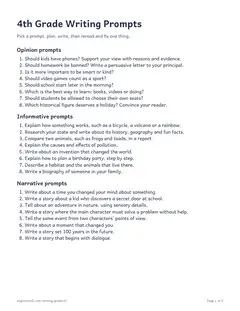 4th Grade writing prompts (PDF)All 24 prompts plus a page of writing paper.
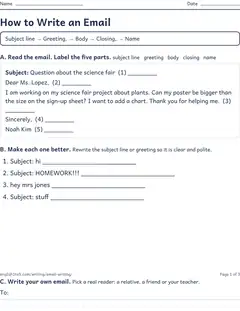 How to Write an EmailLabel the parts of a model email, fix subject lines and greetings, then write your own email.
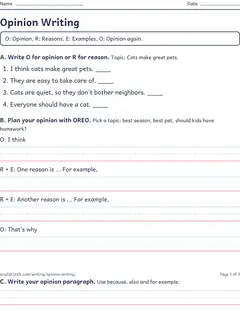 Opinion WritingPick a topic, plan with the OREO organizer, then write an opinion paragraph with linking words.
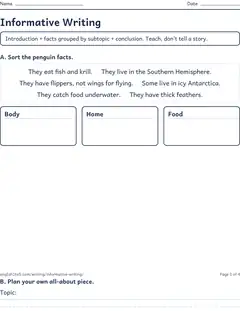 Informative WritingSort facts into subtopics, cross out the opinion, then plan and write your own all-about piece.
 Narrative WritingTurn telling sentences into showing sentences, plan a story with a story map, then write it.
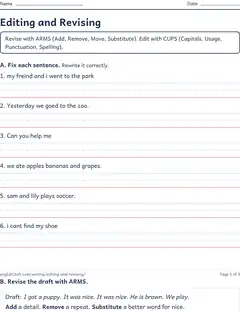 Editing and RevisingFix CUPS mistakes in sentences, revise a short draft with ARMS, then use a checklist on your own writing.
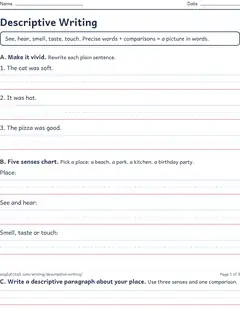 Descriptive WritingFill in a five senses chart, rewrite plain sentences with vivid details, and write a descriptive paragraph.
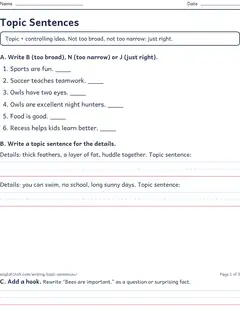 Topic SentencesSort topic sentences as broad, narrow or just right, write topic sentences for details, and add a hook.
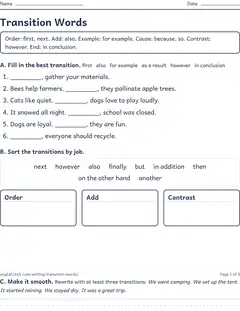 Transition WordsChoose the best transition for each sentence, sort transitions by job, and smooth out a choppy paragraph.
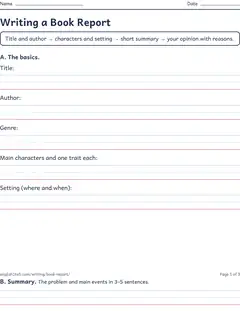 Writing a Book ReportA book report template: title, author, genre, characters, setting, summary, opinion with reasons and a star rating.
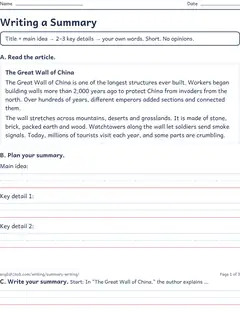 Writing a SummaryRead a short article, cross out details that don't belong, fill in a summary frame and write the summary.
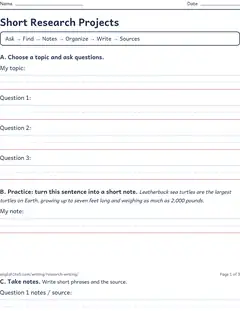 Short Research ProjectsA research planner: choose a topic, write questions, take notes in your own words with sources, and list your sources.
Practicing at home
Find evidence
Use a book or article to support opinions.
Use headings
In reports, one heading per section.
Show, don't tell
Swap feelings words for actions and senses.
Write regularly
A journal builds fluency.
More 4th grade practice
See every reading and writing skill for the year on the 4th grade page. Earlier: 3rd grade writing prompts. Next: 5th grade writing prompts. All lessons: writing. Related: grammar and punctuation.
Last reviewed: November 11, 2026
Questions parents ask
What writing do 4th graders do?
Opinion pieces with reasons and evidence, organized informative reports, detailed narratives, research, summaries and book reports (W.4.1–W.4.3, W.4.7–W.4.9).
How long should 4th grade writing be?
Usually three to five paragraphs.
How can my 4th grader improve their writing?
Read a lot, write often, and revise for one thing at a time: details, transitions or word choice.
Should 4th graders type?
Yes, increasingly. The standards expect keyboarding skills by 4th grade.