Short Research Projects
A research project answers a question by finding information in good sources and sharing it in your own words. The steps are the same at every age: ask a question, find sources, take notes, organize, write, and list your sources.
The six steps
1. Ask. Start with a topic you're curious about and turn it into questions: How do sea turtles find their way home? What do they eat? 2. Find sources. Use library books, kids' encyclopedias and trustworthy websites (sites ending in .gov or .edu, museums, zoos and science magazines for kids).
3. Take notes in short phrases, in your own words, and write down where each fact came from. 4. Organize notes by question or subtopic. 5. Write it up as an informative piece, poster or slideshow. 6. List sources at the end so readers can check your facts.
Ask → Find → Notes → Organize → Write → Sources
3rd graders do short research projects and sort notes into categories (W.3.7, W.3.8); 4th graders investigate different aspects of a topic (W.4.7); 5th graders use several sources (W.5.7). Strong research depends on summarizing and text features.
A note-taking chart: Sea Turtles
Short notes, sorted by question, with the source.
| Question | Notes (my own words) | Source |
|---|---|---|
| What do they eat? | jellyfish, seagrass, crabs; depends on type | Sea Turtles (library book), p. 8 |
| Where do they live? | warm oceans worldwide; come ashore only to nest | National Geographic Kids website |
| How do they find home? | may use Earth's magnetic field like a compass | NOAA website |
| Why are they in danger? | plastic, fishing nets, beach lights confuse babies | aquarium website |
Notes are phrases, not sentences, and never copied. That makes the writing step your own work.
Good notes vs. copying
Source sentence: Leatherback sea turtles are the largest turtles on Earth, growing up to seven feet long and weighing as much as 2,000 pounds.
- Copied: Leatherback sea turtles are the largest turtles on Earth, growing up to seven feet long...
- Good note: leatherback = biggest turtle; up to 7 ft, 2,000 lb
- In the report: The leatherback is the biggest turtle in the world. It can be as long as a car and weigh as much as a small truck!
- Source listed: "Leatherback Turtle." Aquarium of the Pacific website.
- Good question: How do baby sea turtles find the ocean?
- Too big: Everything about the ocean.
- Too small: What color is a turtle's shell? (one-word answer)
- Trustworthy source: a zoo, museum or government science site.
- Not trustworthy: a random comment on a video.
- Two sources agree: a good sign the fact is right.
Checking a fact in two places is a habit worth building early.
How to teach research
One project over about a week, 20 minutes a day.
- Choose and ask. Pick a topic; write 3–4 questions.
- Find 2–3 sources. Library books plus trusted sites.
- Take notes. Short phrases, own words, source for each.
- Organize. One question = one paragraph or section.
- Write and cite. Introduction, sections, conclusion, sources list.
Common mistakes and how to fix them
| Mistake | Why it happens | How to fix it |
|---|---|---|
| Copies sentences | Paraphrasing is hard. | Read, cover, write a short phrase. |
| Topic too big | "Space". | Narrow it: How do astronauts eat in space? |
| Only one source | Stops early. | Find a second source to check facts. |
| Forgets sources | Doesn't track where facts came from. | Write the source next to every note. |
Practice: research projects quiz
10 questions. Your child can tap the speaker to hear a question read aloud. The first try on each question counts toward the score.
-
1.What is the first step in a research project?
Show answer
Ask a question.
-
2.Which is a good research question?
Show answer
How do baby sea turtles find the ocean?
-
3.How should you take notes?
Show answer
Short phrases in your own words.
-
4.Which source is most trustworthy?
Show answer
A museum or zoo website.
-
5.Why list your sources?
Show answer
So readers can check your facts.
-
6.How many sources should a 5th grader use?
Show answer
Several.
-
7.How should you organize your notes?
Show answer
By question or subtopic.
-
8.Tap the word that tells where a fact came from.
.
Show answer
book (a library book).
-
9.Two sources say the same fact. What does that mean?
Show answer
The fact is more likely correct.
-
10.What comes last in a research project?
Show answer
Listing your sources.
Short Research Projects worksheet (free PDF)
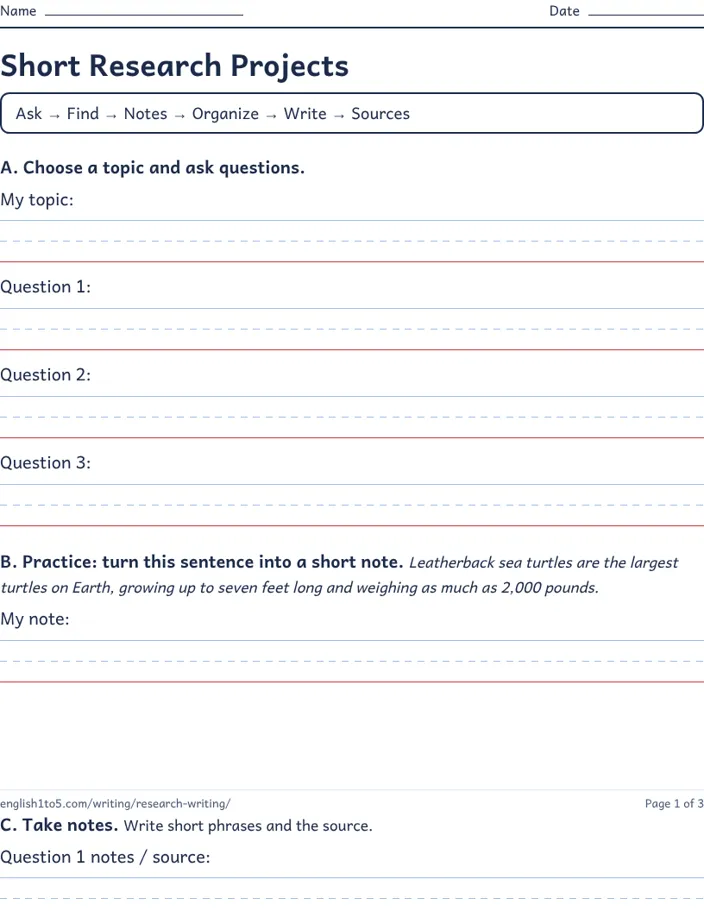
Short Research Projects Worksheet, 3rd–5th grade
A research planner: choose a topic, write questions, take notes in your own words with sources, and list your sources. Prints on US Letter paper, with an answer key.
Download the PDFTry it at home
- Curiosity jar: collect questions to research.
- Library trip: find two books on one topic.
- Fact check: find the same fact in two places.
- Teach the family: share what you learned in 2 minutes.
- Source detective: is this website trustworthy?
What comes next
That completes the writing lessons. Go back to writing. Earlier: writing a summary. Related: informative writing and text features.
Practice with a game
Free, no sign-up, and they work on phones, tablets and computers.
 Text Feature Hunt
 Fact or Opinion?
Last reviewed: November 11, 2026
Questions parents ask
How do kids do a research project?
Ask a question, find good sources, take notes in their own words, organize the notes, write it up and list sources.
What are good research topics for kids?
Specific questions about animals, space, inventions, places or famous people, such as how bees make honey.
What grade does research projects?
3rd through 5th grade (W.3.7, W.4.7, W.5.7), with simpler shared research earlier.
How do kids avoid copying?
Read, cover the source, and write short notes in their own words.
What are trustworthy sources for kids?
Library books, kids' encyclopedias, museum, zoo and government science websites.