Writing a Summary
A written summary tells the most important ideas of a text in a short paragraph, in your own words. It starts with the title and main idea, adds a few key details, and leaves out opinions and small details.
How to write a summary
Reading for a summary and writing one are two halves of the same skill. To write it, start with a sentence that names the text and its main idea: "In 'Saving the Monarchs,' the author explains why monarch butterflies are disappearing and how people can help." Then add two or three key details that support it.
Paraphrase: say it in your own words, not the author's. A good trick is to read, cover the text, then write from memory. Don't include your opinion ("I thought it was great") or tiny details (exact numbers that don't matter). The summary should be much shorter than the original: roughly a quarter of the length or less.
Title + main idea → 2–3 key details → your own words.
Short. No opinions.
4th graders summarize texts (RI.4.2) and take notes on sources (W.4.8); 5th graders summarize and paraphrase in notes and finished work (W.5.8). Summarizing is the core skill of short research projects.
A summary frame
Fill in the blanks, then smooth it into a paragraph.
| Part | Sentence starter |
|---|---|
| Opening | In "[title]," [author] explains / describes / tells about ... |
| Key detail 1 | First, ... / One important idea is ... |
| Key detail 2 | The author also explains that ... |
| Key detail 3 | In addition, ... |
| Wrap-up | Overall, ... / In the end, ... |
For stories, use Somebody-Wanted-But-So-Then instead; for nonfiction, use this frame.
From article to summary
Article (about 120 words): The Great Wall of China is one of the longest structures ever built. Workers began building walls more than 2,000 years ago to protect China from invaders from the north. Over hundreds of years, different emperors added sections and connected them. The wall stretches across mountains, deserts and grasslands. It is made of stone, brick, packed earth and wood. Watchtowers along the wall let soldiers send smoke signals. Today, millions of tourists visit each year, and parts of it are crumbling.
- Opening: The article "The Great Wall of China" explains how and why the wall was built.
- Key detail: It was built over hundreds of years to protect China from northern invaders.
- Key detail: It crosses mountains and deserts and has watchtowers for sending signals.
- Wrap-up: Today it is a popular tourist site, though parts are falling apart.
- Total: 4 sentences, about 60 words.
- Too detailed: It is made of stone, brick, packed earth and wood.
- Opinion: I think the Great Wall is amazing.
- Copied: "Workers began building walls more than 2,000 years ago..."
- Own words: "It was built over hundreds of years."
- Shorter than the original: yes.
The materials list is true but isn't needed to understand the main idea. That's the test for every detail.
How to teach summary writing
Five short steps, about 15 minutes each.
- Read twice. First for understanding, then to find the big ideas.
- Find the main idea. What is the whole text mostly about?
- Pick 2–3 key details. Only the ones needed to understand the main idea.
- Cover and write. Write from memory in your own words.
- Cut opinions and extras. Check length: much shorter than the original.
Common mistakes and how to fix them
| Mistake | Why it happens | How to fix it |
|---|---|---|
| Too long | Includes everything. | Limit to 3–5 sentences. |
| Copies sentences | Not paraphrasing. | Cover the text first. |
| Adds opinions | "It was cool." | Summaries are opinion-free. |
| Misses the main idea | Starts with a detail. | First sentence = title + main idea. |
Practice: summary writing quiz
10 questions. Your child can tap the speaker to hear a question read aloud. The first try on each question counts toward the score.
-
1.What does the first sentence of a summary include?
Show answer
The title and main idea.
-
2.What does paraphrase mean?
Show answer
Say it in your own words.
-
3.Which belongs in a summary?
Show answer
The wall was built to protect China from invaders.
-
4.How long should a summary be compared to the original?
Show answer
Much shorter.
-
5.How many key details should you include?
Show answer
Two or three.
-
6.What's a good trick to avoid copying?
Show answer
Cover the text and write from memory.
-
7.Tap the word that shows an opinion.
.
Show answer
think (I think).
-
8.Which is a good opening?
Show answer
In "Animals in Winter," the author explains how animals survive the cold.
-
9.Which detail would you leave out?
Show answer
The exact materials the wall is made of.
-
10.For a story summary, which frame works well?
Show answer
Somebody-Wanted-But-So-Then.
Writing a Summary worksheet (free PDF)
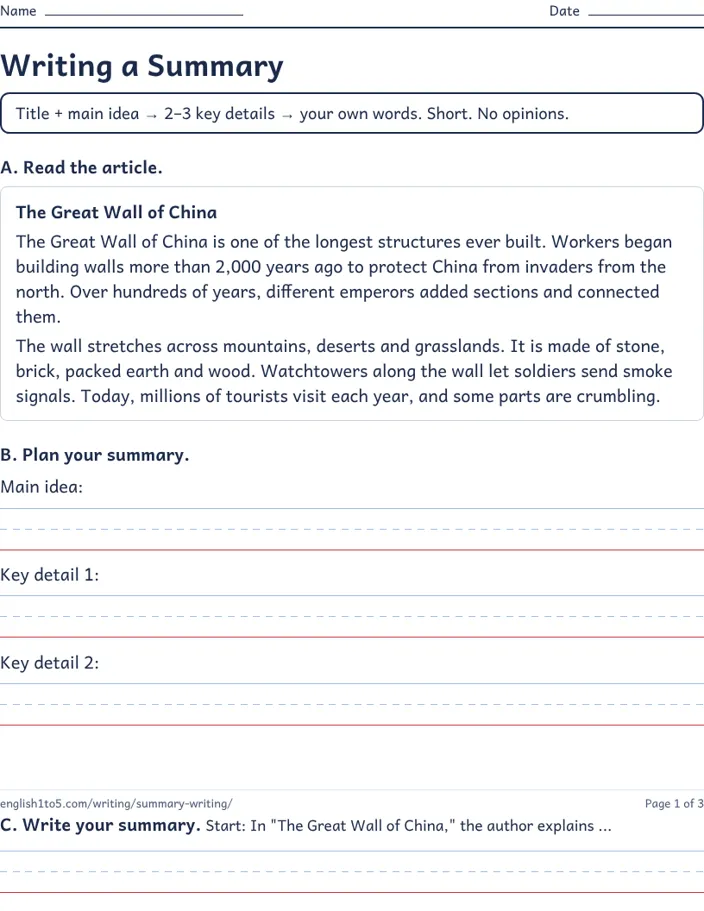
Writing a Summary Worksheet, 4th–5th grade
Read a short article, cross out details that don't belong, fill in a summary frame and write the summary. Prints on US Letter paper, with an answer key.
Download the PDFTry it at home
- News in 3 sentences: summarize an article together.
- Cover and write: no peeking.
- Opinion check: cross out I think.
- Movie summary: in one paragraph.
- Text messages: summarize your day in two lines.
What comes next
Next: short research projects. Earlier: book reports. Related reading: summarizing and main idea.
Practice with a game
Free, no sign-up, and they work on phones, tablets and computers.
 Story Order Train
 Main Idea Machine
Last reviewed: November 11, 2026
Questions parents ask
How do you write a summary for kids?
Name the title and main idea, add two or three key details in your own words, and leave out opinions and small details.
How long should a summary be?
Much shorter than the original: usually one paragraph of 3 to 5 sentences for a short article.
What does paraphrase mean?
Restating information in your own words instead of copying the author's sentences.
What grade learns to write summaries?
4th and 5th grade (RI.4.2, W.4.8, W.5.8).
Should a summary include my opinion?
No. A summary only reports what the text says.