Main Idea and Supporting Details
The main idea is what a text is mostly about, the big point the author wants you to know. The supporting details are the facts and examples that tell more about it. Think of a table: the main idea is the tabletop, and the details are the legs holding it up.
Topic, main idea and details
The topic is one or two words: dogs. The main idea is a full sentence about the topic: Dogs make great pets. The details support it: they are loyal, they love to play, and they can be trained.
Sometimes the main idea is stated in a sentence, often the first or last one in a paragraph. Other times kids have to figure it out by asking: what do all the details have in common? If every sentence is about how bees help flowers, that's the main idea.
Topic: a word or two. Main idea: a sentence.
Details: facts that support it.
2nd graders find the main topic of a text and of each paragraph (RI.2.2), 3rd graders find the main idea and show how details support it (RI.3.2), and 4th graders explain that support and summarize (RI.4.2). It builds on key details.
Topic, main idea and details
Three examples, from topic to details.
| Topic | Main idea | Supporting details |
|---|---|---|
| dogs | Dogs make great pets. | loyal; love to play; can be trained |
| volcanoes | Volcanoes can be very dangerous. | hot lava; ash clouds; can destroy towns |
| recycling | Recycling helps the planet. | less trash; saves trees; saves energy |
| penguins | Penguins are built for cold places. | thick feathers; layer of fat; huddle together |
| sleep | Kids need plenty of sleep. | helps the brain; helps you grow; keeps you healthy |
A good main idea covers all the details, but isn't so big that it could be about anything. "Animals are interesting" is too big for a paragraph about penguins.
Finding the main idea
Honeybees are very important to people. They make the honey we eat. They also make wax for candles. Most important, bees carry pollen from flower to flower, which helps fruits and vegetables grow.
- Topic: honeybees
- Main idea: Honeybees are very important to people.
- Detail: They make honey.
- Detail: They make wax for candles.
- Detail: They carry pollen that helps food grow.
- Too small: Bees make honey. (just one detail)
- Too big: Insects are interesting. (not just about bees)
- Off topic: Some people are afraid of bees.
- Where is it? The first sentence.
- Test: does every detail support it? Yes.
The "too small, too big, just right" test works for any paragraph.
How to teach main idea
Five short steps, about 10 minutes each.
- Name the topic. In one or two words, who or what is it about?
- List the details. What does it tell you about the topic?
- Find what they share. What do all the details have in common?
- Say it in a sentence. That's the main idea.
- Test it. Too small, too big, or just right?
Common mistakes and how to fix them
| Mistake | Why it happens | How to fix it |
|---|---|---|
| Gives the topic, not the main idea | One word instead of a sentence. | Ask: what about bees? |
| Picks one detail | It's the most interesting part. | Does it cover all the other details? |
| Picks the first sentence every time | The main idea isn't always first. | Check it against the details. |
| Makes it too big | Too general. | Could it be about a different text? Then narrow it. |
Practice: main idea quiz
10 questions. Your child can tap the speaker to hear a question read aloud. The first try on each question counts toward the score.
-
1.What is the main idea?
Show answer
What a text is mostly about.
-
2.What do supporting details do?
Show answer
Tell more about the main idea.
-
3.Which is a topic?
Show answer
penguins.
-
4.Bees make honey. They make wax. They help flowers grow. What is the main idea?
Show answer
Bees are helpful.
-
5.Main idea: Dogs make great pets. Which is a supporting detail?
Show answer
Dogs are loyal.
-
6.Main idea: Recycling helps the planet. Which detail does not belong?
Show answer
My bike is red.
-
7.Is the main idea always the first sentence?
Show answer
No.
-
8.Tap the topic of this sentence.
.
Show answer
Volcanoes.
-
9.A main idea that could be about anything is...
Show answer
Too big.
-
10.What question helps find the main idea?
Show answer
What do all the details have in common?
Main Idea and Supporting Details worksheet (free PDF)
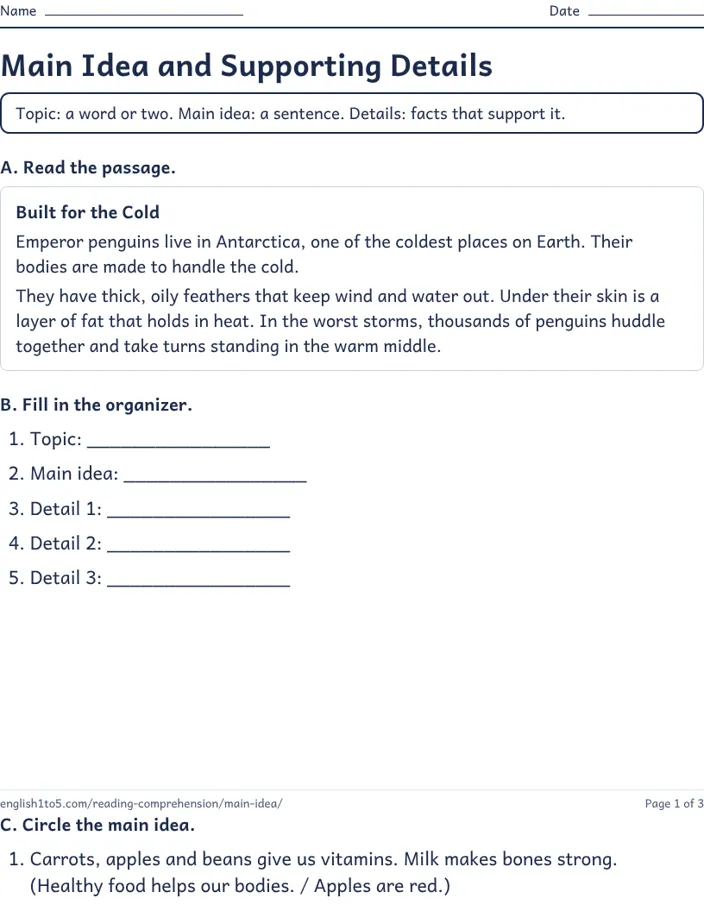
Main Idea and Supporting Details Worksheet, 2nd–4th grade
Read a passage, write the topic, main idea and three details, choose main ideas and find the detail that doesn't belong. Prints on US Letter paper, with an answer key.
Download the PDFTry it at home
- Headline game: give a news story or show a one-sentence headline.
- Table test: main idea on top, details as legs.
- Topic vs. idea: "Dogs" vs. "Dogs make great pets."
- Nonfiction time: find the main idea of one page.
- Too big or small: test each guess.
What comes next
Next: author's purpose. Earlier: key details. Later: summarizing. Related writing: topic sentences.
Practice with a game
Free, no sign-up, and they work on phones, tablets and computers.
 Reading Rocket
 Main Idea Machine
Last reviewed: November 11, 2026
Questions parents ask
What is the main idea?
What a text is mostly about, the big point the author wants readers to understand.
What's the difference between topic and main idea?
The topic is a word or two (dogs). The main idea is a sentence about the topic (Dogs make great pets).
What grade learns main idea?
2nd grade finds the main topic (RI.2.2), 3rd grade the main idea and details (RI.3.2), and 4th grade explains the support and summarizes (RI.4.2).
Is the main idea always the first sentence?
No. It's often the first or last sentence, but sometimes it isn't stated at all and readers have to figure it out.
How do I help my child find the main idea?
Ask what the text is about in a word or two, list the details, then ask what they all have in common.