Author's Purpose
Every author writes for a reason. That reason is the author's purpose. Most texts are written to inform (teach facts), to persuade (change your mind) or to entertain (tell a fun or exciting story). Kids sometimes remember it as PIE.
The three main purposes
Inform: the author wants to teach you something true. Science books, news articles, how-to guides and encyclopedias inform. Persuade: the author wants you to think or do something: buy a toy, vote for a class pet, recycle more. Ads, reviews and opinion letters persuade.
Entertain: the author wants you to enjoy reading. Stories, comics, jokes and most poems entertain. Some texts do more than one: a funny book about sharks can entertain and inform. Ask which purpose is the main one.
P = Persuade I = Inform E = Entertain
Ask: why did the author write this?
2nd graders identify what an author wants to answer, explain or describe (RI.2.6), 3rd graders tell their own view apart from the author's (RI.3.6), and 4th graders explain how an author uses reasons and evidence (RI.4.8). Purpose connects closely to fact and opinion.
Clues to the author's purpose
Look for these clues.
| Purpose | Clues | Examples |
|---|---|---|
| Inform | facts, numbers, headings, diagrams, true information | science book, news article, recipe, encyclopedia |
| Persuade | should, must, best, worst, opinions, a call to act | ad, review, letter to the principal, poster |
| Entertain | characters, a problem, funny or exciting events, rhymes | story, comic, joke book, poem |
Older kids add more purposes: to explain how something works, to describe a place, or to instruct with steps. These are all kinds of informing.
What's the purpose?
Each text is followed by its main purpose.
- "Frogs lay eggs in water. The eggs hatch into tadpoles." → inform
- "Buy Crunchy Pops! The tastiest cereal ever!" → persuade
- "Once upon a time, a dragon who was afraid of the dark..." → entertain
- A recipe for banana bread → inform
- A poster: "Everyone should recycle!" → persuade
- A comic about a talking pizza → entertain
- A news article about a storm → inform
- A letter asking for a longer recess → persuade
- A joke book → entertain
- A map of the zoo → inform
Persuasive texts often sound like facts. "This is the best cereal ever" is an opinion, written to get you to buy it.
How to teach author's purpose
Five short steps, about 10 minutes each.
- Learn PIE. Persuade, inform, entertain.
- Sort real texts. Cereal boxes, recipes, comics, letters: which purpose?
- Find clue words. Facts? Should? A story? Underline the clues.
- Ask why. Why did the author write this? What do they want from you?
- Write all three. Write about dogs to inform, persuade and entertain.
Common mistakes and how to fix them
| Mistake | Why it happens | How to fix it |
|---|---|---|
| Says every story informs | Stories have facts too. | Is it mainly a made-up story? Then it entertains. |
| Misses persuasion in ads | Ads sound like facts. | Ask: does it want you to buy or do something? |
| Thinks funny means entertain only | Some funny texts teach. | Ask about the main purpose. |
| Just guesses | Not using clues. | Underline the clues first. |
Practice: author's purpose quiz
10 questions. Your child can tap the speaker to hear a question read aloud. The first try on each question counts toward the score.
-
1.What does PIE stand for?
Show answer
Persuade, inform, entertain.
-
2.A science book about the moon is written to...
Show answer
inform.
-
3.An ad for a new toy is written to...
Show answer
persuade.
-
4.A story about a silly dragon is written to...
Show answer
entertain.
-
5.Everyone should eat more vegetables! What is the purpose?
Show answer
persuade.
-
6.A recipe for pancakes is written to...
Show answer
inform.
-
7.Tap the clue word that shows persuasion.
!
Show answer
should.
-
8.A joke book is written to...
Show answer
entertain.
-
9.A news article about a big storm is written to...
Show answer
inform.
-
10.A letter to the principal asking for a class pet is written to...
Show answer
persuade.
Author's Purpose worksheet (free PDF)
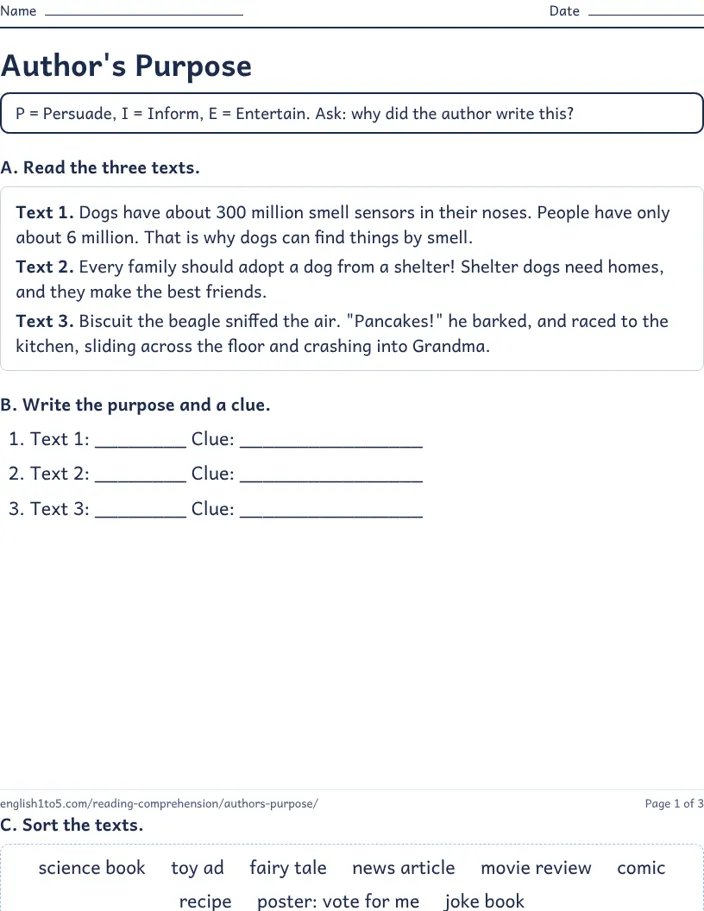
Author's Purpose Worksheet, 2nd–4th grade
Read three short texts on one topic, label each purpose, sort real-world texts and write your own. Prints on US Letter paper, with an answer key.
Download the PDFTry it at home
- Cereal box: what is it trying to get you to do?
- PIE hunt: find one of each at home.
- Ads on TV: what do they want you to buy?
- Write it three ways: inform, persuade, entertain.
- Ask why: why did the author write this book?
What comes next
Next: point of view. Earlier: main idea. Related: fact and opinion and opinion writing.
Practice with a game
Free, no sign-up, and they work on phones, tablets and computers.
 Author's Purpose PIE
 Fact or Opinion?
Last reviewed: November 11, 2026
Questions parents ask
What is author's purpose?
The reason an author writes a text: usually to persuade, inform or entertain.
What does PIE stand for?
Persuade, inform, entertain: the three main reasons authors write.
What grade learns author's purpose?
2nd grade identifies the main purpose (RI.2.6), and it continues through 3rd and 4th grade (RI.3.6, RI.4.8).
Can a text have more than one purpose?
Yes. A funny book about sharks can entertain and inform. Look for the main purpose.
How can you tell if a text is persuasive?
Look for opinion words like should, must, best and worst, and for a request to do or buy something.