Sight Words for Kids
- Kindergarten–3rd grade
- 315 Dolch words
- Common Core RF.K.3c, RF.1.3g, RF.2.3f
Sight words are the common words children learn to read instantly: the, and, is, you, said, was. A few hundred of them make up a huge share of every page in a children's book, so knowing them on sight frees kids to focus on the new words and on what the story means. Below are all the Dolch lists from kindergarten to 3rd grade, each with a quiz and free printable flashcards, plus how to teach them the way that actually works.
Sight word lists by grade
Start with the list for your child's grade, or one list earlier if most of the words are new. Each list page has the full word list, the heart words marked, sentences to read, a 10-question quiz and a printable checklist with flashcards.
| List | Grade | Words | Starts with |
|---|---|---|---|
| Dolch pre-primer | Kindergarten | 40 | a, and, away, big, blue, can… |
| Dolch primer | Kindergarten | 52 | all, am, are, at, ate, be… |
| Dolch 1st Grade | 1st grade | 41 | after, again, an, any, as, ask… |
| Dolch 2nd Grade | 2nd grade | 46 | always, around, because, been, before, best… |
| Dolch 3rd Grade | 3rd grade | 41 | about, better, bring, carry, clean, cut… |
| Dolch nouns | K–3rd grade | 95 | apple, baby, back, ball, bear, bed… |
The 1,000 most common words
Our own ranked list of the 1,000 words young readers meet most often, in groups of 100. Use it alongside the Dolch lists, or instead of them if your child's school uses frequency lists like Fry.
| List | Grade | Starts with |
|---|---|---|
| First 100 Most Common Words | K–1st grade | the, and, to, of, a, in… |
| Second 100 Most Common Words | 1st grade | back, us, where, come, before, say… |
| Third 100 Most Common Words | 2nd grade | yet, heard, himself, called, few, use… |
| Fourth 100 Most Common Words | 2nd–3rd grade | together, rather, green, pretty, try, given… |
| Fifth 100 Most Common Words | 3rd grade | happened, till, within, cannot, wife, indeed… |
| Most Common Words 501 to 1000 | 3rd–5th grade | towards, lived, passed, health, already, fair… |
Sight words, grade by grade
- Kindergarten: the first little words that hold sentences together, like a, the, and, is, see, can, I and you. Kids start with the pre-primer list and move on to the primer list. The standard is reading common words "by sight" (RF.K.3c), and most of the year's phonics practice helps here too.
- 1st grade: the 1st grade list, with some of the oddest spellings in English: of, once, could, were. The standard shifts to reading irregularly spelled words (RF.1.3g), so heart words get the most attention.
- 2nd grade: the 2nd grade list, which kids now need to spell as well as read: because, would, their, does, very show up in almost every piece of writing.
- 3rd grade: the 3rd grade list, the last of the Dolch lists. After that, the focus moves to longer words, word parts and multisyllable words.
The Dolch nouns (apple, ball, cat, tree and 91 more) fit alongside any of these lists. They're easy to picture, which makes them a confidence boost for brand-new readers.
What sight words are, and what they aren't
A sight word is any word a reader recognizes instantly, without having to stop and sound it out. For a fluent adult reader, almost every word is a sight word. For a beginning reader, the goal is to get the most common words to that point first, because they appear so often.
Sight word lists mix two kinds of words. Many are perfectly regular: and, can, it, up, big, help. A child who knows short vowels can sound them out. Others have a tricky part that doesn't follow the usual sounds: said, was, of, the, you. Both kinds belong on the list because they're common, not because they're hard.
What sight words are not is a replacement for phonics. Older reading programs had children memorize long lists of words by their shape, and guess the rest from pictures. Research on how the brain learns to read shows that doesn't work well: we remember words by connecting each letter to its sound. So the best way to learn even a sight word is to look at every letter, link the letters to sounds and notice the odd part. Read more in what are sight words?
Heart words: the tricky part, learned by heart
Sound out the regular parts.
Learn the tricky part by heart: said, was, of.
Teachers now call irregular sight words heart words. In said, the s and the d sound exactly as expected; only the ai is odd, saying short e. So instead of memorizing four letters, your child memorizes one small part. Draw a heart over it on a card and the word becomes much easier.
Some heart words are only tricky for now. See is a heart word for a child who hasn't learned that ee says long e. Once they learn that pattern in vowel teams, see is just a regular word. Others, like of and one, stay tricky forever. For more practice with those, see tricky irregular words.
Dolch or Fry: which list should you use?
Both lists come from counting which words appear most often in reading material.
- Dolch (1930s–1940s): 220 "service words" split into five lists from pre-primer to 3rd grade, plus 95 common nouns. Shorter and grouped by grade, so it's easy to know where to start.
- Fry (1950s, updated 1980): the 1,000 most common words, ranked by frequency in groups of 100. Longer, and it covers words for older readers too.
They overlap a lot, especially at the start. For kindergarten through 2nd grade, either works. Use whichever your child's school sends home, so practice at home matches practice in class. On this site, the Dolch lists are here in full, and for frequency-ranked practice we use our own list of the 1,000 most common words, built from children's books and everyday English.
How many sight words, and by when?
| Grade | A common goal | Dolch lists |
|---|---|---|
| Kindergarten | About 50 to 90 words | Pre-primer and primer |
| 1st grade | About 130 to 150 words | Adds the 1st grade list |
| 2nd grade | About 180 words | Adds the 2nd grade list |
| 3rd grade | All 220, plus the nouns | Adds the 3rd grade list |
These are rough targets, not rules. Schools set their own lists and pace. What matters more than the number is that your child reads the words quickly in real books, not only on flashcards.
How to teach sight words at home
- Five words a week. Pick three to five new words, mixing easy regular words with one or two heart words.
- Sound it out together. For regular words, blend the sounds. For heart words, tap the sounds, match letters to sounds and heart the tricky part.
- One minute of flashcards a day. Use the printable cards. A word is "known" when it's read in under three seconds, three days running.
- Spot them in books. Before reading a book together, ask your child to find this week's words on the page.
- Write them. Writing a word while saying each sound is one of the fastest ways to remember it.
- Keep reviewing. Old words stay in the pile, shuffled in with new ones, until they're automatic.
Games that work
Word hunt: give your child a highlighter and a page from an old magazine; how many times can they find the? Slap it: spread cards on the table, say a word and race to slap it. Read the room: tape cards around the house and read each one as you pass it. For a screen game, Feed Monty has listen-and-tap word practice for pre-readers.
Where kids get stuck
| What you see | What it usually means | What to do |
|---|---|---|
| Reads was as saw, on as no | Not looking at letters in order. | Point under the first letter before reading. Practice the pair side by side. |
| Says the for any short word | Guessing from shape. | Ask your child to say each sound. Shapes aren't enough. |
| Knows words on cards, not in books | Practice only in isolation. | Read the words in sentences daily. Use the sentences on each list page. |
| Forgets words learned last week | Too many new words, too little review. | Cut new words to three a week and review the old pile daily. |
| Spells said as sed | Spelling by sound. | Heart the ai and spell it out loud: s-a-i-d. |
Printables and worksheets
Every list has a free PDF: a checklist to track the words your child knows, and big flashcards to cut out. Want bigger cards, shuffled cards or your own words? Use the free sight word flashcard maker.
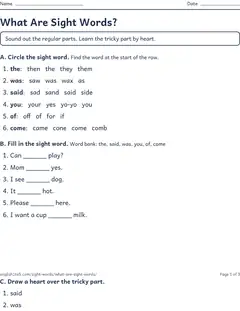 Sight words worksheetFind the word, finish sentences and heart the tricky part.
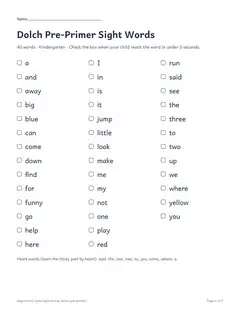 Dolch Pre-Primer list + flashcards40 words, Kindergarten
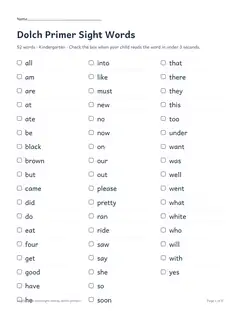 Dolch Primer list + flashcards52 words, Kindergarten
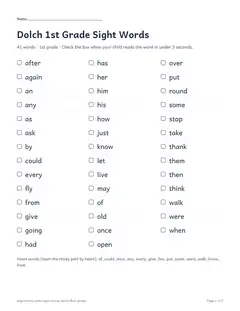 Dolch 1st Grade list + flashcards41 words, 1st grade
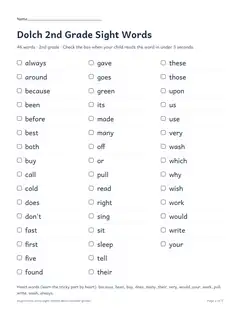 Dolch 2nd Grade list + flashcards46 words, 2nd grade
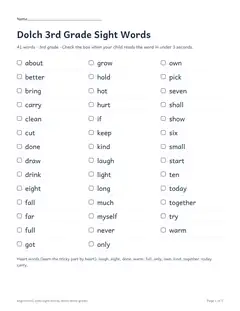 Dolch 3rd Grade list + flashcards41 words, 3rd grade
 Dolch Nouns list + flashcards95 words, K–3rd grade
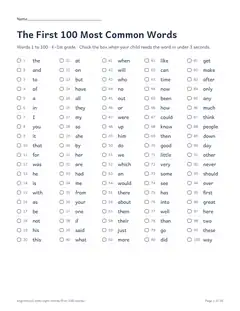 First 100 Most Common WordsK–1st grade
 Second 100 Most Common Words1st grade
 Third 100 Most Common Words2nd grade
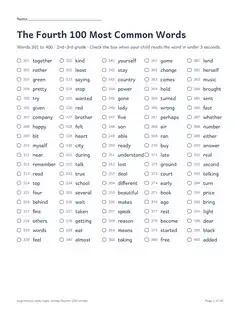 Fourth 100 Most Common Words2nd–3rd grade
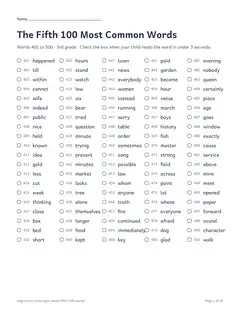 Fifth 100 Most Common Words3rd grade
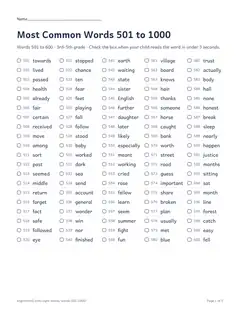 Most Common Words 501 to 10003rd–5th grade
Sight words and phonics work together
Phonics teaches the patterns that let a child sound out thousands of words; sight word practice gets the most common words fast. A good week has both: one phonics pattern, a few sight words and plenty of reading. Start phonics with short vowels, or see all phonics lessons. For what to expect each year, see the kindergarten and 1st grade pages.
Last reviewed: November 11, 2026
Questions parents ask
What are sight words?
Very common words, like the, and, is, said and was, that children learn to read instantly. Some can be sounded out; others have a tricky part to learn by heart.
How many sight words should my child know?
A common goal is the Dolch pre-primer and primer lists (92 words) by the end of kindergarten, and the 1st grade list by the end of 1st grade. Schools vary, so check your child's teacher's list.
What is the difference between Dolch and Fry words?
Dolch has 220 words in five grade-level lists, plus 95 nouns. Fry has 1,000 words in order of how often they appear. About half of the first 100 Fry words are also Dolch words.
Should sight words be memorized?
Not as shapes. Kids remember words best by linking letters to sounds. Sound out the regular parts and learn only the tricky part by heart.
How long should sight word practice take?
About five minutes a day: a quick flashcard review, then spotting the words in a real book.
My child knows the words on cards but not in books. Why?
Card practice alone doesn't always carry over. Read the words in sentences and books every day, and point to them while reading together.