Spelling for Kids
- 1st–5th grade
- Common Core L.1.2–L.5.2
English spelling looks random, but most of it follows patterns a child can learn. This page brings together the spelling rules kids use most, 12 weekly word lists for every grade from 1st to 5th, spelling bee words, and simple ways to practice at home. Every rule has a short lesson, a read-aloud quiz and a free worksheet.
What kids learn in spelling, grade by grade
- 1st grade (L.1.2d, L.1.2e): spelling by sound with short vowels, blends and digraphs; silent e and simple vowel teams; and common tricky words like said and was. Sound spelling of new words is expected and encouraged.
- 2nd grade (L.2.2d, L.2.2e): the same sound spelled different ways (rain, play, cake), bossy r, oi and ou, endings and plurals, compound words and using a beginning dictionary to check.
- 3rd grade (L.3.2e, L.3.2f, L.3.2g): the rules for adding endings, prefixes and suffixes, homophones and contractions.
- 4th grade (L.4.2d): longer words built from parts: -tion, -able, Greek and Latin parts, silent letters and -ough.
- 5th grade (L.5.2e): Latin roots, -ance and -ence, double consonants, tricky homophones and commonly misspelled words.
Spelling and phonics are two sides of the same coin: phonics turns letters into sounds for reading, and spelling turns sounds into letters for writing. Kids who are strong in one usually grow in the other.
The spelling rules
Most English spelling follows patterns.
Learn the pattern, spell hundreds of words.
These lessons cover the rules that explain the most words, in teaching order. Each has a 10-question quiz and a printable worksheet.
- Spelling Rules for KidsUsing common spelling rules when adding endings and spelling vowel sounds. 2nd–4th grade
- ck or k?Choosing ck, k or c to spell the /k/ sound. 1st–2nd grade
- ai or ay?Choosing ai or ay to spell the long a sound. 1st–2nd grade
- The Doubling RuleDoubling the final consonant before a suffix that starts with a vowel. 2nd–3rd grade
- Drop the EDropping a final silent e before a suffix that starts with a vowel. 2nd–3rd grade
- Change Y to IChanging y to i before suffixes, and when to keep the y. 2nd–4th grade
- i Before eChoosing ie or ei in spelling. 3rd–5th grade
- Commonly Misspelled WordsSpelling common tricky words correctly, using memory tricks. 2nd–5th grade
Weekly spelling word lists by grade
Each grade has 12 lists of 10 words, one pattern per list, in the order most schools teach them. Every grade page has a quiz and a printable PDF of all the lists.
| Grade | First lists | Spelling bee |
|---|---|---|
| 1st grade | Short a; Short i; Short o; Short u… | 1st grade bee words |
| 2nd grade | Blends review; Digraphs and ck; Long a; Long e… | 2nd grade bee words |
| 3rd grade | Short or long?; ea that says short e; er, ir, ur, or, ear; Prefixes un- and re-… | 3rd grade bee words |
| 4th grade | -tion and -sion; -able and -ible; Prefixes dis-, mis-, pre-, non-; ie and ei… | 4th grade bee words |
| 5th grade | Latin roots: struct, port, spect, aud, dict; -ance and -ence; -ant and -ent; -ary, -ery, -ory… | 5th grade bee words |
Spelling bee words
Getting ready for a class or school bee? The spelling bee words page has 50 words for each grade in easy, medium and hard levels, plus how to study and how to run a practice bee at home.
How to practice spelling at home
- Say it slowly. Stretch the word and listen for every sound or part.
- Look for the pattern. Which rule or pattern does the word follow? Circle it.
- Look, cover, write, check. Look at the word, cover it, write it from memory, then check letter by letter.
- Find the tricky part. For words that break the rules, mark the odd part and make a memory trick.
- Use it in writing. Three sentences with this week's words do more than writing each word ten times.
- Review. Missed words go back on next week's list.
Ten minutes a day is plenty. Short daily practice through the week beats a long session the night before a test.
Where kids get stuck
| What you see | What it usually means | What to do |
|---|---|---|
| Leaves out sounds: sop for stop | Not hearing every sound. | Stretch the word slowly and tap each sound before writing. |
| Spells by sound: rane for rain | Knows the sound, not the pattern. | Teach the pattern: ai in the middle, ay at the end. |
| Writes runing, makeing, babys | Doesn't know the ending rules yet. | Teach doubling, drop the e and y to i. |
| Mixes there and their | Homophones need meaning, not sound. | Teach each pair with a meaning hint. |
| Aces the test, misspells the same words in writing | Memorized for the test only. | Practice in sentences and review old words. |
Sound spelling, then patterns, then parts
Spelling develops in stages. Young children first spell by sound, writing kat for cat or bot for boat. That's a good sign: it shows they hear every sound. Next, they learn patterns, like silent e and vowel teams, and their spelling starts to look like real English. Finally, from 3rd grade on, they learn that words are built from meaningful parts, like un-, -ful and roots like port, which explains the spelling of long words. Knowing which stage your child is in helps you choose what to practice next, and keeps you from worrying about mistakes that are perfectly normal for their age. A 1st grader who writes rane is doing well; a 4th grader who still does needs the vowel team pattern taught.
Why spelling still matters
With spell checkers everywhere, it's fair to ask whether spelling practice is worth the time. It is, for two reasons. First, spelling and reading use the same knowledge: a child who can spell rain has stored exactly how the word looks and sounds, which makes reading it instant. Research on reading shows that spelling practice improves reading, not just writing.
Second, writing flows better when spelling is automatic. A child who stops to puzzle over every word loses the thread of their ideas. Good spellers can focus on what they want to say. And spell checkers only help if you can recognize the right choice among the suggestions, which takes spelling knowledge too.
A simple weekly spelling routine
| Day | What to do (5 to 10 minutes) |
|---|---|
| Monday | Read the new list together. Find the pattern and circle it in every word. |
| Tuesday | Say each word slowly and write it while saying the sounds. |
| Wednesday | Look, cover, write, check. Do the rule lesson's worksheet if there is one. |
| Thursday | Write three sentences using words from the list. Take the quiz on the grade page. |
| Friday | Practice test. Missed words go on next week's list. |
Are spelling tests useful?
A short weekly test is useful when it leads to action: missed words get more practice, and patterns that keep causing trouble get another week. Tests are less useful when children cram the night before and forget the words by Monday. The best sign of good spelling isn't a test score; it's spelling the same words correctly in everyday writing weeks later. Look at your child's journal or a letter they write, notice the words they now spell right, and tell them.
Spelling worksheets
 Spelling Rules for KidsCircle the right spelling, add endings using the rules, match words to rules and fix sentences.
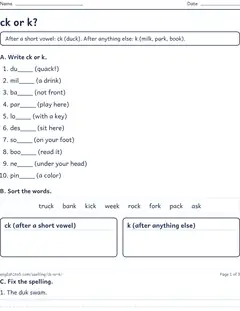 ck or k?Fill in ck or k, sort words by the /k/ spelling, fix misspelled words and write ck words of your own.
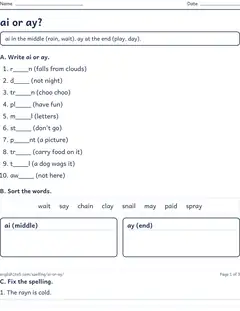 ai or ay?Fill in ai or ay, sort words, fix spelling mistakes and write sentences with ai and ay words.
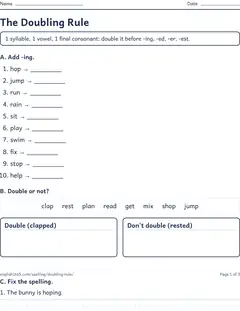 The Doubling RuleAdd -ing and -ed with the doubling rule, sort double and don't-double words, fix mistakes and write a sentence.
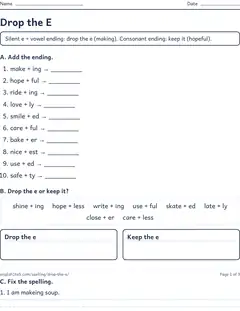 Drop the EAdd endings to silent e words, sort drop and keep words, fix spelling mistakes and write a sentence.
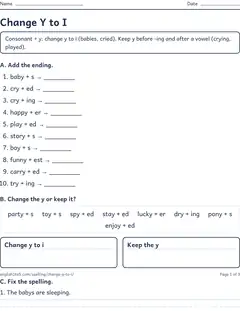 Change Y to IAdd endings to y words, sort change and keep words, fix spelling mistakes and write a sentence.
 i Before eFill in ie or ei, sort words by pattern, fix common misspellings and write sentences with tricky words.
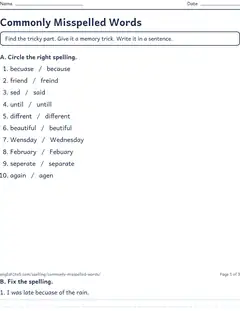 Commonly Misspelled WordsCircle the right spelling, fix mistakes in sentences, choose their or there and make your own memory trick.
Related skills
Spelling grows from phonics and the most common words in sight words. Turn any word list into flashcards with the flashcard maker. For the full year's skills, see the 1st, 2nd, 3rd, 4th or 5th grade pages.
Last reviewed: November 11, 2026
Questions parents ask
How do kids learn to spell?
By linking sounds to letters (phonics), learning common patterns and rules, and practicing tricky words with memory tricks. Reading a lot helps too, because it shows how words look.
How many spelling words should my child practice each week?
About 5 to 10 in 1st grade and 10 to 15 from 2nd grade on, with a few review words from earlier lists.
Should I correct every spelling mistake in my child's writing?
No. Pick one or two words that follow a pattern they've learned, and leave the rest. Too many corrections discourage writing.
Is it OK for young children to spell words the way they sound?
Yes, in kindergarten and early 1st grade. Sound spelling like kat for cat shows your child hears every sound. Correct spelling comes as they learn patterns.
What are the most important spelling rules?
The floss rule, ck or k, ai or ay, the doubling rule, drop the e, change y to i and i before e.
Do spelling tests help?
A short weekly practice test helps if mistakes lead to more practice on those words. Studying only the night before doesn't build lasting spelling.