Drop the E
When a word ends in a silent e, drop the e before adding an ending that starts with a vowel: make → making, hope → hoped, nice → nicer. Keep the e when the ending starts with a consonant: hopeful, lovely.
The drop-the-e rule
A silent e makes the vowel before it long. Endings like -ing, -ed, -er, -est and -able start with a vowel, and that vowel can do the same job. So the e isn't needed: make + ing = making. The a stays long.
Endings that start with a consonant, like -ful, -ly, -ment and -ness, can't do the e's job. So the e stays: hope + ful = hopeful, love + ly = lovely.
Silent e + vowel ending: drop the e (make → making).
Silent e + consonant ending: keep the e (hope → hopeful).
This rule goes with the doubling rule: hoping (from hope, drop the e) and hopping (from hop, double the p) look alike but mean different things.
Drop it or keep it?
Look at the first letter of the ending.
| Word | Vowel ending: drop the e | Consonant ending: keep the e |
|---|---|---|
| hope | hoping, hoped | hopeful, hopeless |
| make | making, maker | — |
| love | loving, loved | lovely |
| care | caring, cared | careful, careless |
| nice | nicer, nicest | nicely |
| use | using, used | useful |
| safe | safer, safest | safely, safety |
A few words keep the e to protect a sound, like noticeable and courageous. Kids meet those later, in 4th and 5th grade.
Drop the e in sentences
The base word is in brackets.
- I am making a cake. (make)
- We hoped it would snow. (hope)
- She is riding her bike. (ride)
- He is a careful driver. (care)
- This road is safer. (safe)
- They are skating on ice. (skate)
- Thank you for sharing. (share)
- It was a lovely day. (love)
- I used a pencil. (use)
- The rope is useful. (use)
Examples 9 and 10 show both rules with the same word: used (drop the e) and useful (keep it).
How to teach drop the e
Five short steps, about 10 minutes each.
- Find the silent e. Circle the e at the end of make, hope, ride.
- Look at the ending. Does it start with a vowel or a consonant?
- Vowel? Cross out the e. Write make, cross out the e, add -ing: making.
- Consonant? Keep it. hope + ful: the e stays.
- Mixed practice. Add -ing, -ed and -ful to care, use and hope.
Common mistakes and how to fix them
| Mistake | Why it happens | How to fix it |
|---|---|---|
| Writes makeing | Keeping the e. | -ing starts with a vowel, so drop the e. |
| Writes hopful | Dropping the e before a consonant ending. | -ful starts with a consonant. Keep the e. |
| Writes hopping for hoping | Mixing up the doubling rule. | Which word? Hope (long o) → hoping. Hop → hopping. |
| Writes beeing for being | Applying the rule to ee. | Be doesn't end in a silent e. Just add -ing. |
Practice: drop the e quiz
10 questions. Your child can tap the speaker to hear a question read aloud. The first try on each question counts toward the score.
-
1.Which spelling is right?
Show answer
making.
-
2.Which spelling is right?
Show answer
hopeful.
-
3.Which spelling is right?
Show answer
riding.
-
4.Add -ed to smile.
Show answer
smiled.
-
5.Add -ly to safe.
Show answer
safely.
-
6.Tap the word where the e was dropped.
.
Show answer
skating (from skate).
-
7.Which spelling is right?
Show answer
useful.
-
8.Which comes from hope?
Show answer
hoping.
-
9.Which spelling is right?
Show answer
nicer.
-
10.When do you keep the silent e?
Show answer
When the ending starts with a consonant.
Drop the E worksheet (free PDF)
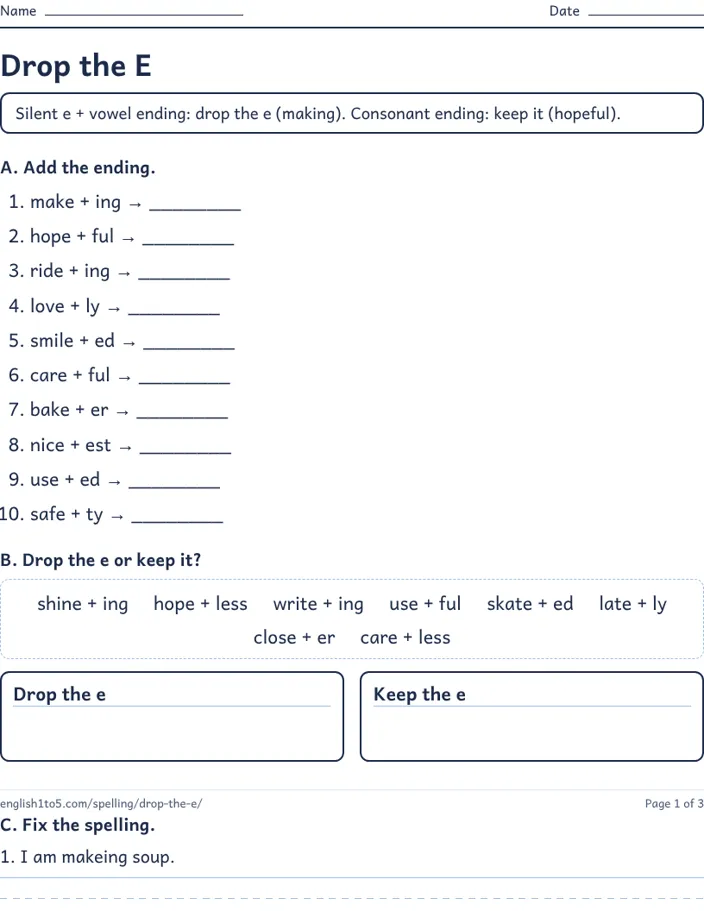
Drop the E Worksheet, 2nd–3rd grade
Add endings to silent e words, sort drop and keep words, fix spelling mistakes and write a sentence. Prints on US Letter paper, with an answer key.
Download the PDFTry it at home
- Cross it out: write the word, cross out the e, add -ing.
- Kitchen words: baking, slicing, taking: drop the e.
- Vowel or consonant? point to the first letter of the ending.
- Hoping vs. hopping: act out both.
- Proofread: look for -ing words in your child's writing.
What comes next
Next: change y to i. Earlier: the doubling rule. Related: silent e. All rules: spelling rules for kids.
Last reviewed: November 11, 2026
Questions parents ask
What is the drop the e rule?
When a word ends in silent e, drop the e before adding an ending that starts with a vowel: make → making.
When do you keep the e?
When the ending starts with a consonant: hopeful, lovely, careful.
Why do we drop the e?
The vowel at the start of the ending keeps the vowel long, so the silent e isn't needed.
Is it hoping or hopping?
Hoping comes from hope (long o). Hopping comes from hop (short o).
What grade learns drop the e?
Usually 2nd or 3rd grade.