Informative Writing
Informative writing (also called explanatory or all-about writing) teaches the reader about a topic using facts. It has an introduction that names the topic, facts grouped into subtopics, and a conclusion that wraps it up.
What makes it informative?
The writer acts like a teacher. The goal isn't to tell a story or share an opinion, but to explain. Every sentence should be a fact or explanation about the topic: what something is, how it works, where it lives, why it matters.
Good informative writing is organized. Facts about what sharks eat go together; facts about where they live go together. Older writers add headings, definitions of key words, and details like numbers or quotes. Linking words such as also, another, for example and because connect ideas.
Introduction + facts grouped by subtopic + conclusion.
Teach, don't tell a story.
1st graders name a topic, give some facts and close (W.1.2). 3rd graders group related information and use linking words (W.3.2), and 5th graders add precise words, quotes and a logical structure (W.5.2). Informative writing uses the same skills as main idea and text features.
A planning chart: All About Sea Turtles
Group facts under subtopics.
| Part | Content |
|---|---|
| Introduction | Sea turtles are reptiles that live in oceans all over the world. |
| Subtopic 1: Body | hard shell; flippers for swimming; can't pull their heads in |
| Subtopic 2: Food | jellyfish, seagrass, crabs, depending on the type |
| Subtopic 3: Babies | lay eggs on beaches at night; babies hatch and race to the sea |
| Conclusion | Sea turtles are amazing ocean travelers, and we can help them by keeping beaches clean. |
Each subtopic can become its own paragraph, with a heading in longer pieces.
Model: All About Honeybees
Each sentence is labeled.
- Introduction: Honeybees are busy insects that help people in many ways.
- Subtopic, body: A honeybee has six legs, four wings and a stinger.
- Fact: Its fuzzy body helps it carry pollen.
- Subtopic, jobs: Worker bees collect nectar from flowers.
- Fact: They turn the nectar into honey inside the hive.
- Subtopic, helping people: Bees carry pollen from flower to flower.
- Fact: This helps apples, berries and many other foods grow.
- Conclusion: Without honeybees, our world would have a lot less food.
- Opinion, not fact: Bees are the cutest bugs.
- Story, not fact: One day I got stung at the park.
The conclusion doesn't add new facts. It reminds the reader why the topic matters.
How to teach informative writing
Five short steps, about 15 minutes each.
- Pick an expert topic. Something your child knows a lot about, or wants to learn.
- Gather facts. Books, websites, what they know.
- Sort into subtopics. Body, food, home: group the facts.
- Write intro, body, conclusion. One paragraph per subtopic for older kids.
- Add features. Headings, a labeled picture, bold words.
Common mistakes and how to fix them
| Mistake | Why it happens | How to fix it |
|---|---|---|
| Writes a story instead | Mixing narrative and informative. | Ask: is this a fact that teaches? |
| Facts are jumbled | Not grouped. | Sort facts by subtopic first. |
| Adds opinions | "Sharks are awesome." | Keep to facts; save feelings for the conclusion. |
| Copies sentences from a book | Not paraphrasing. | Read, close the book, write it in your own words. |
Practice: informative writing quiz
10 questions. Your child can tap the speaker to hear a question read aloud. The first try on each question counts toward the score.
-
1.What does informative writing do?
Show answer
Teaches the reader facts about a topic.
-
2.Which sentence belongs in informative writing?
Show answer
Owls hunt at night.
-
3.What does the introduction do?
Show answer
Names the topic.
-
4.How should facts be organized?
Show answer
Grouped by subtopic.
-
5.Which is a good subtopic for All About Penguins?
Show answer
What penguins eat.
-
6.Tap the linking word.
. .
Show answer
also.
-
7.What does the conclusion do?
Show answer
Wraps up the topic.
-
8.Which text feature helps organize informative writing?
Show answer
Headings.
-
9.Where can you find facts?
Show answer
Books and trusted websites.
-
10.Should you copy sentences from a book?
Show answer
No.
Informative Writing worksheet (free PDF)
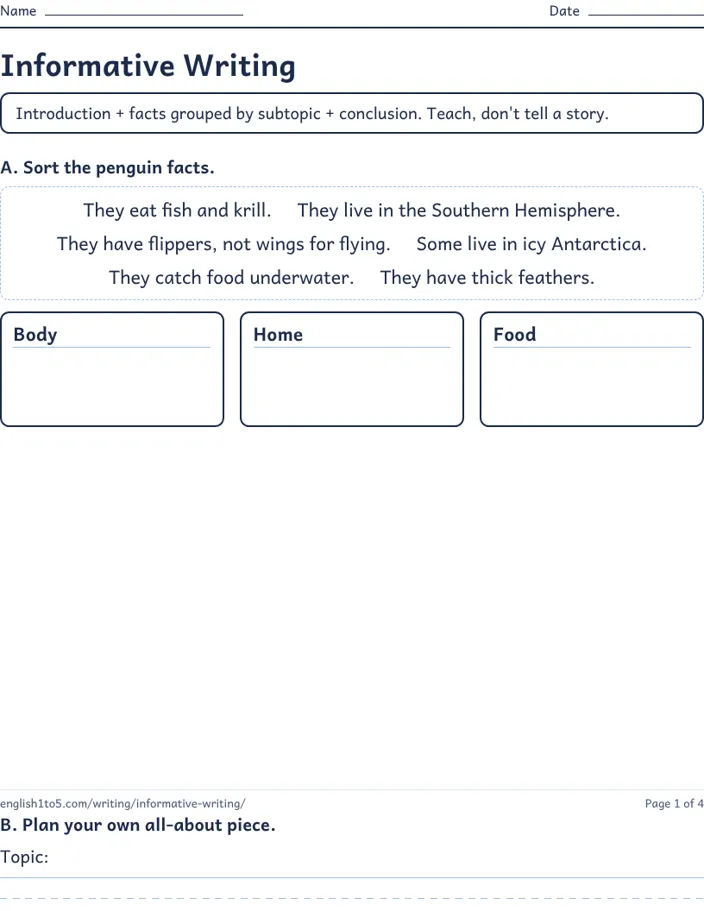
Informative Writing Worksheet, 1st–5th grade
Sort facts into subtopics, cross out the opinion, then plan and write your own all-about piece. Prints on US Letter paper, with an answer key.
Download the PDFTry it at home
- Expert topics: what does your child know a lot about?
- Library trip: find 3 facts in a nonfiction book.
- Fact cards: write facts on cards and sort them.
- Teach me: your child teaches you the topic.
- Mini-book: a page per subtopic with pictures.
What comes next
Next: narrative writing. Earlier: opinion writing. Related: writing a paragraph and text features.
Practice with a game
Free, no sign-up, and they work on phones, tablets and computers.
 Text Feature Hunt
 Fact or Opinion?
Last reviewed: November 11, 2026
Questions parents ask
What is informative writing?
Writing that teaches the reader about a topic using facts, with an introduction, organized body and conclusion.
Is informative writing the same as expository writing?
Yes, mostly. Informative, explanatory and expository all mean writing to teach or explain.
What grade learns informative writing?
Every grade from kindergarten to 5th (W.1.2, W.3.2, W.5.2).
What are good informative writing topics for kids?
An animal, a sport, a hobby, a place, how something works, or a person from history.
Can informative writing include pictures?
Yes. Labeled pictures and diagrams help explain the topic.