Narrative Writing
Narrative writing tells a story. It can be real (something that happened to you, called a personal narrative) or made up. A good narrative has characters, a setting, events in order, details that help the reader picture it, and an ending.
What makes a strong story?
Most stories follow a shape: a beginning that introduces the characters and setting, a middle with a problem and events, and an end where the problem is solved and the character feels or learns something. These are the same story elements kids find when reading.
Details make a story come alive. Instead of "It was fun," a good writer shows it: "We laughed so hard that milk came out of my brother's nose." Older writers add dialogue (what characters say), feelings and sensory details (what they see, hear, smell, taste and touch).
Beginning (who, where) → Middle (problem, events) → End (solution, feeling).
Show, don't just tell.
1st graders write two or more events in order with time words and an ending (W.1.3). 3rd and 5th graders develop real or imagined events with dialogue, description and clear sequence (W.3.3, W.5.3). Dialogue needs quotation marks.
A story map to plan your narrative
Plan before you write.
| Part | Question | Example |
|---|---|---|
| Characters | Who is in it? | me and my little sister, Ava |
| Setting | Where and when? | the beach, last summer |
| Problem | What goes wrong? | A wave knocked down our sandcastle. |
| Events | What happens? | Ava cried; we got more buckets; we built a wall to stop the waves. |
| Solution | How is it solved? | We built a bigger castle farther from the water. |
| Ending | How does the character feel or what did they learn? | Proud. Sometimes you have to start over. |
Time words keep events in order: one morning, first, then, suddenly, after that, finally.
Telling vs. showing
Turn plain sentences into vivid ones.
- Tell: I was scared.
- Show: My hands shook, and my heart pounded like a drum.
- Tell: The dog was happy.
- Show: The dog spun in circles and licked my whole face.
- Tell: It was cold.
- Show: Our breath made little clouds, and my toes went numb.
- Dialogue: "Watch out!" yelled Ava.
- Time word: Suddenly, a giant wave crashed onto the sand.
- Sensory detail: The salty air stung my nose.
- Ending feeling: As we walked home, I felt proud of our new castle.
Showing lets the reader figure out the feeling, the same way kids make inferences when reading.
How to teach narrative writing
Five short steps, about 15 minutes each.
- Tell it first. Your child tells the story out loud.
- Plan with a story map. Characters, setting, problem, events, solution.
- Zoom in. Pick one small moment, not a whole day.
- Show, don't tell. Add feelings, dialogue and senses.
- End with a feeling. How did the character feel or change?
Common mistakes and how to fix them
| Mistake | Why it happens | How to fix it |
|---|---|---|
| Lists everything that happened all day | "Bed-to-bed" stories. | Zoom in on one moment. |
| No problem | Story feels flat. | What went wrong or was surprising? |
| Tells feelings instead of showing | "I was happy." | What did your face or body do? |
| Ending is "The end." | Not sure how to finish. | Say how the character felt or what they learned. |
Practice: narrative writing quiz
10 questions. Your child can tap the speaker to hear a question read aloud. The first try on each question counts toward the score.
-
1.What does narrative writing do?
Show answer
Tells a story.
-
2.A true story about yourself is called a...
Show answer
personal narrative.
-
3.Which sentence shows instead of tells?
Show answer
My hands shook as I stepped on stage.
-
4.What does the beginning of a story do?
Show answer
Introduces the characters and setting.
-
5.Tap the time word.
, .
Show answer
Suddenly.
-
6.What is dialogue?
Show answer
What characters say.
-
7.Which is a better story topic?
Show answer
The day my tooth fell out at lunch.
-
8.Which is a sensory detail?
Show answer
The cookies smelled like warm butter.
-
9.Which is the best ending?
Show answer
As the sun set, I knew it was the best day ever.
-
10.What goes around dialogue?
Show answer
Quotation marks.
Narrative Writing worksheet (free PDF)
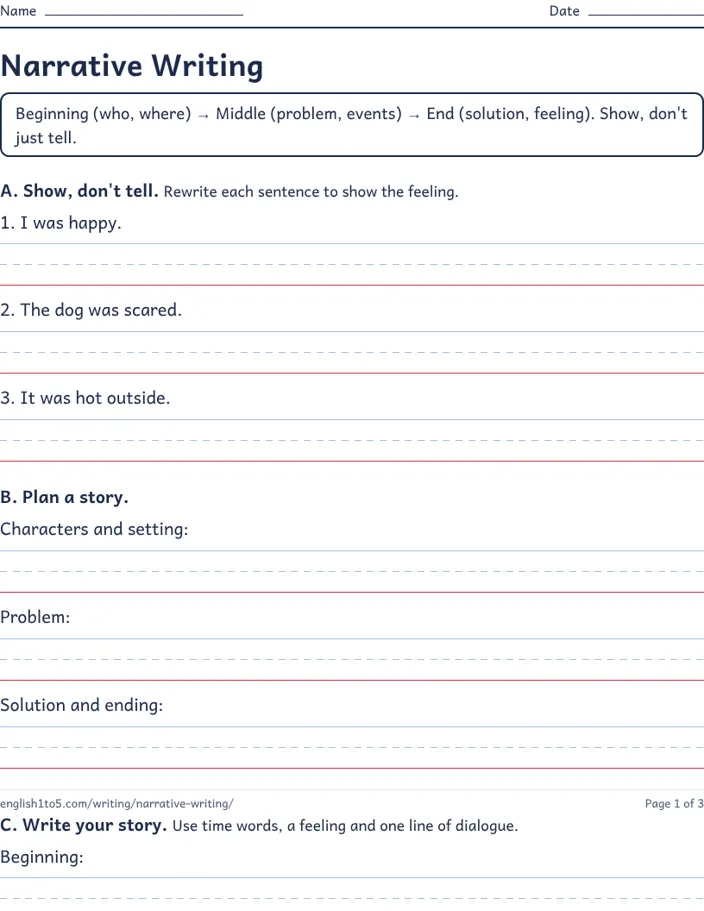
Narrative Writing Worksheet, 1st–5th grade
Turn telling sentences into showing sentences, plan a story with a story map, then write it. Prints on US Letter paper, with an answer key.
Download the PDFTry it at home
- Tell it first: say the story aloud before writing.
- Small moments: one moment, not a whole day.
- Feelings charades: act out a feeling, write how it looks.
- Family stories: write about a funny family memory.
- Picture prompts: write a story about a photo.
What comes next
Next: writing a paragraph. Earlier: informative writing. Related: story elements, descriptive writing and quotation marks.
Practice with a game
Free, no sign-up, and they work on phones, tablets and computers.
 Quotation Station
Last reviewed: November 11, 2026
Questions parents ask
What is narrative writing?
Writing that tells a story, real or imagined, with characters, a setting, events in order and an ending.
What is a personal narrative?
A true story about something that happened to the writer, told in first person.
What grade learns narrative writing?
Every grade from kindergarten to 5th; detail and technique grow each year (W.1.3, W.3.3, W.5.3).
What does show, don't tell mean?
Instead of naming a feeling (I was scared), describe what it looked or felt like (my knees shook).
How long should a kid's story be?
1st graders: a few sentences with a beginning, middle and end. By 5th grade: several paragraphs with dialogue and description.