Quotation Marks in Dialogue
Quotation marks go around the exact words someone says. A comma separates the speaker from the speech, and the end punctuation goes inside the closing quotation mark: Leo said, "I'm hungry."
How do quotation marks work?
Quotation marks are like a speech bubble in a comic. Everything inside them is exactly what the character said, word for word. Everything outside them is the narrator telling you who spoke and how.
The tricky part is the punctuation around the quote. A comma usually separates the "said" part from the spoken part, and the period, comma, question mark or exclamation point goes inside the closing quotation mark, never after it.
Leo said, "I'm hungry."
"I'm hungry," Leo said.
The Common Core standards start dialogue in 3rd grade (L.3.2c) and add quoting from a text in 4th grade (L.4.2b). Writing dialogue makes kids' stories come alive, so it's worth getting right.
The three dialogue patterns
Most dialogue follows one of these. Look closely at where each comma and end mark goes.
| Pattern | Example | What to notice |
|---|---|---|
| speaker first | Mia said, "Let's go." | comma after said; period inside the quote |
| speaker last | "Let's go," Mia said. | comma inside the quote; period at the very end |
| question or exclamation | "Can we go?" asked Mia. | the ? replaces the comma, and it's inside the quote |
| split quote | "If we hurry," said Mia, "we can catch the bus." | the second part starts lowercase because it's the same sentence |
The spoken words always start with a capital letter, even in the middle of a sentence: Mia said, "Let's go."
Dialogue punctuated correctly
Read each one aloud. The quotation marks show exactly where the speaking starts and stops.
- Dad said, "Dinner is ready."
- "I'm coming," Ava called.
- "Where are my shoes?" asked Leo.
- Grandma whispered, "The baby is asleep."
- "Watch out!" shouted the coach.
- Mom asked, "Did you feed the dog?"
- "I love this song," said Sam.
- "Yes," said Mia, "I finished my homework."
- The teacher said, "Open your books to page 10."
- "Wow, look at that rainbow!" Ava said.
In example 3, the question mark replaces the comma. You never use both: "Where are my shoes?," is wrong.
New speaker, new line
When two characters talk back and forth, start a new paragraph every time the speaker changes:
- "Do you want to play?" asked Leo.
- "Sure," said Mia. "Let's play tag."
- "You're it!" Leo shouted.
- The new line tells the reader someone else is talking, even if you don't write "said" every time.
How to teach quotation marks
Five short steps, about 10 minutes each.
- Start with comics. Read a comic strip. Turn one speech bubble into a sentence with quotation marks.
- Act it out. Say a line, and your child writes it down: Mom said, "..." Then swap.
- Trace the punctuation. In a book, your child traces the comma and the end mark inside the quotation marks with a finger.
- Flip the speaker. Rewrite Mia said, "Let's go." as "Let's go," Mia said. Notice where the comma moves.
- Write a conversation. Your child writes four lines between two characters, starting a new line for each speaker.
Common mistakes and how to fix them
| Mistake | Why it happens | How to fix it |
|---|---|---|
| Leo said, "I'm hungry". | Putting the period outside. | In US English, it goes inside: "I'm hungry." |
| "Where are you?," asked Mom. | Using both a question mark and a comma. | The question mark is enough: "Where are you?" asked Mom. |
| Mia said "let's go." | Missing the comma and the capital. | Mia said, "Let's go." |
| Two speakers in one paragraph. | Not knowing the new-line rule. | Start a new line each time the speaker changes. |
Practice: quotation marks quiz
10 questions. Your child can tap the speaker to hear a question read aloud. The first try on each question counts toward the score.
-
1.Which is correct?
Show answer
Leo said, "I'm hungry."
-
2.Which is correct?
Show answer
"Let's go," Mia said.
-
3.Which is correct?
Show answer
"Can we play?" asked Sam.
-
4.What goes inside quotation marks?
Show answer
the exact words someone says.
-
5.Which is correct?
Show answer
Dad said, "Dinner is ready."
-
6.When should you start a new paragraph in dialogue?
Show answer
every time the speaker changes.
-
7.Which is correct?
Show answer
"Watch out!" yelled Ava.
-
8.Where does the comma go? Mom asked "Are you ready?"
Show answer
Mom asked, "Are you ready?"
-
9.Which is a split quote punctuated correctly?
Show answer
"If we hurry," said Mia, "we can make it."
-
10.Which needs quotation marks?
Show answer
Leo said, "I'm tired." Those are his exact words.
Quotation Marks in Dialogue worksheet (free PDF)
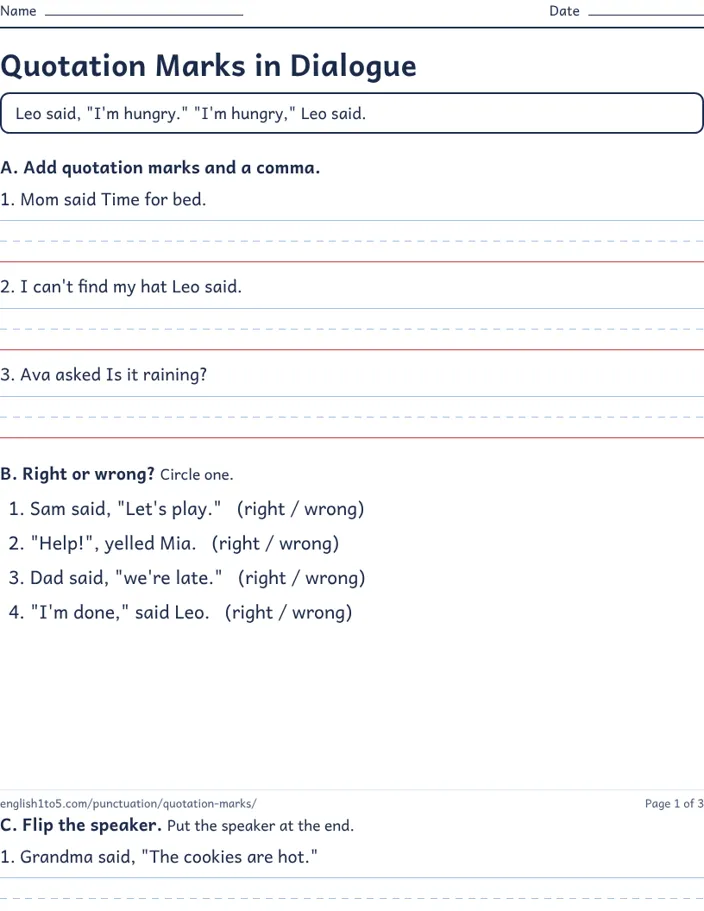
Quotation Marks in Dialogue Worksheet, 3rd–4th grade
Add quotation marks and commas, fix punctuation in dialogue, flip the speaker and write a short conversation. Prints on US Letter paper, with an answer key.
Download the PDFTry it at home
- Comic strips: turn speech bubbles into sentences with quotation marks.
- Family quotes: write down something funny someone said at dinner, with quotation marks.
- Reading: find dialogue in a chapter book and trace the punctuation.
- Texting: write a short text exchange as dialogue.
- Stories: add one line of dialogue to every story your child writes.
What comes next
Next, kids learn commas before and, but and so in compound sentences. See all skills on the 3rd grade and 4th grade pages, or browse all punctuation lessons.
Last reviewed: November 11, 2026
Questions parents ask
How do you use quotation marks in dialogue?
Put them around the exact words someone says, use a comma to separate the speaker from the speech, and put the end punctuation inside the closing quotation mark: Leo said, "I'm hungry."
What grade learns quotation marks?
3rd grade, for dialogue (L.3.2c). 4th grade adds quoting from a text (L.4.2b).
Does the period go inside or outside the quotation marks?
In US English, periods and commas always go inside: "I'm hungry." British English sometimes puts them outside.
When do you start a new paragraph in dialogue?
Every time the speaker changes. It helps the reader follow who is talking.
Do you need a comma before a quote?
Usually, yes: Mia said, "Let's go." If the quote ends in a question mark or exclamation point, that replaces the comma: "Let's go!" Mia said.