Descriptive Writing
Descriptive writing paints a picture in the reader's mind. Instead of "The cookie was good," a descriptive writer says, "The warm cookie crunched, then melted into gooey chocolate." The secret ingredients: the five senses, precise words and comparisons.
Three tools for description
Sensory details tell what something looks, sounds, smells, tastes and feels like. You don't need all five every time, but using two or three makes a scene real. Precise words beat general ones: golden retriever beats dog, sprinted beats went fast, and scarlet beats red.
Comparisons help readers understand something new by linking it to something familiar. Similes use like or as ("as soft as a cloud"); metaphors say one thing is another ("the lake was a mirror"). Description makes stories, reports and even letters more vivid.
See, hear, smell, taste, touch.
Precise words + comparisons = a picture in words.
2nd graders choose adjectives and adverbs (L.2.1e), 3rd graders describe actions, thoughts and feelings (W.3.3b), and 4th graders use concrete words and sensory details to show events precisely (W.4.3d). Description is the heart of good narrative writing.
Five senses: describing a bakery
A sensory chart before writing.
| Sense | Details |
|---|---|
| See | golden loaves, flour dust in the sunlight, a glass case of pink cupcakes |
| Hear | the oven door creaks, a timer dings, paper bags crinkle |
| Smell | warm bread, cinnamon, melted butter |
| Taste | a soft, sweet roll with sugary glaze |
| Touch | a warm, crusty loaf; sticky fingers |
Turn the chart into sentences: "The moment I opened the door, the smell of warm cinnamon wrapped around me like a blanket."
Plain vs. vivid
Each plain sentence is rewritten with description.
- Plain: The dog was big.
- Vivid: The shaggy dog was as tall as a pony.
- Plain: It was cold.
- Vivid: Icy wind stung my cheeks, and my fingers went numb.
- Plain: The room was messy.
- Vivid: Socks, comic books and cracker crumbs covered every inch of the floor.
- Plain: She went to the door.
- Vivid: She tiptoed to the creaky door.
- Plain: The soup was good.
- Vivid: The steaming tomato soup tasted sweet and a little peppery.
Notice the specific nouns (comic books, cracker crumbs) and verbs (tiptoed, stung). They do as much work as adjectives.
How to teach descriptive writing
Five short steps, about 10 to 15 minutes each.
- Use a real object. Describe an orange with all five senses.
- Make a sense chart. Five rows, a few words each.
- Swap plain words. Find stronger nouns, verbs and adjectives.
- Add a comparison. As ___ as ___, or like ___.
- Guess it. Read a description; can someone guess the object?
Common mistakes and how to fix them
| Mistake | Why it happens | How to fix it |
|---|---|---|
| Piles on adjectives | "The big, huge, giant, enormous dog." | One precise word beats four vague ones. |
| Uses only sight | Forgetting other senses. | Add a sound or a smell. |
| Uses general words | nice, good, fun, big. | Ban those words and find better ones. |
| Tells feelings | "It was scary." | Describe what made it scary. |
Practice: descriptive writing quiz
10 questions. Your child can tap the speaker to hear a question read aloud. The first try on each question counts toward the score.
-
1.What does descriptive writing do?
Show answer
Paints a picture with words.
-
2.How many senses are there?
Show answer
Five.
-
3.Which sentence uses the sense of smell?
Show answer
The kitchen smelled like warm cinnamon.
-
4.Which is more descriptive?
Show answer
The shaggy dog was as tall as a pony.
-
5.Tap the sound word.
.
Show answer
creaked.
-
6.Which verb is more precise than went?
Show answer
tiptoed.
-
7.As soft as a cloud is a...
Show answer
simile.
-
8.Tap the touch word.
.
Show answer
gritty (hot also works).
-
9.Which word should you swap for something stronger?
Show answer
nice.
-
10.Is it better to use four adjectives or one precise word?
Show answer
One precise word.
Descriptive Writing worksheet (free PDF)
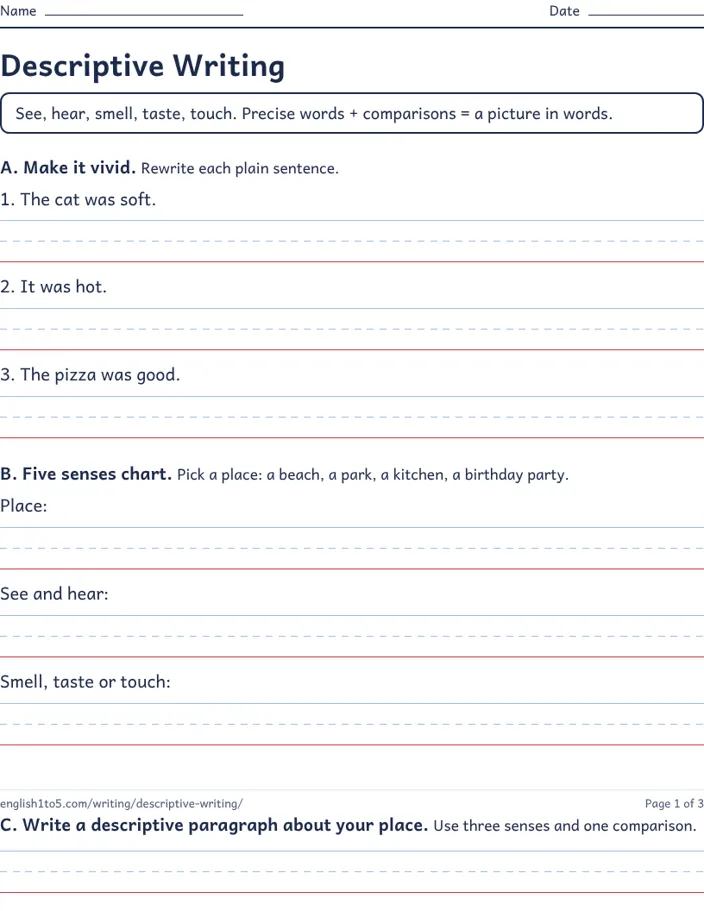
Descriptive Writing Worksheet, 2nd–4th grade
Fill in a five senses chart, rewrite plain sentences with vivid details, and write a descriptive paragraph. Prints on US Letter paper, with an answer key.
Download the PDFTry it at home
- Mystery bag: describe an object by touch only.
- Five senses walk: list what you notice outside.
- Ban nice: find a better word.
- Guess my place: describe a room; others guess.
- Read like a writer: find a great description in a book.
What comes next
Next: topic sentences. Earlier: editing and revising. Related: adjectives, shades of meaning and similes and metaphors.
Practice with a game
Free, no sign-up, and they work on phones, tablets and computers.
 Build an Alien
 Shades of Meaning
Last reviewed: November 11, 2026
Questions parents ask
What is descriptive writing?
Writing that uses details, especially the five senses, to help the reader picture a person, place, thing or event.
How do you teach descriptive writing?
Start with a real object, use a five senses chart, swap plain words for precise ones and add a comparison.
What grade learns descriptive writing?
Usually 2nd to 4th grade (L.2.1e, W.3.3b, W.4.3d), and it keeps growing after that.
What are sensory details?
Details that tell what something looks, sounds, smells, tastes or feels like.
Should kids use lots of adjectives?
Not too many. One precise word, like scarlet or sprinted, usually beats several vague ones.