3rd Grade Writing
- 3rd grade
- Common Core W.3.1–W.3.3
- 24 prompts · 12 lessons
3rd grade writing gets structured: clear topic sentences, reasons grouped into paragraphs, linking words, dialogue in stories, and real revising. The 24 prompts on this page are written for 3rd graders, in the three types of writing the standards require.
What kids learn in 3rd grade writing
3rd graders write opinion pieces that list reasons and use linking words like because, therefore and for example. Informative pieces group related information together, and narratives include dialogue, descriptions and a clear sequence.
They also plan, revise and edit with support, and start short research projects. Strong topic sentences and transition words make the biggest difference this year.
A good goal: a multi-paragraph piece with an introduction and conclusion by the end of the year.
3rd grade writing prompts
24 original prompts written for 3rd grade, eight each for opinion, informative and narrative writing, the three types in the Common Core writing standards. Pick one a day, or one a week for a longer piece. Download them as a printable PDF with a page of writing paper.
Opinion prompts
How to write it: opinion writing
- Should kids get paid for doing chores? Give reasons and examples.
- Is it better to live in the city or the country?
- Should students wear school uniforms?
- What is the best invention of all time?
- Should zoos exist? Explain your view.
- Should schools have a four-day week?
- Is it better to have one best friend or many friends?
- Which book should every 3rd grader read? Convince your reader.
Informative prompts
How to write it: informative writing
- Explain how to take care of a pet. Group your facts.
- Research an animal and write about where it lives, what it eats and how it survives.
- Explain why we have day and night.
- Describe a holiday or tradition from your family or culture.
- Explain how to stay safe in a storm.
- Write about a famous person you admire and what they did.
- Explain the water cycle in your own words.
- Teach a younger kid how to ride a bike.
Narrative prompts
How to write it: narrative writing
- Write about a time you had to make a hard choice.
- Tell about a time you worked as a team.
- Write a story about a kid who finds a mysterious map.
- Write about a time you felt nervous and what you did.
- Tell the story of your favorite family memory, with dialogue.
- Write a story from the point of view of your pet.
- Imagine you woke up as a teacher for a day. What happens?
- Write a story that ends: ...and that's how I learned to never give up.
3rd grade writing lessons, in order
Each lesson takes about 10 to 15 minutes and has a quiz and a free worksheet.
- 1. Writing a Friendly LetterWriting a friendly letter with all five parts and correct commas. L.2.2b, W.2.5, W.3.4
- 2. How to Write an EmailWriting a clear, polite email with a subject line, greeting, body, closing and name. W.4.4, L.4.3c, W.5.6
- 3. Opinion WritingWriting an opinion piece with a clear opinion, reasons, examples and a conclusion. W.1.1, W.3.1, W.5.1
- 4. Informative WritingWriting an informative piece with an introduction, facts grouped by subtopic and a conclusion. W.1.2, W.3.2, W.5.2
- 5. Narrative WritingWriting a narrative with characters, setting, events in order, details and an ending. W.1.3, W.3.3, W.5.3
- 6. Writing a ParagraphWriting a paragraph with a topic sentence, supporting details and a closing sentence. W.2.2, W.3.2a, W.3.4
- 7. Editing and RevisingRevising writing to make it better and editing it to fix mistakes. W.2.5, W.3.5, L.3.2, W.4.5
- 8. Descriptive WritingUsing sensory details, precise words and comparisons to describe vividly. L.2.1e, W.3.3b, W.4.3d
- 9. Topic SentencesWriting strong topic sentences that state the main idea of a paragraph. W.3.2a, W.3.1a, W.4.2a
- 10. Transition WordsChoosing transition words to show order, add ideas, give examples, compare and conclude. W.3.1c, W.3.3c, W.4.2c, W.5.2c
- 11. Writing a Book ReportWriting a book report with basic information, a short summary and a supported opinion. W.3.1, W.4.9, W.5.9
- 12. Short Research ProjectsDoing a short research project: asking questions, finding sources, taking notes and writing it up. W.3.7, W.3.8, W.4.7, W.5.7
What the standards say
These are the Common Core 3rd grade writing and language standards this page covers. Most US states use the same or very similar goals.
- L.3.2: Demonstrate command of the conventions of standard English capitalization, punctuation, and spelling when writing.
- W.3.1: Write opinion pieces on topics or texts, supporting a point of view with reasons.
- W.3.1a: Introduce the topic or text they are writing about, state an opinion, and create an organizational structure that lists reasons.
- W.3.1c: Use linking words and phrases (e.g., because, therefore, since, for example) to connect opinion and reasons.
- W.3.2: Write informative/explanatory texts to examine a topic and convey ideas and information clearly.
- W.3.2a: Introduce a topic and group related information together; include illustrations when useful to aiding comprehension.
- W.3.3: Write narratives to develop real or imagined experiences or events using effective technique, descriptive details, and clear event sequences.
- W.3.3b: Use dialogue and descriptions of actions, thoughts, and feelings to develop experiences and events or show the response of characters to situations.
- W.3.3c: Use temporal words and phrases to signal event order.
- W.3.4: With guidance and support from adults, produce writing in which the development and organization are appropriate to task and purpose.
- W.3.5: With guidance and support from peers and adults, develop and strengthen writing as needed by planning, revising, and editing.
- W.3.7: Conduct short research projects that build knowledge about a topic.
- W.3.8: Recall information from experiences or gather information from print and digital sources; take brief notes on sources and sort evidence into provided categories.
A simple weekly plan
Ten to fifteen minutes a day is plenty. This rhythm works for most families; swap days around to fit your week.
| Day | What to do |
|---|---|
| Monday | Pick a prompt and talk it through. |
| Tuesday | Plan with an organizer or drawing. |
| Wednesday | Write the draft. |
| Thursday | Revise: add one detail, swap one word. |
| Friday | Edit with CUPS and share it with someone. |
Mixed quiz
Ten questions drawn from the 3rd grade writing lessons: writing a friendly letter, how to write an email, opinion writing, informative writing, narrative writing, writing a paragraph and more. Tap the speaker to hear a question read aloud. Any question your child misses points to the lesson to revisit.
-
1.How many parts does a friendly letter have?
Show answer
Five.
-
2.What does the subject line do?
Show answer
It tells what the email is about.
-
3.What does OREO stand for?
Show answer
Opinion, Reasons, Examples, Opinion.
-
4.What does informative writing do?
Show answer
Teaches the reader facts about a topic.
-
5.What does narrative writing do?
Show answer
Tells a story.
-
6.What is a paragraph?
Show answer
A group of sentences about one main idea.
-
7.What does revising do?
Show answer
Makes writing better.
-
8.What does descriptive writing do?
Show answer
Paints a picture with words.
-
9.What does a topic sentence do?
Show answer
Tells what the paragraph is about.
-
10.What do transition words do?
Show answer
Connect ideas.
Printables
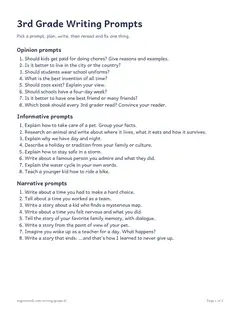 3rd Grade writing prompts (PDF)All 24 prompts plus a page of writing paper.
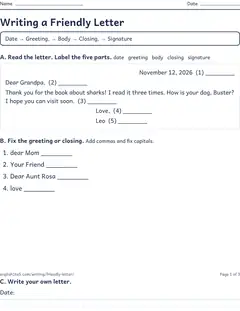 Writing a Friendly LetterLabel the parts of a model letter, fix commas and capitals, then write your own friendly letter.
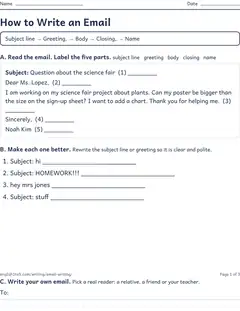 How to Write an EmailLabel the parts of a model email, fix subject lines and greetings, then write your own email.
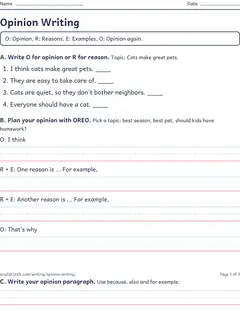 Opinion WritingPick a topic, plan with the OREO organizer, then write an opinion paragraph with linking words.
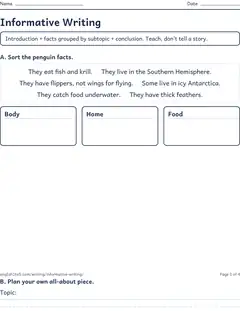 Informative WritingSort facts into subtopics, cross out the opinion, then plan and write your own all-about piece.
 Narrative WritingTurn telling sentences into showing sentences, plan a story with a story map, then write it.
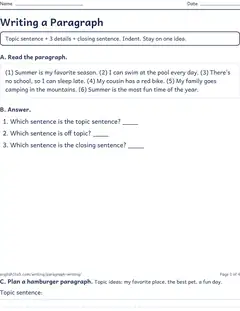 Writing a ParagraphLabel a model paragraph, cross out the off-topic sentence, plan with a hamburger organizer and write your own paragraph.
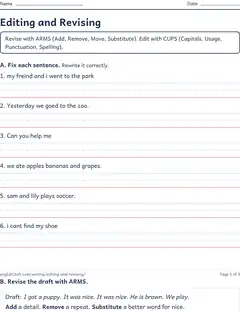 Editing and RevisingFix CUPS mistakes in sentences, revise a short draft with ARMS, then use a checklist on your own writing.
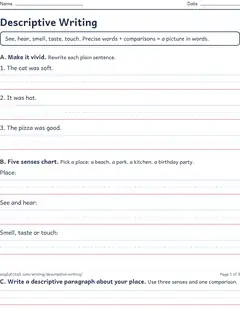 Descriptive WritingFill in a five senses chart, rewrite plain sentences with vivid details, and write a descriptive paragraph.
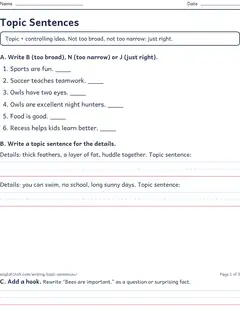 Topic SentencesSort topic sentences as broad, narrow or just right, write topic sentences for details, and add a hook.
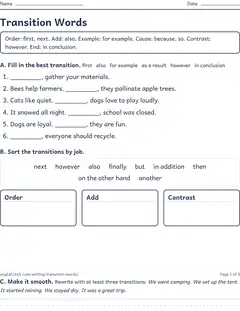 Transition WordsChoose the best transition for each sentence, sort transitions by job, and smooth out a choppy paragraph.
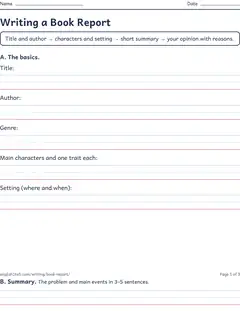 Writing a Book ReportA book report template: title, author, genre, characters, setting, summary, opinion with reasons and a star rating.
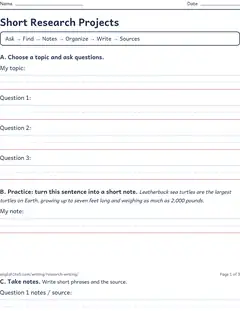 Short Research ProjectsA research planner: choose a topic, write questions, take notes in your own words with sources, and list your sources.
Practicing at home
Plan in boxes
One box per paragraph.
Ban boring words
Swap nice, good and fun for stronger words.
Revise with ARMS
Add, remove, move, substitute.
Read like a writer
Notice how authors start and end stories.
More 3rd grade practice
See every reading and writing skill for the year on the 3rd grade page. Earlier: 2nd grade writing prompts. Next: 4th grade writing prompts. All lessons: writing. Related: grammar and punctuation.
Last reviewed: November 11, 2026
Questions parents ask
What writing do 3rd graders do?
Opinion pieces with reasons, informative pieces grouped by topic, narratives with dialogue and description, and short research (W.3.1–W.3.3, W.3.7).
How long should 3rd grade writing be?
Usually two to four paragraphs.
How do I help my 3rd grader organize writing?
Use a planner with a box for each paragraph and a topic sentence for each.
What are good 3rd grade writing prompts?
Should kids get paid for chores? Explain how to care for a pet. Write about a hard choice.