How to Write an Email
An email is a letter sent by computer, tablet or phone. A good email has five parts: a subject line, a greeting, a body, a closing and your name. It gets to the point quickly, because the reader may be busy.
The five parts of an email
The subject line tells the reader what the email is about before they open it: Question about the science project. Keep it short, about three to seven words, and make it specific. The greeting says hello: Dear Ms. Lopez, or Hi Grandpa, with a comma after the name.
The body is the message. Say why you are writing in the first sentence, then add the details, then say what you need or hope for. Short paragraphs with a blank line between them are easier to read on a screen. The closing says goodbye, like Thank you, or Love,, and your name goes under it.
Unlike a paper letter, an email doesn't need a date at the top. The email program adds the date and time for you. It also shows your email address, so the reader knows who sent it. You fill in the To line with the reader's address before you send.
Subject line → Greeting, → Body → Closing, → Name
4th graders learn when to use formal English and when casual words are fine (L.4.3c), and 5th graders use technology to write and share their work (W.5.6). Email is one of the most useful real-world places to practice both. It is also the kind of writing they'll do most often as adults.
Parts of an email
What each part does, with an example for a teacher and one for a grandparent.
| Part | What it does | To a teacher | To a grandparent |
|---|---|---|---|
| Subject line | tells what the email is about | Question about Friday's spelling test | Pictures from my soccer game! |
| Greeting | says hello, then a comma | Dear Mr. Chen, | Hi Grandma, |
| Body | the message: why, details, what you need | I was absent on Tuesday. Could you tell me which list we are studying? | We won 3 to 2! I scored the last goal. When can you come watch? |
| Closing | says goodbye, then a comma | Thank you, | Love, |
| Name | who wrote it | Ava Martinez | Ava |
With a teacher or another adult you don't know well, use their title and last name (Mr., Ms., Dr.) and full sentences. With family and friends, casual words like Hi and exclamation points are fine.
Two model emails
First a polite email to a teacher, then a friendly one to family. Each part is labeled.
- Subject: Question about the science fair
- Greeting: Dear Ms. Lopez,
- Body: I am working on my science fair project about how plants grow toward light. Can my poster be bigger than the size on the sign-up sheet? I want to add a chart of my measurements.
- Body: Thank you for helping me.
- Closing: Sincerely,
- Name: Noah Kim
- Subject: I lost my first tooth!
- Greeting: Hi Uncle Ray,
- Body: Guess what? My front tooth came out at lunch today. I put it in a little envelope so I wouldn't lose it. How is your new puppy? Please send a picture!
- Closing: Love,
- Name: Lily
- Vague subject: Hi → Question about the science fair
- Too casual for a teacher: hey whats up → Dear Ms. Lopez,
Both bodies start with the reason for writing and end with a question or a thank-you. The teacher email uses full sentences and a polite closing; the family email can be playful.
How to teach email writing
Five short steps, about 10 to 15 minutes each. Practice on paper first, then on a real device with a grown-up.
- Pick a real reader and reason. Thank a relative, ask a teacher a question, invite a friend.
- Write the subject line first. If you can't say what it's about in a few words, plan more.
- Choose the right tone. Formal for teachers and other adults; friendly for family and friends.
- Draft the body in three parts. Why I'm writing, the details, what I need or hope for.
- Reread before sending. Check the greeting, commas, spelling and the To line. Emails can't be taken back.
Common mistakes and how to fix them
| Mistake | Why it happens | How to fix it |
|---|---|---|
| Leaves the subject line blank or writes Hi | Doesn't see why it matters. | Write what the email is about: Question about homework. |
| Writes in all capital letters | Wants to sound excited. | ALL CAPS reads like shouting. Use normal capitals. |
| Too casual with a teacher | Writes the way they text friends. | Use Dear, full sentences and a polite closing. |
| One giant paragraph | Doesn't think about reading on a screen. | Short paragraphs with a blank line between. |
| Forgets to sign | Thinks the address is enough. | Always end with a closing and your name. |
Practice: email writing quiz
10 questions. Your child can tap the speaker to hear a question read aloud. The first try on each question counts toward the score.
-
1.What does the subject line do?
Show answer
It tells what the email is about.
-
2.Which is the best subject line?
Show answer
Question about Friday's field trip
-
3.Which greeting is best for an email to your teacher?
Show answer
Dear Mr. Patel,
-
4.What comes right after the greeting Dear Ms. Lopez?
Show answer
A comma.
-
5.What should the first sentence of the body do?
Show answer
Say why you are writing.
-
6.Why shouldn't you write in ALL CAPS?
Show answer
It reads like shouting.
-
7.Tap the closing.
,
Show answer
Thank you.
-
8.Which closing fits an email to a principal?
Show answer
Sincerely,
-
9.Does an email need a date at the top?
Show answer
No. The email program adds it.
-
10.What should you do before you click Send?
Show answer
Reread it and check the To line.
How to Write an Email worksheet (free PDF)
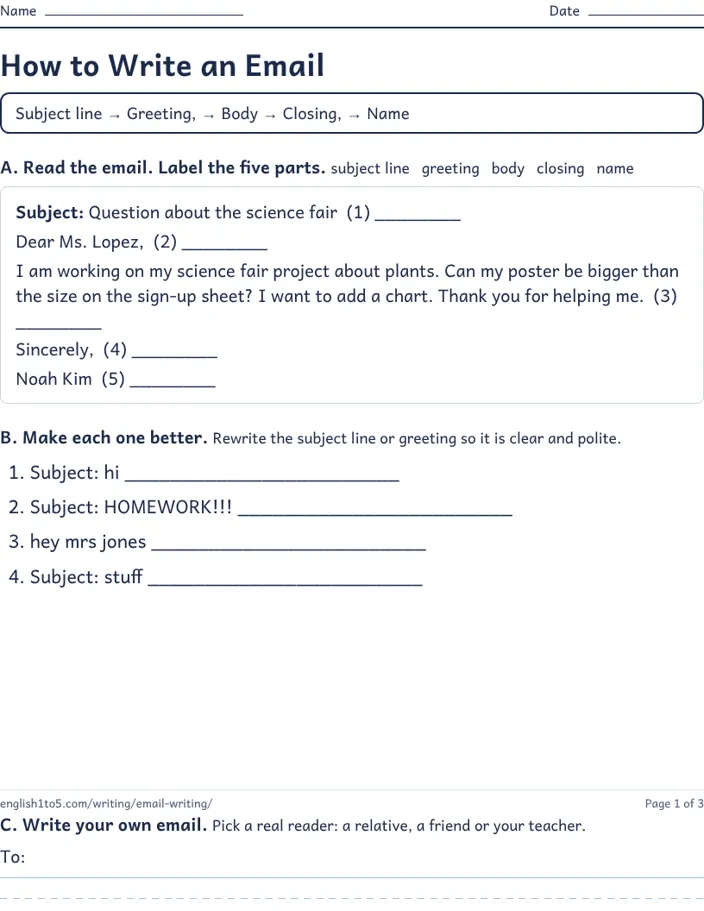
How to Write an Email Worksheet, 3rd–5th grade
Label the parts of a model email, fix subject lines and greetings, then write your own email. Prints on US Letter paper, with an answer key.
Download the PDFTry it at home
- Real email: write to a grandparent with a grown-up, and read the reply together.
- Subject line game: read an email aloud and invent the best subject line.
- Tone switch: write the same news to a friend and to a teacher.
- Thank-you emails: after a birthday or a visit.
- Safety rule: only email people your grown-up says are OK, and never share passwords.
What comes next
Next: opinion writing. Earlier: writing a friendly letter. Related: commas in letters and editing and revising.
Practice with a game
Free, no sign-up, and they work on phones, tablets and computers.
 Capital Catch
 Comma Coach
Last reviewed: November 11, 2026
Questions parents ask
What are the parts of an email?
Subject line, greeting, body, closing and your name. The email program adds the date and your address.
How do you write a good subject line?
Say what the email is about in three to seven words, like Question about the science fair. Avoid vague subjects like Hi.
How should a kid start an email to a teacher?
With Dear and the teacher's title and last name, then a comma: Dear Ms. Lopez, Then say why you are writing in the first sentence.
What is a good closing for an email?
Thank you, or Sincerely, for teachers and other adults; Love, or See you soon, for family and friends. Put a comma after it and your name under it.
What grade learns to write emails?
Most kids practice in 3rd to 5th grade, when they start using school email or learning apps. It connects to W.4.4 and W.5.6 in the Common Core.
How can kids email safely?
Only email people a parent or teacher has said are OK, never share passwords or home addresses, and tell a grown-up about any email that feels strange.