4th Grade Reading Comprehension
- 4th grade
- Common Core RL.4.1–RL.4.10
- 3 passages · 12 lessons
4th grade comprehension asks kids to dig below the surface: infer what the author doesn't say, find the theme, summarize, and recognize how a text is organized. The three passages on this page include a story, a science text about the water cycle and two first-person accounts of the same day.
What kids learn in 4th grade reading comprehension
The big skills are inferences backed by details, theme and summary, text structure (sequence, cause and effect, compare and contrast, problem and solution) and comparing first- and third-person point of view.
4th graders also read poems and plays and explain how they differ from stories, and explain how authors use reasons and evidence. Answers should include details and examples from the text.
Encourage longer written answers: a claim, the evidence, and how the evidence supports it.
4th grade reading passages
Three original passages written for 4th grade: two stories and a nonfiction text. Your child reads the passage, answers the questions, then checks the answers. Each question practices a skill from the lessons below. Download all three as a printable PDF (with an answer key).
1. The Lighthouse Keeper's Daughterstory
Every night, Nell's father climbed the 112 steps of the lighthouse to light the great lamp. Ships far out at sea watched for its beam to stay away from the rocks.
One stormy evening, her father came down with a terrible fever. "The lamp," he whispered. "It has to be lit." Nell had never done it alone, and the wind howled against the tower.
She grabbed the lantern and started up the stairs. Her legs ached and the old windows rattled, but she counted every step out loud to keep going. At the top, her hands shook as she struck the match. On the third try, the wick caught, and the beam swept out across the black water.
In the morning, a fishing boat pulled into the harbor. The captain climbed the hill and knocked on their door. "Whoever lit that lamp last night," he said, "saved my crew."
Questions
- What problem does Nell face? (story elements: characters, setting, events)
- Describe Nell using a trait. Give two pieces of evidence. (character traits)
- What can you infer about the fishing boat? (making inferences)
- What is a theme of the story? (finding the theme of a story)
- Summarize the story in two sentences. (how to summarize)
Show answers
- Her father is sick, and she has to light the lamp alone in a storm.
- Brave or determined: she climbed alone in the storm and kept trying the match.
- It was at sea in the storm and used the light to avoid the rocks.
- Courage means doing what's needed even when you're afraid.
- When her father got sick during a storm, Nell climbed the lighthouse alone and lit the lamp. The next morning, a captain thanked them for saving his crew.
2. The Water Cyclenonfiction
The water you drink today may once have been part of a dinosaur's lake. That's because Earth's water moves in a never-ending loop called the water cycle.
It begins with evaporation. The sun heats water in oceans, lakes and puddles, turning it into an invisible gas called water vapor that rises into the air.
High in the sky, the air is cold. The vapor cools and turns back into tiny droplets, which gather to form clouds. This is called condensation.
When the droplets grow heavy, they fall as rain, snow, sleet or hail. This is precipitation. The water flows into rivers, soaks into the ground or collects in oceans, and the cycle starts again.
Questions
- What is the text structure? How do you know? (text structure)
- What causes evaporation? (cause and effect)
- What is condensation? (key details)
- What is the main idea? (main idea and supporting details)
- Why does the author mention dinosaurs? (author's purpose)
Show answers
- Sequence: it explains steps in order (begins, then, when).
- The sun heating water.
- Water vapor cooling into droplets that form clouds.
- Earth's water moves in a never-ending cycle.
- To show that water has been recycled for a very long time, and to hook the reader.
3. Two Views of the Snow Daystory
MAYA: I woke up and the whole world was white! School was closed. I built a fort, had a snowball fight with my brother and drank three cups of cocoa. Best. Day. Ever.
MR. LEE (Maya's neighbor): I woke up at five to shovel the driveway. By the time I finished, the snowplow had buried it again. My car wouldn't start, and I missed an important meeting. I'll be glad when this snow melts.
Questions
- What point of view is each part written in? (point of view)
- How do Maya and Mr. Lee feel about the snow? (compare and contrast)
- Why do they feel differently? (point of view)
- Which words show Mr. Lee's mood? (making inferences)
- Write one sentence that compares and one that contrasts the two views. (compare and contrast)
Show answers
- First person (I).
- Maya loves it; Mr. Lee is frustrated.
- Maya gets a day off to play; Mr. Lee has work and chores made harder by snow.
- Answers will vary: buried it again, wouldn't start, glad when this snow melts.
- Both woke up to snow. Maya was excited, but Mr. Lee was frustrated.
4th grade reading lessons, in order
Each lesson takes about 10 minutes and has a quiz and a free worksheet with its own reading passage.
- 1. Main Idea and Supporting DetailsFinding the main idea of a paragraph or text and the details that support it. RI.2.2, RI.3.2, RI.4.2
- 2. Author's PurposeFiguring out whether an author wrote to inform, persuade or entertain. RI.2.6, RI.3.6, RI.4.8
- 3. Point of ViewTelling first-person from third-person narration and comparing characters' points of view. RL.2.6, RL.3.6, RL.4.6, RL.5.6
- 4. Compare and ContrastComparing and contrasting characters, stories and texts using details. RL.2.9, RI.2.9, RL.3.9, RL.5.3
- 5. Character TraitsDescribing characters' traits and feelings using evidence from their actions, words and thoughts. RL.3.3, RL.4.3
- 6. Fact and OpinionTelling facts from opinions and spotting opinion clue words. RI.3.6, RI.4.8, RI.5.8
- 7. Making InferencesMaking inferences from text clues and background knowledge and supporting them with evidence. RL.3.1, RL.4.1, RI.4.1, RL.5.1
- 8. Finding the Theme of a StoryFinding a theme from details in a story, drama or poem. RL.4.2, RL.5.2
- 9. How to SummarizeSummarizing stories and nonfiction texts briefly and in their own words. RL.4.2, RI.4.2, RI.5.2
- 10. Text StructureIdentifying the five common nonfiction text structures and their signal words. RI.4.5, RI.5.5
- 11. Reading PoemsNaming the parts of a poem and explaining how poems differ from prose. RL.3.5, RL.4.5, RL.4.2
- 12. Reading PlaysNaming the parts of a play and explaining how drama differs from stories. RL.3.5, RL.4.5, RL.5.3
What the standards say
These are the Common Core 4th grade reading literature and informational text standards this page covers. Most US states use the same or very similar goals.
- RI.4.1: Refer to details and examples in a text when explaining what the text says explicitly and when drawing inferences from the text.
- RI.4.2: Determine the main idea of a text and explain how it is supported by key details; summarize the text.
- RI.4.5: Describe the overall structure (e.g., chronology, comparison, cause/effect, problem/solution) of events, ideas, concepts, or information in a text or part of a text.
- RI.4.8: Explain how an author uses reasons and evidence to support particular points in a text.
- RL.4.1: Refer to details and examples in a text when explaining what the text says explicitly and when drawing inferences from the text.
- RL.4.2: Determine a theme of a story, drama, or poem from details in the text; summarize the text.
- RL.4.3: Describe in depth a character, setting, or event in a story or drama, drawing on specific details in the text (e.g., a character's thoughts, words, or actions).
- RL.4.5: Explain major differences between poems, drama, and prose, and refer to the structural elements of poems (e.g., verse, rhythm, meter) and drama (e.g., casts of characters, settings, descriptions, dialogue, stage directions) when writing or speaking about a text.
- RL.4.6: Compare and contrast the point of view from which different stories are narrated, including the difference between first- and third-person narrations.
A simple weekly plan
Ten to fifteen minutes a day is plenty. This rhythm works for most families; swap days around to fit your week.
| Day | What to do |
|---|---|
| Monday | Read passage 1 together and answer the questions. |
| Tuesday | Do a lesson and its quiz. |
| Wednesday | Read passage 2; answer with evidence. |
| Thursday | Read passage 3, or a library book, and talk about it. |
| Friday | Take the mixed quiz below. Revisit any skill your child missed. |
Mixed quiz
Ten questions drawn from the 4th grade lessons: main idea and supporting details, author's purpose, point of view, compare and contrast, character traits, fact and opinion and more. Tap the speaker to hear a question read aloud. Any question your child misses points to the lesson to revisit.
-
1.What is the main idea?
Show answer
What a text is mostly about.
-
2.What does PIE stand for?
Show answer
Persuade, inform, entertain.
-
3.I grabbed my bike and rode away. What point of view is this?
Show answer
First person.
-
4.What does compare mean?
Show answer
Find how things are alike.
-
5.What is a character trait?
Show answer
What a character is like inside.
-
6.What is a fact?
Show answer
Something that can be proved true.
-
7.What is an inference?
Show answer
Figuring something out from clues and what you know.
-
8.What is a theme?
Show answer
The big message or life lesson of a story.
-
9.What is a summary?
Show answer
The most important parts in a few sentences.
-
10.What is text structure?
Show answer
How an author organizes information.
Printables
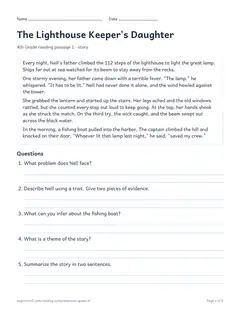 4th Grade reading passages (PDF)All three passages from this page, with questions and an answer key.
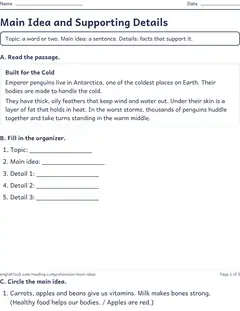 Main Idea and Supporting DetailsRead a passage, write the topic, main idea and three details, choose main ideas and find the detail that doesn't belong.
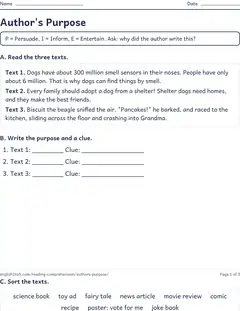 Author's PurposeRead three short texts on one topic, label each purpose, sort real-world texts and write your own.
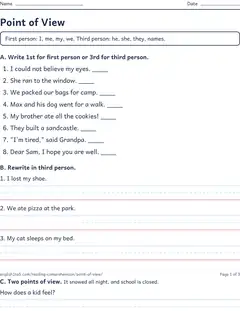 Point of ViewLabel sentences as first or third person, rewrite sentences, and describe one event from two characters' points of view.
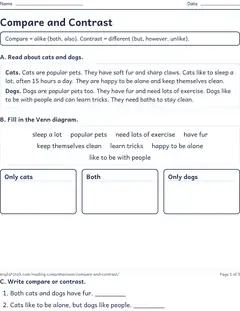 Compare and ContrastRead about cats and dogs, fill in a Venn diagram, label compare or contrast sentences and write your own.
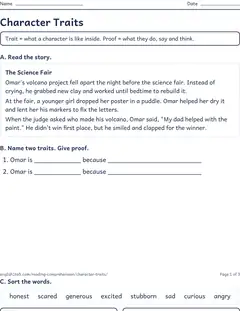 Character TraitsRead a short story, name the main character's traits with proof, sort traits from feelings and match actions to traits.
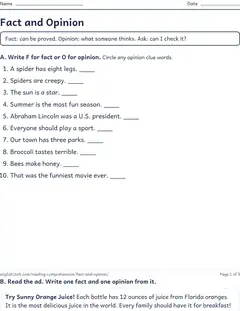 Fact and OpinionLabel sentences as fact or opinion, circle clue words, find facts and opinions in a short ad and write one of each.
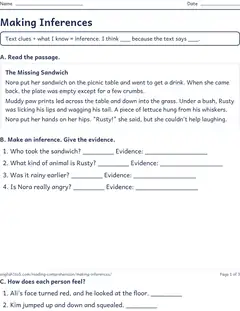 Making InferencesRead a short mystery, make inferences with evidence, fill in a clues-plus-knowledge chart and infer feelings.
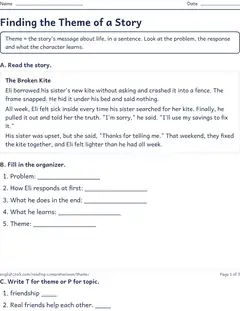 Finding the Theme of a StoryRead a short story, fill in a problem-response-lesson organizer, write the theme and sort themes from topics.
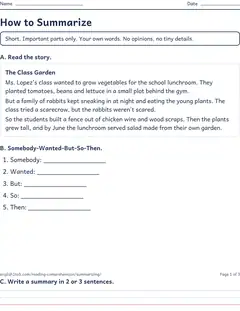 How to SummarizeRead a story and fill in Somebody-Wanted-But-So-Then, write a summary, then choose the best summary of a nonfiction passage.
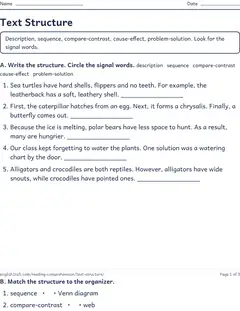 Text StructureLabel five short paragraphs by structure, circle signal words, match structures to organizers and write your own paragraph.
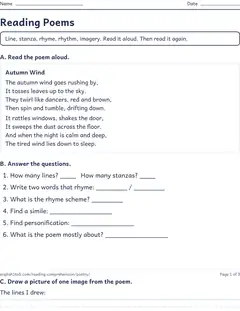 Reading PoemsRead an original poem, count lines and stanzas, find rhymes, imagery and personification, and write two rhyming lines.
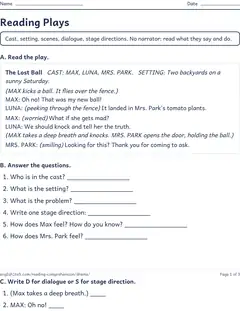 Reading PlaysRead a short play, find the cast, setting, dialogue and stage directions, and write the next lines.
Practicing at home
Infer together
"What can you tell about this character that the author doesn't say?"
Summarize chapters
Two or three sentences after each chapter.
Spot the structure
Is this article a sequence, a comparison or a problem and solution?
Read poems and plays
Read a play aloud as a family.
More 4th grade practice
See every reading and writing skill for the year on the 4th grade page. Earlier: 3rd grade reading passages. Next: 5th grade reading passages. All lessons: reading comprehension.
Practice with a game
Free, no sign-up, and they work on phones, tablets and computers.
 Point of View Sort
 Main Idea Machine
 Cause and Effect Connect
 Author's Purpose PIE
Last reviewed: November 11, 2026
Questions parents ask
What reading comprehension skills are taught in 4th grade?
Inferences with evidence, theme, summary, text structure, point of view, poems and plays, and how authors use reasons and evidence.
How long are 4th grade reading passages?
About 300 to 600 words.
What's the difference between theme and main idea?
Theme is a story's message about life; main idea is what a nonfiction text is mostly about.
How do I help with inferences?
Ask what the text suggests and how they know, and have them point to the clue.