Text Structure
Text structure is how an author organizes information. Most nonfiction uses one of five structures: description, sequence, compare and contrast, cause and effect, and problem and solution. Spotting the structure helps you understand and remember what you read.
Why structure matters
Knowing the structure is like having a map. If you see that an article is cause and effect, you know to look for why things happened and what resulted. If it's sequence, you track the order. Readers who notice structure remember more.
Signal words are the biggest clue: first, next, finally point to sequence; because, as a result to cause and effect; both, however to compare and contrast. Headings and the author's purpose help too. A long text can mix structures, with different sections organized different ways.
Description, sequence, compare-contrast, cause-effect, problem-solution.
Look for the signal words.
4th graders describe the structure of a text or part of a text (RI.4.5), and 5th graders compare the structures of two or more texts (RI.5.5). The same structures help kids organize their own informative writing.
The five text structures
Each has its own signal words and organizer.
| Structure | What it does | Signal words | Organizer |
|---|---|---|---|
| Description | tells about a topic's features | for example, such as, also, looks like | web |
| Sequence | tells events or steps in order | first, next, then, finally, in 1990 | timeline or numbered list |
| Compare and contrast | shows how things are alike and different | both, alike, however, but, unlike | Venn diagram |
| Cause and effect | explains why something happened and the result | because, so, as a result, therefore | cause → effect boxes |
| Problem and solution | states a problem and how it was or could be solved | problem, solution, solved, one answer is | problem box → solution box |
Problem-solution and cause-effect can look alike. Ask: is the author explaining why something happened, or offering a fix?
Name the structure
Each short text is labeled with its structure.
- "Cheetahs have spotted coats, long legs and a small head. They can run 70 miles per hour." → description
- "First, mix the flour and eggs. Next, add milk. Finally, pour the batter into a hot pan." → sequence
- "Both frogs and toads are amphibians. However, frogs have smooth skin, but toads are bumpy." → compare and contrast
- "Because of heavy rain, the river rose. As a result, the town flooded." → cause and effect
- "Our park had too much litter. To solve this, students put up recycling bins." → problem and solution
- "In 1903, the Wright brothers flew their first plane. Six years later, they sold one to the army." → sequence
- "Saturn is a giant planet with bright rings made of ice and rock." → description
- "Unlike cats, dogs need daily walks." → compare and contrast
- "The bridge was too old to be safe, so the city built a new one." → problem and solution
- "Since the bees disappeared, fewer apples grew." → cause and effect
Example 9 has so, a cause-effect word, but the text is about fixing a problem. Look at the whole idea, not just one word.
How to teach text structure
Five short steps, about 10 minutes each.
- One structure at a time. Learn its signal words and organizer.
- Hunt signal words. Underline them in an article.
- Fill the organizer. Timeline, Venn, cause-effect boxes.
- Write one paragraph each. Same topic, five structures.
- Compare two texts. Same topic, different structures (5th grade).
Common mistakes and how to fix them
| Mistake | Why it happens | How to fix it |
|---|---|---|
| Decides from one word | Signal words can mislead. | Look at the whole paragraph. |
| Mixes up cause-effect and problem-solution | They look alike. | Why it happened, or how it was fixed? |
| Thinks all nonfiction is description | It's the most common. | Check for order, comparison or causes. |
| Ignores headings | Headings hint at structure. | "How to..." or "Then and Now" are clues. |
Practice: text structure quiz
10 questions. Your child can tap the speaker to hear a question read aloud. The first try on each question counts toward the score.
-
1.What is text structure?
Show answer
How an author organizes information.
-
2.First, mix the flour. Next, add eggs. Finally, bake. Which structure?
Show answer
sequence.
-
3.Both frogs and toads lay eggs, but frogs have smooth skin. Which structure?
Show answer
compare and contrast.
-
4.Because of the rain, the river flooded. Which structure?
Show answer
cause and effect.
-
5.The park had litter, so students added recycling bins. Which structure?
Show answer
problem and solution.
-
6.Cheetahs have spots, long legs and a small head. Which structure?
Show answer
description.
-
7.Tap the compare-contrast signal word.
, .
Show answer
Unlike.
-
8.Which organizer fits sequence?
Show answer
A timeline.
-
9.Tap the cause-effect signal word.
. , .
Show answer
result (as a result).
-
10.How many main text structures are there?
Show answer
Five.
Text Structure worksheet (free PDF)
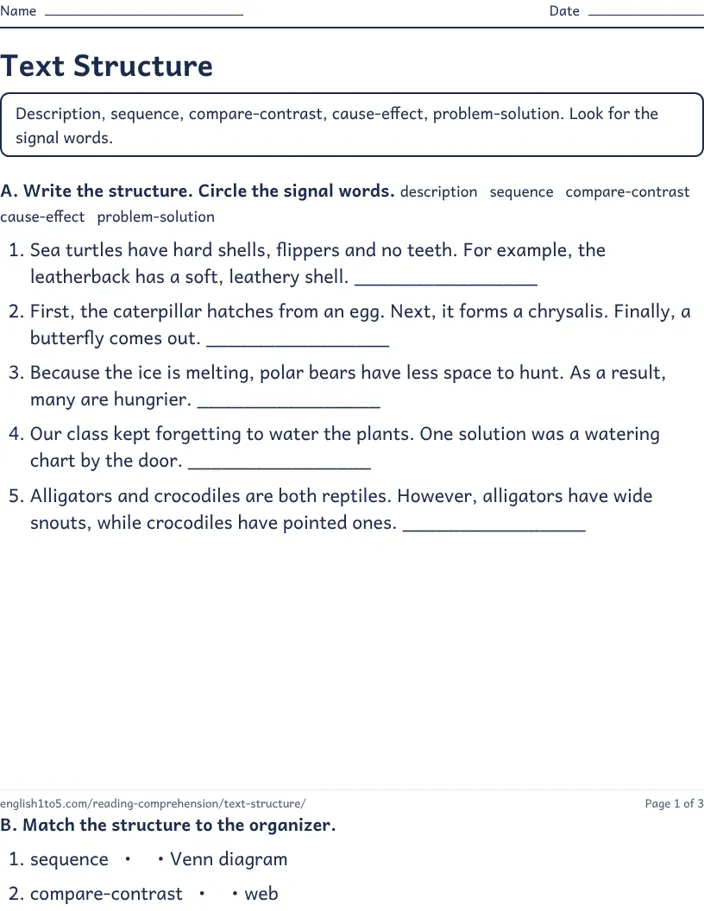
Text Structure Worksheet, 4th–5th grade
Label five short paragraphs by structure, circle signal words, match structures to organizers and write your own paragraph. Prints on US Letter paper, with an answer key.
Download the PDFTry it at home
- Article sort: which structure is this news story?
- Recipe = sequence: find the signal words.
- Then and now: compare-contrast at the museum.
- Why it happened: cause and effect in science shows.
- Fix it: write a problem-solution letter.
What comes next
Next: reading poems. Earlier: summarizing, compare and contrast and cause and effect.
Last reviewed: November 11, 2026
Questions parents ask
What are the 5 text structures?
Description, sequence (chronological order), compare and contrast, cause and effect, and problem and solution.
How do you identify text structure?
Look for signal words, headings and what the author is trying to do: describe, show order, compare, explain why, or solve.
What grade learns text structure?
4th grade describes a text's structure (RI.4.5), and 5th grade compares the structures of two texts (RI.5.5).
Can a text have more than one structure?
Yes. Longer texts often use different structures in different sections.
Why does text structure matter?
It helps readers know what to look for and remember information, and helps writers organize their ideas.