Character Traits
A character trait describes what a character is like on the inside: brave, honest, kind, stubborn. Authors rarely tell you straight out. Instead, you figure out traits from what a character does, says and thinks.
Traits, feelings and looks
A trait is part of who someone is, and it shows up again and again: a generous character keeps sharing. A feeling is how a character feels right now, and it changes: sad, excited, scared. And physical traits (tall, red-haired) describe the outside. Reading lessons focus on the inside.
To find a trait, look for evidence. If a girl gives her lunch to a friend who forgot his, she is generous. If a boy keeps trying to ride his bike after falling ten times, he is determined. The action is the proof.
Trait = what a character is like inside.
Proof = what they do, say and think.
3rd graders describe characters' traits, motivations and feelings and explain how their actions move the story along (RL.3.3). 4th graders describe characters in depth with specific details (RL.4.3). Finding traits is a kind of inference.
Character trait words
Use precise words, not just nice or mean.
| Positive traits | Negative traits | Either |
|---|---|---|
| brave, kind, honest | selfish, rude, dishonest | curious, quiet |
| generous, helpful, loyal | greedy, bossy, lazy | stubborn, bold |
| determined, patient, clever | boastful, jealous, careless | shy, serious |
| responsible, caring, fair | mean, impatient, sneaky | talkative, competitive |
| hard-working, cheerful | lazy, grumpy | adventurous, cautious |
"Stubborn" can be good or bad: a stubborn hero won't give up, but a stubborn bully won't listen. Context decides.
Evidence → trait
Each action is proof of a trait.
- Ana shared her umbrella with a stranger. → kind, generous
- Leo kept practicing piano after making mistakes. → determined
- Max told the teacher he broke the vase. → honest
- The hare bragged that he was the fastest. → boastful
- Jin asked a hundred questions about space. → curious
- Zoe pushed ahead of everyone in line. → rude, impatient
- The ant saved food for winter. → responsible, hard-working
- The fox tricked the crow out of her cheese. → sneaky, clever
- Sam hid behind his mom when guests came. → shy
- Priya stood up for a kid being teased. → brave, fair
A strong answer gives the trait and the proof: "Max is honest because he told the teacher the truth."
How to teach character traits
Five short steps, about 10 minutes each.
- Trait vs. feeling. Brave (always) or scared (right now)? Sort words.
- Build a word list. Go beyond nice and mean: generous, stubborn, curious.
- Find the proof. What did the character do, say or think?
- Use because. "She is ___ because ___."
- Track changes. Does the character change by the end?
Common mistakes and how to fix them
| Mistake | Why it happens | How to fix it |
|---|---|---|
| Gives a feeling, not a trait | Happy, sad and mad change. | Ask: is that what they're like all the time? |
| Describes looks | Tall or blond isn't inside. | Focus on how they act. |
| Uses only nice or mean | Small vocabulary. | Use the trait list. |
| No proof | Just names the trait. | Add because and an action. |
Practice: character traits quiz
10 questions. Your child can tap the speaker to hear a question read aloud. The first try on each question counts toward the score.
-
1.What is a character trait?
Show answer
What a character is like inside.
-
2.Max told the truth about breaking the vase. Max is...
Show answer
honest.
-
3.Leo kept practicing after many mistakes. Leo is...
Show answer
determined.
-
4.Which is a feeling, not a trait?
Show answer
excited.
-
5.The hare kept bragging that he was fastest. The hare is...
Show answer
boastful.
-
6.Tap the action that shows the girl is generous.
.
Show answer
gave.
-
7.How do you find a character's traits?
Show answer
From what they do, say and think.
-
8.Which is a physical trait?
Show answer
tall.
-
9.Jin asks lots of questions about space. Jin is...
Show answer
curious.
-
10.Which answer is best?
Show answer
Priya is brave because she stood up for a kid.
Character Traits worksheet (free PDF)
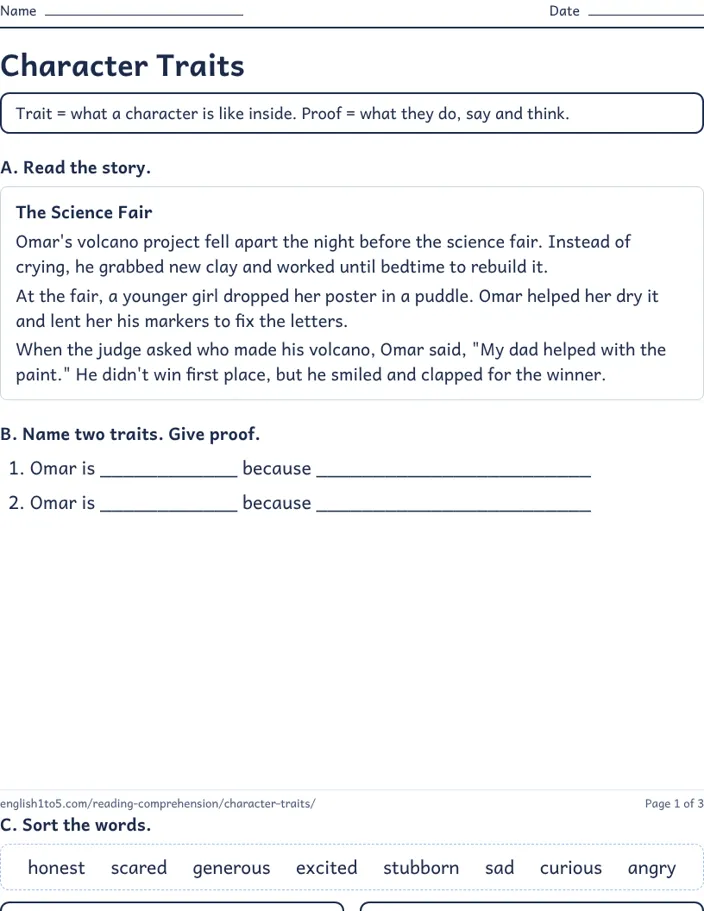
Character Traits Worksheet, 3rd–4th grade
Read a short story, name the main character's traits with proof, sort traits from feelings and match actions to traits. Prints on US Letter paper, with an answer key.
Download the PDFTry it at home
- Trait talk: what is this character like? How do you know?
- Because: always add proof.
- Movie characters: name three traits for the hero.
- Trait or feeling? sort words on cards.
- Kind words: name a trait you see in a family member.
What comes next
Next: cause and effect. Earlier: compare and contrast and story elements. Related grammar: adjectives.
Practice with a game
Free, no sign-up, and they work on phones, tablets and computers.
 How Do They Feel?
Last reviewed: November 11, 2026
Questions parents ask
What are character traits?
Words that describe what a character is like inside, like brave, honest, selfish or curious.
How do you find character traits?
Look at what the character does, says and thinks, then choose a trait the evidence supports.
What's the difference between a trait and a feeling?
A trait is part of who the character is and shows up again and again. A feeling is how they feel right now.
What grade learns character traits?
3rd grade describes traits, feelings and motivations (RL.3.3); 4th grade describes characters in depth (RL.4.3).
What are examples of character traits?
brave, kind, honest, generous, determined, curious, selfish, boastful, lazy and stubborn.