Finding the Theme of a Story
The theme is the big message or life lesson of a story, something true about life that goes beyond this one story. Common themes include never give up, honesty matters and true friends help each other.
Theme vs. topic vs. moral
The topic is what the story is about in a word or two: friendship, courage. The theme is what the story says about that topic, in a full sentence: "Real friends stand by you when things get hard." A fable's moral is a theme that's stated outright.
Most stories don't state their theme. You find it by looking at the main character's problem, how they respond and what they learn or how they change. If a character lies, gets in trouble, then tells the truth and feels better, the theme is probably about honesty.
Theme = the story's message about life, in a sentence.
Look at the problem, the response and what the character learns.
4th graders find a theme from details and summarize the text (RL.4.2); 5th graders also look at how characters respond to challenges and how a poem's speaker reflects on a topic (RL.5.2). Themes work for any reader, not just the character.
Common themes and story examples
A topic becomes a theme when you say what the story teaches about it.
| Topic | Theme (a full sentence) | Example story |
|---|---|---|
| perseverance | Keep trying, even when it's hard. | The Tortoise and the Hare |
| honesty | Telling the truth builds trust. | The Boy Who Cried Wolf |
| kindness | Small acts of kindness can come back to you. | The Lion and the Mouse |
| friendship | Real friends help each other. | Charlotte's Web |
| being yourself | Your differences can be your strengths. | Rudolph the Red-Nosed Reindeer |
| greed | Wanting too much can leave you with nothing. | The Golden Goose |
A theme should fit the whole story, not just one part, and it should be a lesson for everyone. "Omar should fix his volcano" is a plot detail; "Don't give up when things go wrong" is a theme.
Finding the theme
Jada wanted to win the class spelling bee more than anything. When her friend Kiara was nervous, Jada stayed after school to quiz her every day. At the bee, Kiara won and Jada came in second. Jada hugged her friend and said, "I'm so proud of you."
- Character: Jada.
- Problem: she wants to win, but her friend needs help.
- Response: she helps her friend anyway.
- Outcome: her friend wins.
- How she feels: proud, not jealous.
- Topic: friendship.
- Theme: Being a good friend matters more than winning.
- Not a theme: Kiara won the spelling bee. (that's a plot detail)
- Too narrow: Jada should quiz Kiara.
- Just a topic: friendship.
Detail-to-theme: Jada's actions (helping, hugging, being proud) are the evidence for the theme.
How to teach theme
Five short steps, about 10 minutes each.
- Start with morals. Fables state the lesson; read a few first.
- Name the topic. What big idea is this story about?
- Track the character. Problem, response, what they learn.
- Write a sentence. What does the story say about the topic?
- Check it. Does it fit the whole story? Is it a lesson for everyone?
Common mistakes and how to fix them
| Mistake | Why it happens | How to fix it |
|---|---|---|
| Gives the topic only | One word, not a message. | Ask: what does the story say about friendship? |
| Retells the plot | Plot vs. message. | Ask: what lesson could anyone learn? |
| Names a theme from one scene | Not the whole story. | Check the beginning, middle and end. |
| Uses names in the theme | Too specific. | Remove the names: make it about everyone. |
Practice: theme quiz
10 questions. Your child can tap the speaker to hear a question read aloud. The first try on each question counts toward the score.
-
1.What is a theme?
Show answer
The big message or life lesson of a story.
-
2.Which is a theme, not just a topic?
Show answer
Never give up, even when it's hard.
-
3.A theme of The Tortoise and the Hare:
Show answer
Keep trying and you can succeed.
-
4.What helps you find the theme?
Show answer
What the main character learns.
-
5.Jada helps her friend, who then beats her, and Jada is proud. The theme:
Show answer
Being a good friend matters more than winning.
-
6.Which is a plot detail, not a theme?
Show answer
Kiara won the spelling bee.
-
7.A boy lies, loses his friends' trust, then tells the truth. The theme is about...
Show answer
honesty.
-
8.Is the theme usually stated in the story?
Show answer
No, you usually figure it out.
-
9.Tap the topic word in this theme.
.
Show answer
Kindness.
-
10.Should a theme include character names?
Show answer
No.
Finding the Theme of a Story worksheet (free PDF)
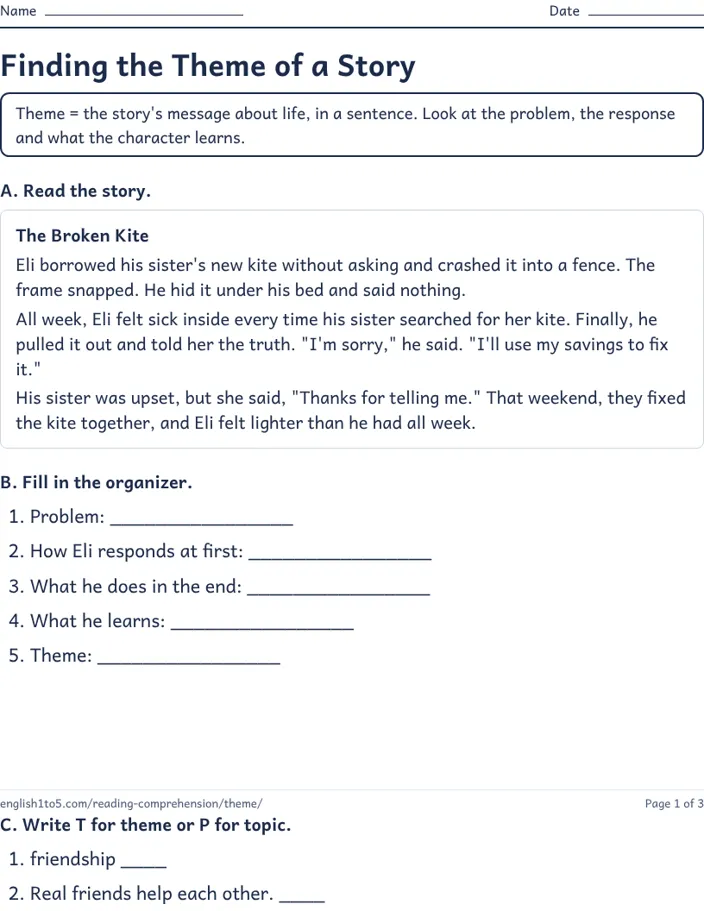
Finding the Theme of a Story Worksheet, 4th–5th grade
Read a short story, fill in a problem-response-lesson organizer, write the theme and sort themes from topics. Prints on US Letter paper, with an answer key.
Download the PDFTry it at home
- Movie theme: what lesson did the movie teach?
- Topic to theme: friendship → what about it?
- Change test: how did the character change?
- Song themes: what message does a favorite song send?
- No names: make the theme about everyone.
What comes next
Next: summarizing. Earlier: making inferences and fables and their lessons. Related: character traits.
Last reviewed: November 11, 2026
Questions parents ask
What is the theme of a story?
The big message or life lesson the story teaches, stated as a full sentence.
What's the difference between theme and topic?
The topic is a word or two (friendship). The theme is what the story says about it (Real friends help each other).
What's the difference between theme and moral?
A moral is a lesson stated directly, usually at the end of a fable. A theme is usually unstated and has to be figured out.
What grade learns theme?
4th and 5th grade (RL.4.2, RL.5.2), building on morals and central messages in 2nd and 3rd grade.
Can a story have more than one theme?
Yes. Longer stories often have several themes, all supported by details.