5th Grade Reading Comprehension
- 5th grade
- Common Core RL.5.1–RL.5.10
- 3 passages · 6 lessons
5th grade comprehension prepares kids for middle school: quoting the text to support inferences, finding themes, summarizing texts with more than one main idea, and comparing structures and points of view. The three passages on this page are a realistic story, a problem-and-solution text and a short play.
What kids learn in 5th grade reading comprehension
5th graders quote accurately from a text when explaining inferences, determine themes including how characters respond to challenges, and summarize texts with two or more main ideas.
They compare the structure of different texts, explain how a narrator's point of view shapes the story, and analyze how authors use evidence. Reading plays and poems continues, now with more focus on how they're built.
Expect written answers of several sentences, with a quote or specific detail as evidence.
5th grade reading passages
Three original passages written for 5th grade: a mix of stories, nonfiction and more. Your child reads the passage, answers the questions, then checks the answers. Each question practices a skill from the lessons below. Download all three as a printable PDF (with an answer key).
1. The Last Busstory
Theo had exactly three minutes to reach the bus stop. If he missed the 5:40, he'd miss his sister's first concert, and he had promised her he'd be there.
He was halfway down Elm Street when he saw it: an elderly man on the sidewalk, groceries scattered, one hand pressed to his knee. People hurried past, glancing at their phones.
Theo checked his watch. 5:38. He thought of his sister's nervous face that morning. Then he knelt down, gathered the oranges and helped the man to a bench. "Are you okay, sir?" The man nodded, smiling. "Thanks to you."
The bus roared past. Theo ran the whole two miles to the school. He slipped into the back row just as his sister walked on stage, and when she found his face in the crowd, her shoulders relaxed.
Questions
- What choice does Theo face? (story elements: characters, setting, events)
- How does the author show that other people didn't help? (making inferences)
- What is a theme? Use details to support it. (finding the theme of a story)
- What can you infer from "her shoulders relaxed"? (making inferences)
- Summarize the story. (how to summarize)
Show answers
- Help the man and risk missing the bus, or keep going to keep his promise.
- They hurried past, looking at their phones.
- Doing the right thing can mean sacrificing, but it can still work out: Theo helped the man and still made it.
- She was relieved and happy Theo came.
- Theo was rushing to his sister's concert when he stopped to help a fallen man. He missed the bus but ran to the school and arrived just in time.
2. Saving the Monarchsnonfiction
Each fall, millions of monarch butterflies fly up to 3,000 miles from Canada and the United States to the mountains of Mexico. It is one of the most amazing journeys in the animal world. But monarch numbers have dropped sharply over the last thirty years.
One major cause is the loss of milkweed. Monarch caterpillars can eat only milkweed, and many fields where it once grew have been plowed or paved. Without milkweed, monarchs can't lay eggs, and fewer caterpillars survive.
The good news is that people can help. Families and schools are planting milkweed in gardens, along roads and in parks. Scientists ask volunteers to count monarchs and report what they see, so they can track where the butterflies need the most help.
If enough people plant milkweed, the monarchs' great migration can continue for generations to come.
Questions
- What is the overall text structure? Explain. (text structure)
- What is one cause of the decline, and what is its effect? (cause and effect)
- State two main ideas of the text. (main idea and supporting details)
- Why does the author include the 3,000-mile journey? (author's purpose)
- Summarize the text in two sentences. (how to summarize)
Show answers
- Problem and solution: monarchs are declining (problem) and people plant milkweed and count butterflies (solution).
- Loss of milkweed; monarchs can't lay eggs and fewer caterpillars survive.
- Monarchs make an amazing migration but are declining; people can help by planting milkweed.
- To show how amazing monarchs are and make readers care.
- Monarch butterflies are declining because milkweed is disappearing. Planting milkweed and helping scientists count monarchs can protect them.
3. City Mouse, Country Mouse (a short play)play
CAST: COUNTRY MOUSE, CITY MOUSE. SETTING: A quiet barn, then a busy city kitchen.
Scene 1. (CITY MOUSE visits the barn.)
COUNTRY MOUSE: (proudly) Welcome! I saved you the best barley and corn.
CITY MOUSE: (nibbling politely) It's... plain. Come to the city. We feast every night!
Scene 2. (A fancy kitchen. Cake and cheese on the table.)
COUNTRY MOUSE: (amazed) I've never seen so much food!
(A door bangs. A cat hisses. Both mice dash into a hole.)
CITY MOUSE: (panting) That happens every night. You get used to it.
COUNTRY MOUSE: (shaking) Thank you, cousin, but I'd rather eat plain corn in peace than cake in fear. Goodbye!
Questions
- Name two features that show this is a play. (reading plays)
- How are the two settings different? (compare and contrast)
- What do the stage directions tell you about Country Mouse in Scene 2? (reading plays)
- What is the theme? (finding the theme of a story)
- Whose point of view do you agree with, and why? (point of view)
Show answers
- A cast list, scenes, dialogue with names, stage directions in parentheses.
- The barn is quiet and plain; the city kitchen is fancy but dangerous.
- He goes from amazed to scared (shaking).
- A simple, peaceful life is better than a rich life full of danger.
- Answers will vary.
5th grade reading lessons, in order
Each lesson takes about 10 minutes and has a quiz and a free worksheet with its own reading passage.
- 1. Point of ViewTelling first-person from third-person narration and comparing characters' points of view. RL.2.6, RL.3.6, RL.4.6, RL.5.6
- 2. Compare and ContrastComparing and contrasting characters, stories and texts using details. RL.2.9, RI.2.9, RL.3.9, RL.5.3
- 3. Making InferencesMaking inferences from text clues and background knowledge and supporting them with evidence. RL.3.1, RL.4.1, RI.4.1, RL.5.1
- 4. Finding the Theme of a StoryFinding a theme from details in a story, drama or poem. RL.4.2, RL.5.2
- 5. How to SummarizeSummarizing stories and nonfiction texts briefly and in their own words. RL.4.2, RI.4.2, RI.5.2
- 6. Text StructureIdentifying the five common nonfiction text structures and their signal words. RI.4.5, RI.5.5
What the standards say
These are the Common Core 5th grade reading literature and informational text standards this page covers. Most US states use the same or very similar goals.
- RI.5.2: Determine two or more main ideas of a text and explain how they are supported by key details; summarize the text.
- RI.5.5: Compare and contrast the overall structure (e.g., chronology, comparison, cause/effect, problem/solution) of events, ideas, concepts, or information in two or more texts.
- RL.5.1: Quote accurately from a text when explaining what the text says explicitly and when drawing inferences from the text.
- RL.5.2: Determine a theme of a story, drama, or poem from details in the text, including how characters in a story or drama respond to challenges or how the speaker in a poem reflects upon a topic; summarize the text.
- RL.5.3: Compare and contrast two or more characters, settings, or events in a story or drama, drawing on specific details in the text (e.g., how characters interact).
- RL.5.6: Describe how a narrator's or speaker's point of view influences how events are described.
A simple weekly plan
Ten to fifteen minutes a day is plenty. This rhythm works for most families; swap days around to fit your week.
| Day | What to do |
|---|---|
| Monday | Read passage 1 together and answer the questions. |
| Tuesday | Do a lesson and its quiz. |
| Wednesday | Read passage 2; answer with evidence. |
| Thursday | Read passage 3, or a library book, and talk about it. |
| Friday | Take the mixed quiz below. Revisit any skill your child missed. |
Mixed quiz
Ten questions drawn from the 5th grade lessons: point of view, compare and contrast, making inferences, finding the theme of a story, how to summarize, text structure. Tap the speaker to hear a question read aloud. Any question your child misses points to the lesson to revisit.
-
1.I grabbed my bike and rode away. What point of view is this?
Show answer
First person.
-
2.What does compare mean?
Show answer
Find how things are alike.
-
3.What is an inference?
Show answer
Figuring something out from clues and what you know.
-
4.What is a theme?
Show answer
The big message or life lesson of a story.
-
5.What is a summary?
Show answer
The most important parts in a few sentences.
-
6.What is text structure?
Show answer
How an author organizes information.
-
7.She grabbed her bike and rode away. What point of view is this?
Show answer
Third person.
-
8.What does contrast mean?
Show answer
Find how things are different.
-
9.Sam came in dripping wet with an umbrella. What can you infer?
Show answer
It's raining.
-
10.Which is a theme, not just a topic?
Show answer
Never give up, even when it's hard.
Printables
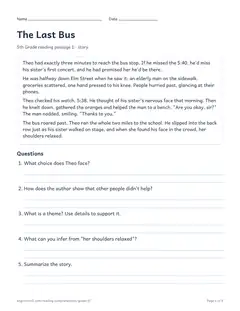 5th Grade reading passages (PDF)All three passages from this page, with questions and an answer key.
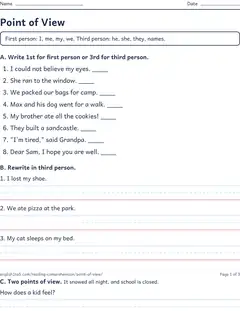 Point of ViewLabel sentences as first or third person, rewrite sentences, and describe one event from two characters' points of view.
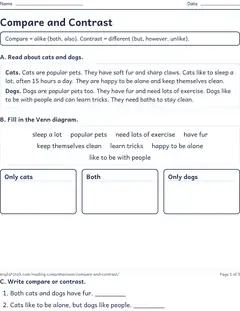 Compare and ContrastRead about cats and dogs, fill in a Venn diagram, label compare or contrast sentences and write your own.
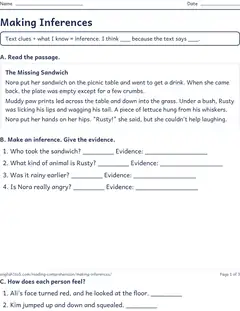 Making InferencesRead a short mystery, make inferences with evidence, fill in a clues-plus-knowledge chart and infer feelings.
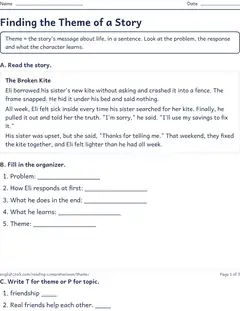 Finding the Theme of a StoryRead a short story, fill in a problem-response-lesson organizer, write the theme and sort themes from topics.
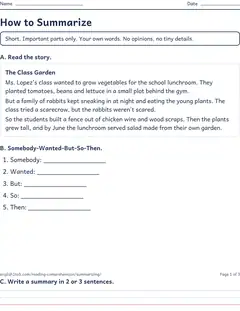 How to SummarizeRead a story and fill in Somebody-Wanted-But-So-Then, write a summary, then choose the best summary of a nonfiction passage.
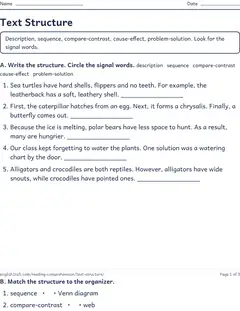 Text StructureLabel five short paragraphs by structure, circle signal words, match structures to organizers and write your own paragraph.
Practicing at home
Quote it
Ask your child to find the exact words that prove an answer.
Debate themes
Two people can find different themes; both need evidence.
Read the news together
Short articles are perfect for main ideas, structure and purpose.
Book talks
Discuss chapter books like a book club.
More 5th grade practice
See every reading and writing skill for the year on the 5th grade page. Earlier: 4th grade reading passages. All lessons: reading comprehension.
Practice with a game
Free, no sign-up, and they work on phones, tablets and computers.
 Reading Rocket
Last reviewed: November 11, 2026
Questions parents ask
What reading comprehension skills are taught in 5th grade?
Quoting text to support inferences, themes, summarizing texts with multiple main ideas, comparing text structures, point of view and author's evidence.
How long are 5th grade reading passages?
About 400 to 800 words.
What should 5th graders be reading?
Chapter books, nonfiction articles, poetry, plays and news written for kids.
My 5th grader reads but doesn't remember. What helps?
Pause to summarize each chapter in two sentences and talk about it.