3rd Grade Reading Comprehension
- 3rd grade
- Common Core RL.3.1–RL.3.10
- 3 passages · 13 lessons
3rd grade is the year kids shift from learning to read to reading to learn. The three passages on this page include a story about solving a problem, a nonfiction text about animals in winter and a persuasive text, with questions that ask kids to explain their thinking.
What kids learn in 3rd grade reading comprehension
3rd graders describe characters' traits and motivations, explain cause and effect in stories and science texts, find the main idea and how details support it, and tell their own view apart from an author's.
They also read different kinds of nonfiction, including persuasive texts, and start telling facts from opinions. Answers should refer directly to the text: "I know because the text says..."
Longer chapter books become common this year. Short passages like these are great for practicing the skills; real books are where kids use them.
3rd grade reading passages
Three original passages written for 3rd grade: a mix of stories, nonfiction and more. Your child reads the passage, answers the questions, then checks the answers. Each question practices a skill from the lessons below. Download all three as a printable PDF (with an answer key).
1. The Science Fair Surprisestory
Priya had worked on her volcano for two weeks. On the morning of the science fair, she carried it carefully to the gym.
When it was her turn, she poured in the vinegar. Nothing happened. Priya's face turned red. Kids started to whisper.
Priya took a deep breath. "I think I know what went wrong," she said. She checked the jar and found she had used salt instead of baking soda. She added the baking soda, and foam rushed over the top.
The judges didn't give her first place, but one wrote on her card: "Great problem solving!" Priya kept that card on her wall for years.
Questions
- What was Priya's problem? (story elements: characters, setting, events)
- What caused the problem? (cause and effect)
- Name a character trait for Priya and give proof. (character traits)
- How did Priya feel when nothing happened? How do you know? (making inferences)
- Why did Priya keep the card? (making inferences)
Show answers
- Her volcano didn't erupt.
- She used salt instead of baking soda.
- Calm or determined: she took a deep breath and figured out what went wrong.
- Embarrassed: her face turned red.
- She was proud of solving the problem.
2. Animals in Winternonfiction
Winter is hard for animals. Food is scarce and the weather is cold. Animals have different ways to survive.
Some animals migrate, or travel to warmer places. Many birds fly south each fall and return in spring.
Other animals hibernate. Bears, bats and woodchucks go into a deep sleep. Their hearts beat slowly, so they use very little energy.
Some animals adapt and stay active. Snowshoe hares grow white fur to hide in the snow, and squirrels eat nuts they buried in the fall.
Questions
- What is the main idea? (main idea and supporting details)
- What does migrate mean? (key details)
- Why do hibernating animals use little energy? (cause and effect)
- Compare: how are bears and squirrels different in winter? (compare and contrast)
- Is this text written to inform, persuade or entertain? (author's purpose)
Show answers
- Animals have different ways to survive winter.
- To travel to a warmer place.
- Their hearts beat slowly in a deep sleep.
- Bears hibernate; squirrels stay active and eat stored nuts.
- Inform.
3. Should Our School Have a Garden?nonfiction
Our school should build a garden. A garden would teach us where food comes from. We could plant seeds, water them and watch them grow.
A garden would also help us eat healthier. Kids are more likely to try vegetables they grew themselves.
Some people say a garden is too much work. But each class could take one week to care for it, so no one would have too much to do.
A school garden is the best way to learn outside the classroom. Let's start one this spring!
Questions
- What does the author want? (author's purpose)
- What is the author's purpose? (author's purpose)
- Write one fact from the text. (fact and opinion)
- Write one opinion from the text. (fact and opinion)
- What reason does the author give against the garden, and how do they answer it? (main idea and supporting details)
Show answers
- A school garden.
- To persuade.
- Answers will vary, such as: seeds need water to grow.
- A school garden is the best way to learn outside the classroom.
- Some say it's too much work; each class could take one week.
3rd grade reading lessons, in order
Each lesson takes about 10 minutes and has a quiz and a free worksheet with its own reading passage.
- 1. Key DetailsFinding the key details in a text and telling them apart from less important ones. RI.1.2, RI.2.1, RI.3.1, RI.3.2
- 2. Text FeaturesUsing nonfiction text features to find and understand information. RI.1.5, RI.2.5, RI.3.5
- 3. Fables and Their LessonsRecounting fables and figuring out their moral or lesson. RL.2.2, RL.3.2
- 4. Main Idea and Supporting DetailsFinding the main idea of a paragraph or text and the details that support it. RI.2.2, RI.3.2, RI.4.2
- 5. Author's PurposeFiguring out whether an author wrote to inform, persuade or entertain. RI.2.6, RI.3.6, RI.4.8
- 6. Point of ViewTelling first-person from third-person narration and comparing characters' points of view. RL.2.6, RL.3.6, RL.4.6, RL.5.6
- 7. Compare and ContrastComparing and contrasting characters, stories and texts using details. RL.2.9, RI.2.9, RL.3.9, RL.5.3
- 8. Character TraitsDescribing characters' traits and feelings using evidence from their actions, words and thoughts. RL.3.3, RL.4.3
- 9. Cause and EffectFinding causes and effects in stories and nonfiction using signal words. RI.3.3, RI.3.8, RL.3.3
- 10. Fact and OpinionTelling facts from opinions and spotting opinion clue words. RI.3.6, RI.4.8, RI.5.8
- 11. Making InferencesMaking inferences from text clues and background knowledge and supporting them with evidence. RL.3.1, RL.4.1, RI.4.1, RL.5.1
- 12. Reading PoemsNaming the parts of a poem and explaining how poems differ from prose. RL.3.5, RL.4.5, RL.4.2
- 13. Reading PlaysNaming the parts of a play and explaining how drama differs from stories. RL.3.5, RL.4.5, RL.5.3
What the standards say
These are the Common Core 3rd grade reading literature and informational text standards this page covers. Most US states use the same or very similar goals.
- RI.3.1: Ask and answer questions to demonstrate understanding of a text, referring explicitly to the text as the basis for the answers.
- RI.3.2: Determine the main idea of a text; recount the key details and explain how they support the main idea.
- RI.3.3: Describe the relationship between a series of historical events, scientific ideas or concepts, or steps in technical procedures in a text, using language that pertains to time, sequence, and cause/effect.
- RI.3.5: Use text features and search tools (e.g., key words, sidebars, hyperlinks) to locate information relevant to a given topic efficiently.
- RI.3.6: Distinguish their own point of view from that of the author of a text.
- RI.3.8: Describe the logical connection between particular sentences and paragraphs in a text (e.g., comparison, cause/effect, first/second/third in a sequence).
- RL.3.1: Ask and answer questions to demonstrate understanding of a text, referring explicitly to the text as the basis for the answers.
- RL.3.2: Recount stories, including fables, folktales, and myths from diverse cultures; determine the central message, lesson, or moral and explain how it is conveyed through key details in the text.
- RL.3.3: Describe characters in a story (e.g., their traits, motivations, or feelings) and explain how their actions contribute to the sequence of events.
- RL.3.5: Refer to parts of stories, dramas, and poems when writing or speaking about a text, using terms such as chapter, scene, and stanza; describe how each successive part builds on earlier sections.
- RL.3.6: Distinguish their own point of view from that of the narrator or those of the characters.
- RL.3.9: Compare and contrast the themes, settings, and plots of stories written by the same author about the same or similar characters (e.g., in books from a series).
A simple weekly plan
Ten to fifteen minutes a day is plenty. This rhythm works for most families; swap days around to fit your week.
| Day | What to do |
|---|---|
| Monday | Read passage 1 together and answer the questions. |
| Tuesday | Do a lesson and its quiz. |
| Wednesday | Read passage 2; answer with evidence. |
| Thursday | Read passage 3, or a library book, and talk about it. |
| Friday | Take the mixed quiz below. Revisit any skill your child missed. |
Mixed quiz
Ten questions drawn from the 3rd grade lessons: key details, text features, fables and their lessons, main idea and supporting details, author's purpose, point of view and more. Tap the speaker to hear a question read aloud. Any question your child misses points to the lesson to revisit.
-
1.What are key details?
Show answer
The most important facts in a text.
-
2.Where do you find what a bold word means?
Show answer
The glossary.
-
3.What is a fable?
Show answer
A short story that teaches a lesson.
-
4.What is the main idea?
Show answer
What a text is mostly about.
-
5.What does PIE stand for?
Show answer
Persuade, inform, entertain.
-
6.I grabbed my bike and rode away. What point of view is this?
Show answer
First person.
-
7.What does compare mean?
Show answer
Find how things are alike.
-
8.What is a character trait?
Show answer
What a character is like inside.
-
9.What is a cause?
Show answer
Why something happens.
-
10.What is a fact?
Show answer
Something that can be proved true.
Printables
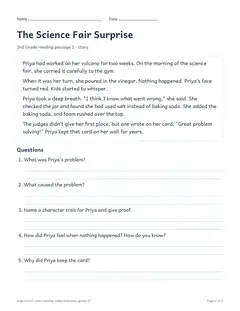 3rd Grade reading passages (PDF)All three passages from this page, with questions and an answer key.
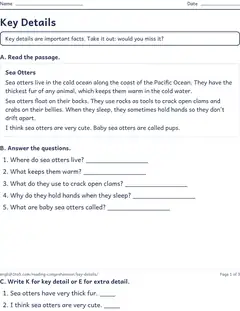 Key DetailsRead a short nonfiction passage, answer key detail questions, and sort details into key or extra.
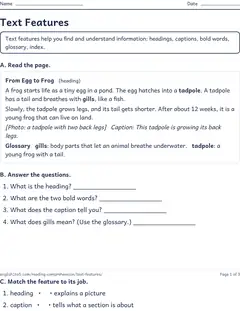 Text FeaturesRead a mini nonfiction page, find its text features, match features to their jobs and choose the right feature.
 Fables and Their LessonsRead a fable, answer questions about the character and problem, choose the moral and match fables to their lessons.
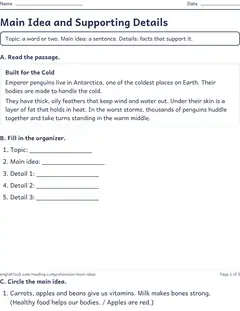 Main Idea and Supporting DetailsRead a passage, write the topic, main idea and three details, choose main ideas and find the detail that doesn't belong.
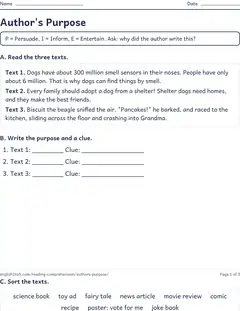 Author's PurposeRead three short texts on one topic, label each purpose, sort real-world texts and write your own.
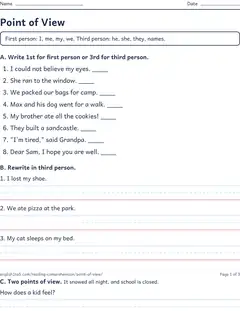 Point of ViewLabel sentences as first or third person, rewrite sentences, and describe one event from two characters' points of view.
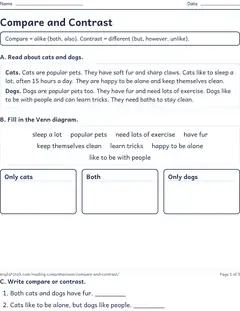 Compare and ContrastRead about cats and dogs, fill in a Venn diagram, label compare or contrast sentences and write your own.
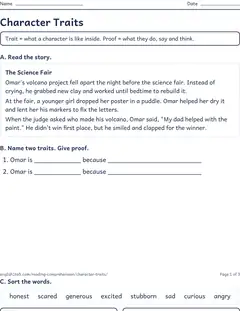 Character TraitsRead a short story, name the main character's traits with proof, sort traits from feelings and match actions to traits.
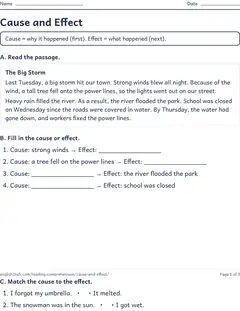 Cause and EffectRead a short passage, fill in cause and effect boxes, match causes to effects and finish a cause-and-effect chain.
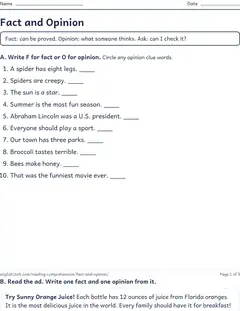 Fact and OpinionLabel sentences as fact or opinion, circle clue words, find facts and opinions in a short ad and write one of each.
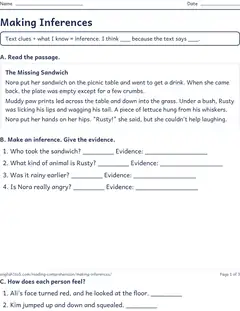 Making InferencesRead a short mystery, make inferences with evidence, fill in a clues-plus-knowledge chart and infer feelings.
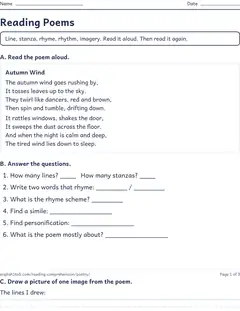 Reading PoemsRead an original poem, count lines and stanzas, find rhymes, imagery and personification, and write two rhyming lines.
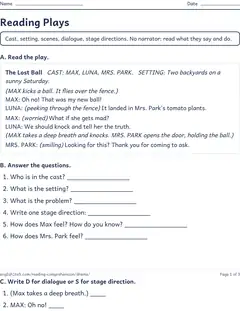 Reading PlaysRead a short play, find the cast, setting, dialogue and stage directions, and write the next lines.
Practicing at home
Ask for evidence
"How do you know?" after every answer.
Talk about characters
What is the character like? How do their choices change the story?
Read persuasive texts
Ads and letters are great for fact vs. opinion.
Read nonfiction
Science and history articles build knowledge and vocabulary.
More 3rd grade practice
See every reading and writing skill for the year on the 3rd grade page. Earlier: 2nd grade reading passages. Next: 4th grade reading passages. All lessons: reading comprehension.
Practice with a game
Free, no sign-up, and they work on phones, tablets and computers.
 Point of View Sort
 Main Idea Machine
 Cause and Effect Connect
 Author's Purpose PIE
Last reviewed: November 11, 2026
Questions parents ask
What reading comprehension skills are taught in 3rd grade?
Character traits and motivations, cause and effect, main idea and key details, author's point of view, fact and opinion, and using text features and evidence.
How long are 3rd grade reading passages?
About 200 to 400 words.
Why is 3rd grade such a big reading year?
Kids are now expected to learn from what they read in every subject, so comprehension becomes essential.
What if my 3rd grader struggles with comprehension?
Read together, stop to talk, and check that decoding isn't the problem. Slow reading makes understanding harder.