2nd Grade Reading Comprehension
- 2nd grade
- Common Core RL.2.1–RL.2.10
- 3 passages · 12 lessons
2nd graders read longer texts and start thinking about the why behind them: the lesson of a fable, the main topic of each paragraph, the author's purpose and how characters respond. The three passages on this page include a fable, a nonfiction text and a realistic story.
What kids learn in 2nd grade reading comprehension
The big new skills are finding the moral or lesson of a story, identifying the main topic of a multi-paragraph text and the focus of each paragraph, and figuring out why an author wrote something.
2nd graders also compare two versions of the same story, use text features like captions and bold words, and describe how characters respond to problems. Questions now ask for reasons, not just facts.
Encourage your child to answer in full sentences and point to the part of the text that proves it.
2nd grade reading passages
Three original passages written for 2nd grade: two stories and a nonfiction text. Your child reads the passage, answers the questions, then checks the answers. Each question practices a skill from the lessons below. Download all three as a printable PDF (with an answer key).
1. The Fox and the Crowstory
A crow found a piece of cheese and flew up to a branch to eat it. A hungry fox saw her and wanted that cheese.
"Good morning, beautiful crow," said the fox. "Your feathers are so shiny. I bet your voice is the loveliest in the forest. Won't you sing for me?"
The crow was so pleased that she opened her beak to sing. The cheese fell right into the fox's mouth.
"Thank you," said the fox, licking his lips. "Next time, don't trust someone who flatters you."
Questions
- What did the fox want? (story elements: characters, setting, events)
- How did the fox trick the crow? (cause and effect)
- What kind of story is this? How do you know? (fables and their lessons)
- What is the moral? (fables and their lessons)
- Use one word to describe the fox. (character traits)
Show answers
- The crow's cheese.
- He said nice things and asked her to sing, so she dropped the cheese.
- A fable: it is short, has talking animals and teaches a lesson.
- Don't trust someone who flatters you.
- Sneaky or clever.
2. How Bees Make Honeynonfiction
Honeybees live together in a hive. Each hive has one queen and thousands of worker bees.
Worker bees fly from flower to flower, sipping a sweet juice called nectar. They carry it back to the hive.
Inside, the bees put the nectar into tiny wax rooms called cells. They fan their wings to dry it out. Slowly, the nectar turns thick and sticky. Now it is honey!
Bees save the honey to eat in winter, when there are no flowers.
Questions
- What is the main topic? (main idea and supporting details)
- What is nectar? (key details)
- What do bees do after they put nectar in the cells? (sequencing: first, next, last)
- Why do bees save honey? (cause and effect)
- Which text feature would help you find the word nectar fast? (text features)
Show answers
- How bees make honey.
- A sweet juice in flowers.
- Fan their wings to dry it.
- To eat in winter when there are no flowers.
- A glossary (or bold print).
3. The New Kidstory
On Monday, a new girl named Ana sat alone at lunch. She looked down at her tray and didn't eat much.
Jacob noticed. He remembered his first day at a new school, when no one talked to him. He picked up his tray and walked over.
"Hi, I'm Jacob. Want to sit with us?" Ana smiled for the first time all day.
By Friday, Ana was laughing with Jacob's whole table. She even taught them a game from her old school.
Questions
- How did Ana feel on Monday? How do you know? (making inferences)
- Why did Jacob go over to Ana? (cause and effect)
- How did things change by Friday? (sequencing: first, next, last)
- What is a lesson from this story? (fables and their lessons)
- How are Ana and Jacob alike? (compare and contrast)
Show answers
- Lonely or sad: she sat alone and didn't eat much.
- He remembered how it felt to be new.
- Ana had friends and was laughing.
- Being kind to someone new can make a big difference.
- Both were new at a school once.
2nd grade reading lessons, in order
Each lesson takes about 10 minutes and has a quiz and a free worksheet with its own reading passage.
- 1. Asking and Answering QuestionsAsking and answering who, what, where, when, why and how questions about a text. RL.K.1, RL.1.1, RL.2.1
- 2. Story Elements: Characters, Setting, EventsFinding the characters, setting, problem, events and solution in a story. RL.K.3, RL.1.3, RL.2.5
- 3. Sequencing: First, Next, LastPutting events from a story or how-to text in order using sequence words. RL.1.3, RL.2.5, RI.2.3
- 4. Making PredictionsMaking and checking predictions using clues from the text and pictures. RL.K.7, RL.1.7, RL.2.7
- 5. Key DetailsFinding the key details in a text and telling them apart from less important ones. RI.1.2, RI.2.1, RI.3.1, RI.3.2
- 6. Text FeaturesUsing nonfiction text features to find and understand information. RI.1.5, RI.2.5, RI.3.5
- 7. Fables and Their LessonsRecounting fables and figuring out their moral or lesson. RL.2.2, RL.3.2
- 8. Main Idea and Supporting DetailsFinding the main idea of a paragraph or text and the details that support it. RI.2.2, RI.3.2, RI.4.2
- 9. Author's PurposeFiguring out whether an author wrote to inform, persuade or entertain. RI.2.6, RI.3.6, RI.4.8
- 10. Point of ViewTelling first-person from third-person narration and comparing characters' points of view. RL.2.6, RL.3.6, RL.4.6, RL.5.6
- 11. Compare and ContrastComparing and contrasting characters, stories and texts using details. RL.2.9, RI.2.9, RL.3.9, RL.5.3
- 12. Fact and OpinionTelling facts from opinions and spotting opinion clue words. RI.3.6, RI.4.8, RI.5.8
What the standards say
These are the Common Core 2nd grade reading literature and informational text standards this page covers. Most US states use the same or very similar goals.
- RI.2.1: Ask and answer such questions as who, what, where, when, why, and how to demonstrate understanding of key details in a text.
- RI.2.2: Identify the main topic of a multiparagraph text as well as the focus of specific paragraphs within the text.
- RI.2.3: Describe the connection between a series of historical events, scientific ideas or concepts, or steps in technical procedures in a text.
- RI.2.5: Know and use various text features (e.g., captions, bold print, subheadings, glossaries, indexes, electronic menus, icons) to locate key facts or information in a text efficiently.
- RI.2.6: Identify the main purpose of a text, including what the author wants to answer, explain, or describe.
- RI.2.9: Compare and contrast the most important points presented by two texts on the same topic.
- RL.2.1: Ask and answer such questions as who, what, where, when, why, and how to demonstrate understanding of key details in a text.
- RL.2.2: Recount stories, including fables and folktales from diverse cultures, and determine their central message, lesson, or moral.
- RL.2.5: Describe the overall structure of a story, including describing how the beginning introduces the story and the ending concludes the action.
- RL.2.6: Acknowledge differences in the points of view of characters, including by speaking in a different voice for each character when reading dialogue aloud.
- RL.2.7: Use information gained from the illustrations and words in a print or digital text to demonstrate understanding of its characters, setting, or plot.
- RL.2.9: Compare and contrast two or more versions of the same story (e.g., Cinderella stories) by different authors or from different cultures.
A simple weekly plan
Ten to fifteen minutes a day is plenty. This rhythm works for most families; swap days around to fit your week.
| Day | What to do |
|---|---|
| Monday | Read passage 1 together and answer the questions. |
| Tuesday | Do a lesson and its quiz. |
| Wednesday | Read passage 2; answer with evidence. |
| Thursday | Read passage 3, or a library book, and talk about it. |
| Friday | Take the mixed quiz below. Revisit any skill your child missed. |
Mixed quiz
Ten questions drawn from the 2nd grade lessons: asking and answering questions, story elements: characters, setting, events, sequencing: first, next, last, making predictions, key details, text features and more. Tap the speaker to hear a question read aloud. Any question your child misses points to the lesson to revisit.
-
1.Which question word asks about a place?
Show answer
Where.
-
2.What are characters?
Show answer
The people or animals in a story.
-
3.What does sequencing mean?
Show answer
Putting events in order.
-
4.What is a prediction?
Show answer
A smart guess about what will happen next.
-
5.What are key details?
Show answer
The most important facts in a text.
-
6.Where do you find what a bold word means?
Show answer
The glossary.
-
7.What is a fable?
Show answer
A short story that teaches a lesson.
-
8.What is the main idea?
Show answer
What a text is mostly about.
-
9.What does PIE stand for?
Show answer
Persuade, inform, entertain.
-
10.I grabbed my bike and rode away. What point of view is this?
Show answer
First person.
Printables
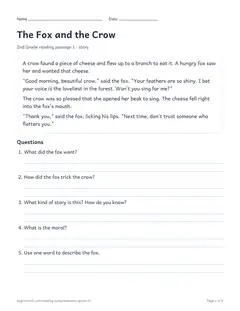 2nd Grade reading passages (PDF)All three passages from this page, with questions and an answer key.
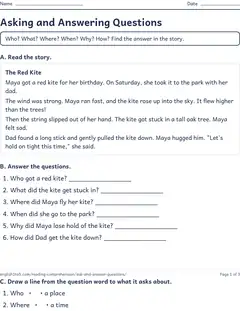 Asking and Answering QuestionsRead a short story, answer who, what, where, when, why and how questions, and write your own question.
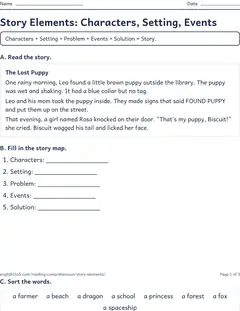 Story Elements: Characters, Setting, EventsRead a short story, fill in a story map, and sort words into characters and settings.
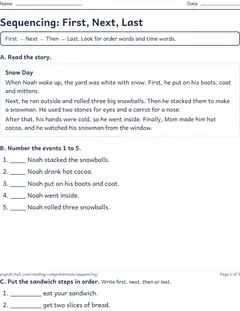 Sequencing: First, Next, LastNumber story events in order, order the steps for making a sandwich, and write your own sequence.
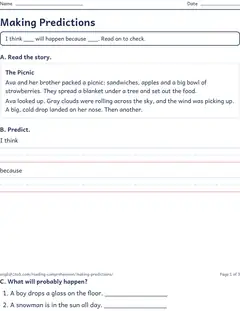 Making PredictionsRead a story that stops at an exciting part, predict what happens, find the clue, then check the ending.
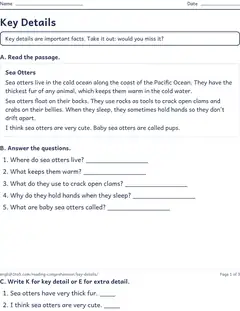 Key DetailsRead a short nonfiction passage, answer key detail questions, and sort details into key or extra.
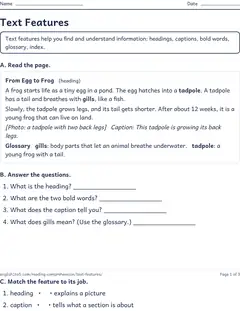 Text FeaturesRead a mini nonfiction page, find its text features, match features to their jobs and choose the right feature.
 Fables and Their LessonsRead a fable, answer questions about the character and problem, choose the moral and match fables to their lessons.
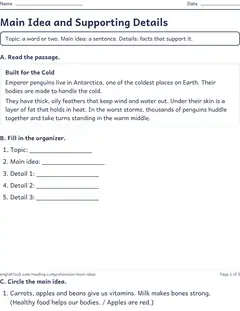 Main Idea and Supporting DetailsRead a passage, write the topic, main idea and three details, choose main ideas and find the detail that doesn't belong.
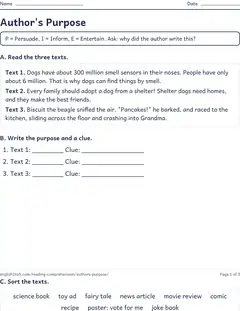 Author's PurposeRead three short texts on one topic, label each purpose, sort real-world texts and write your own.
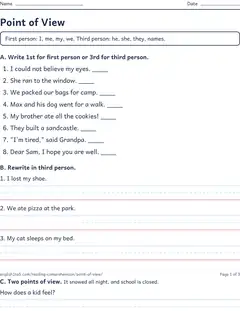 Point of ViewLabel sentences as first or third person, rewrite sentences, and describe one event from two characters' points of view.
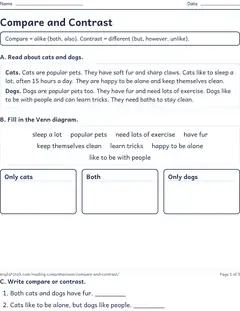 Compare and ContrastRead about cats and dogs, fill in a Venn diagram, label compare or contrast sentences and write your own.
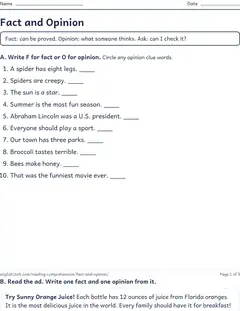 Fact and OpinionLabel sentences as fact or opinion, circle clue words, find facts and opinions in a short ad and write one of each.
Practicing at home
Ask why
Why did the character do that? Why did the author write this?
Find the lesson
After a story, ask what the character learned.
Read two versions
Compare two Cinderella or Three Little Pigs stories.
Prove it
Point to the sentence that supports the answer.
More 2nd grade practice
See every reading and writing skill for the year on the 2nd grade page. Earlier: 1st grade reading passages. Next: 3rd grade reading passages. All lessons: reading comprehension.
Last reviewed: November 11, 2026
Questions parents ask
What reading comprehension skills are taught in 2nd grade?
Asking and answering who, what, where, when, why and how; finding a story's lesson; main topic; author's purpose; text features; and comparing versions of stories.
How long are 2nd grade reading passages?
About 150 to 300 words, several paragraphs.
What kinds of texts should 2nd graders read?
A mix of stories, fables, folktales and nonfiction about science and history.
How do I know if a passage is the right level?
Your child should read most words correctly and be able to retell it. If not, read it together first.