Sequencing: First, Next, Last
Sequencing means putting events in the order they happen. Stories, recipes and science texts all have an order, and words like first, next, then and last help readers follow it.
Why order matters
Change the order of a story and it stops making sense: the kite can't get stuck before Maya flies it. Kids who track sequence understand cause and effect, can retell stories well, and can follow instructions.
Sequence words (also called signal or transition words) are clues: first, next, then, after that, later, finally, last. Times and days are clues too: in the morning, on Monday, the next day. Some texts have numbered steps, like a recipe.
First → Next → Then → Last
Look for order words and time words.
1st graders describe major events in order (RL.1.3), and 2nd graders explain how a story's beginning and ending fit together (RL.2.5) and follow steps in informational texts (RI.2.3). Kids use the same words in how-to writing.
Sequence words
Look for these words when you read.
| Beginning | Middle | End |
|---|---|---|
| first | next | last |
| to start | then | finally |
| in the beginning | after that | at the end |
| once upon a time | later | in the end |
| one morning | the next day | that night |
Not every text uses these words. Then kids have to think: what had to happen before this?
Putting events in order
How to plant a seed. The steps are out of order, then in order.
- Out of order: Water the seed. Dig a hole. Wait for it to grow. Put the seed in.
- First, dig a small hole.
- Next, put the seed in the hole.
- Then, cover it with soil and water it.
- Last, wait for it to grow.
- The Red Kite in order: First, Maya got a kite.
- Next, she flew it at the park.
- Then, the kite got stuck in a tree.
- After that, Dad pulled it down.
- Finally, Maya hugged Dad.
To check a sequence, read it aloud. Does each step need the one before it?
How to teach sequencing
Five short steps, about 10 minutes each.
- Daily routines. What do you do first when you wake up? Next? Last?
- Picture cards. Cut up a comic strip and put it back in order.
- Find the words. Underline first, next, then and last in a text.
- Follow a recipe. Make a snack, reading each step in order.
- Retell with order words. First, next, then, finally.
Common mistakes and how to fix them
| Mistake | Why it happens | How to fix it |
|---|---|---|
| Lists events in the order they remember | Not using the text. | Go back and check: what came before? |
| Skips the middle | Remembers the start and end best. | Ask: what happened between? |
| Ignores order words | Not noticing signal words. | Underline them before ordering. |
| Can't sequence without order words | Needs clues. | Ask: what had to happen first? |
Practice: sequencing quiz
10 questions. Your child can tap the speaker to hear a question read aloud. The first try on each question counts toward the score.
-
1.What does sequencing mean?
Show answer
Putting events in order.
-
2.Which word tells what happens last?
Show answer
finally.
-
3.Which comes first when you plant a seed?
Show answer
Dig a hole.
-
4.Tap the sequence word.
, .
Show answer
Next.
-
5.What comes right after you put on your socks?
Show answer
Put on your shoes.
-
6.In The Red Kite, what happened before the kite got stuck?
Show answer
The string slipped.
-
7.Which order is right?
Show answer
egg, chick, hen.
-
8.Tap the sequence word.
, .
Show answer
Finally.
-
9.Which word goes in the middle of a story?
Show answer
then.
-
10.Which order makes sense?
Show answer
Wake up, eat breakfast, go to school.
Sequencing: First, Next, Last worksheet (free PDF)
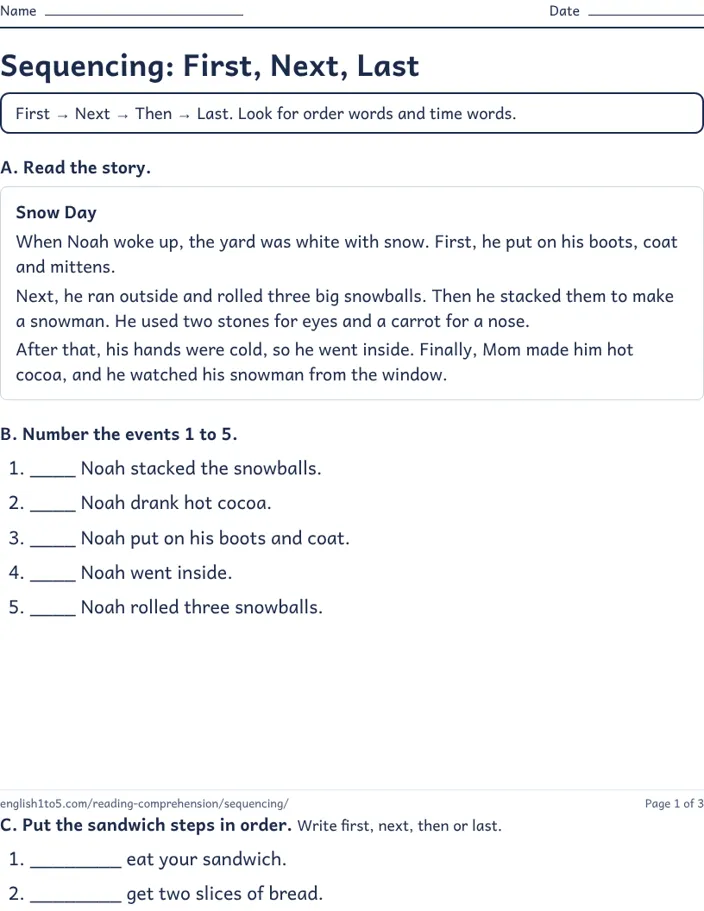
Sequencing: First, Next, Last Worksheet, 1st–2nd grade
Number story events in order, order the steps for making a sandwich, and write your own sequence. Prints on US Letter paper, with an answer key.
Download the PDFTry it at home
- Morning routine: say it with first, next, last.
- Cook together: read a recipe in order.
- Comic cut-ups: put the panels back in order.
- Photo order: sort vacation photos by time.
- Retell a show: use order words.
What comes next
Next: making predictions. Earlier: story elements. Related writing: how-to writing. Related grammar: past tense verbs.
Last reviewed: November 11, 2026
Questions parents ask
What is sequencing in reading?
Putting the events of a story or the steps of a process in the order they happen.
What are sequence words?
Words that show order, like first, next, then, after that, later, finally and last.
What grade learns sequencing?
1st and 2nd grade, with practice continuing in later grades (RL.1.3, RL.2.5, RI.2.3).
Why is sequencing important?
It helps kids retell stories, follow directions, understand cause and effect and write in order.
How can I practice sequencing at home?
Talk through daily routines, cook from recipes, and retell stories and shows with first, next, then and last.