1st Grade Reading Comprehension
- 1st grade
- Common Core RL.1.1–RL.1.10
- 3 passages · 7 lessons
1st grade is when children start reading stories on their own and understanding them. The three passages on this page are written at a 1st grade level, with questions about key details, the order of events and story elements, plus a nonfiction passage about frogs.
What kids learn in 1st grade reading comprehension
1st graders ask and answer questions about key details, retell stories with the important parts, and describe characters, settings and events. In nonfiction, they find the main topic and retell key details, and start using text features like headings and bold words.
Comprehension and decoding grow together. If a passage is too hard to sound out, read it aloud first, then let your child reread it. Understanding matters more than reading every word perfectly.
Talk about what you read, every time. Questions like "Why did she do that?" and "What do you think happens next?" build thinking that worksheets can't.
1st grade reading passages
Three original passages written for 1st grade: two stories and a nonfiction text. Your child reads the passage, answers the questions, then checks the answers. Each question practices a skill from the lessons below. Download all three as a printable PDF (with an answer key).
1. The Lost Mittenstory
It was a snowy day. Lily wore her new blue mittens to the park.
She made a snowman with a carrot nose. When she was done, one mitten was gone!
Lily looked in the snow. She looked by the slide. Then she looked at her snowman. Her blue mitten was on its head like a little hat!
Lily laughed. "You can keep it until we go home," she said.
Questions
- Where did Lily go? (story elements: characters, setting, events)
- What was Lily's problem? (story elements: characters, setting, events)
- Where did she look first? (sequencing: first, next, last)
- Where was the mitten? (asking and answering questions)
- Retell the story in three sentences. (retelling a story)
Show answers
- To the park.
- One mitten was missing.
- In the snow.
- On the snowman's head.
- Lily made a snowman and lost a mitten. She looked for it. It was on the snowman's head.
2. All About Frogsnonfiction
Frogs live near ponds and rivers. They have long back legs for jumping.
A frog starts as a tiny egg in the water. The egg hatches into a tadpole with a tail.
The tadpole grows legs, and its tail gets shorter. Soon it is a frog!
Frogs catch bugs with their long, sticky tongues.
Questions
- Where do frogs live? (key details)
- Why do frogs have long back legs? (key details)
- What hatches from a frog egg? (sequencing: first, next, last)
- How do frogs catch bugs? (key details)
- What is this text mostly about? (key details)
Show answers
- Near ponds and rivers.
- For jumping.
- A tadpole.
- With their long, sticky tongues.
- Frogs: where they live, how they grow and what they eat.
3. Ben's Gardenstory
Ben wanted to grow a sunflower. Grandma gave him a seed.
First, Ben dug a hole. Next, he put the seed in and covered it with dirt. Then he watered it every day.
Days went by. Nothing happened. Ben felt sad.
One morning, Ben saw a tiny green sprout! By summer, the sunflower was taller than Ben.
Questions
- What did Ben want to grow? (asking and answering questions)
- What did Ben do first? (sequencing: first, next, last)
- Why did Ben feel sad? (asking and answering questions)
- Predict: what might Ben grow next year? (making predictions)
- What happened at the end? (retelling a story)
Show answers
- A sunflower.
- He dug a hole.
- Nothing happened for days.
- Answers will vary, such as more sunflowers.
- The sunflower grew taller than Ben.
1st grade reading lessons, in order
Each lesson takes about 10 minutes and has a quiz and a free worksheet with its own reading passage.
- 1. Asking and Answering QuestionsAsking and answering who, what, where, when, why and how questions about a text. RL.K.1, RL.1.1, RL.2.1
- 2. Retelling a StoryRetelling a story in order with the key details. RL.K.2, RL.1.2
- 3. Story Elements: Characters, Setting, EventsFinding the characters, setting, problem, events and solution in a story. RL.K.3, RL.1.3, RL.2.5
- 4. Sequencing: First, Next, LastPutting events from a story or how-to text in order using sequence words. RL.1.3, RL.2.5, RI.2.3
- 5. Making PredictionsMaking and checking predictions using clues from the text and pictures. RL.K.7, RL.1.7, RL.2.7
- 6. Key DetailsFinding the key details in a text and telling them apart from less important ones. RI.1.2, RI.2.1, RI.3.1, RI.3.2
- 7. Text FeaturesUsing nonfiction text features to find and understand information. RI.1.5, RI.2.5, RI.3.5
What the standards say
These are the Common Core 1st grade reading literature and informational text standards this page covers. Most US states use the same or very similar goals.
- RI.1.2: Identify the main topic and retell key details of a text.
- RI.1.5: Know and use various text features (e.g., headings, tables of contents, glossaries, electronic menus, icons) to locate key facts or information in a text.
- RL.1.1: Ask and answer questions about key details in a text.
- RL.1.2: Retell stories, including key details, and demonstrate understanding of their central message or lesson.
- RL.1.3: Describe characters, settings, and major events in a story, using key details.
- RL.1.7: Use illustrations and details in a story to describe its characters, setting, or events.
A simple weekly plan
Ten to fifteen minutes a day is plenty. This rhythm works for most families; swap days around to fit your week.
| Day | What to do |
|---|---|
| Monday | Read passage 1 together and answer the questions. |
| Tuesday | Do a lesson and its quiz. |
| Wednesday | Read passage 2; answer with evidence. |
| Thursday | Read passage 3, or a library book, and talk about it. |
| Friday | Take the mixed quiz below. Revisit any skill your child missed. |
Mixed quiz
Ten questions drawn from the 1st grade lessons: asking and answering questions, retelling a story, story elements: characters, setting, events, sequencing: first, next, last, making predictions, key details and more. Tap the speaker to hear a question read aloud. Any question your child misses points to the lesson to revisit.
-
1.Which question word asks about a place?
Show answer
Where.
-
2.What does it mean to retell a story?
Show answer
Tell it again in your own words.
-
3.What are characters?
Show answer
The people or animals in a story.
-
4.What does sequencing mean?
Show answer
Putting events in order.
-
5.What is a prediction?
Show answer
A smart guess about what will happen next.
-
6.What are key details?
Show answer
The most important facts in a text.
-
7.Where do you find what a bold word means?
Show answer
The glossary.
-
8.Which question word asks about a person?
Show answer
Who.
-
9.What are the three parts of a retell?
Show answer
Beginning, middle, end.
-
10.What is the setting?
Show answer
Where and when the story happens.
Printables
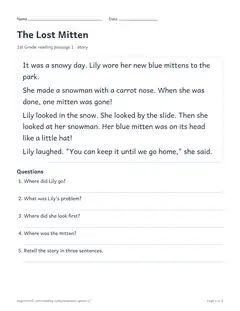 1st Grade reading passages (PDF)All three passages from this page, with questions and an answer key.
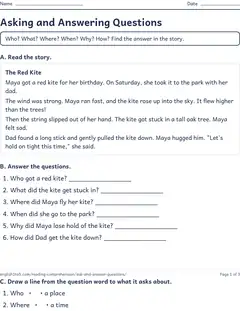 Asking and Answering QuestionsRead a short story, answer who, what, where, when, why and how questions, and write your own question.
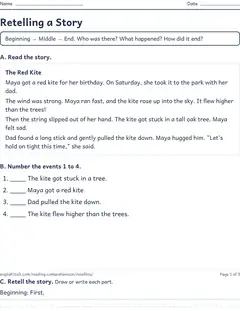 Retelling a StoryRead a short story, draw and write the beginning, middle and end, and number events in order.
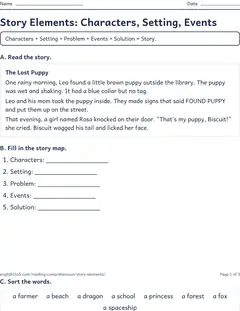 Story Elements: Characters, Setting, EventsRead a short story, fill in a story map, and sort words into characters and settings.
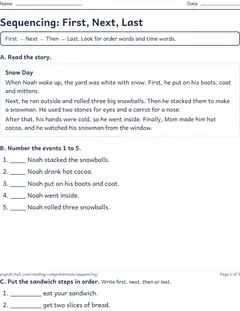 Sequencing: First, Next, LastNumber story events in order, order the steps for making a sandwich, and write your own sequence.
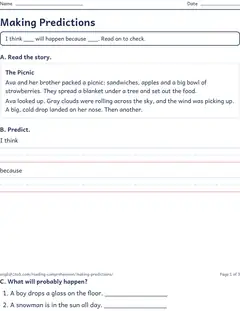 Making PredictionsRead a story that stops at an exciting part, predict what happens, find the clue, then check the ending.
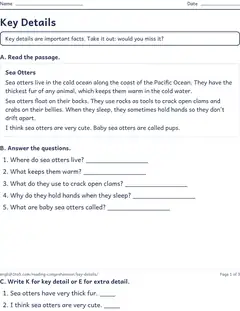 Key DetailsRead a short nonfiction passage, answer key detail questions, and sort details into key or extra.
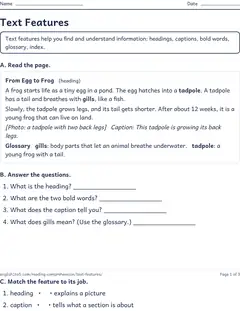 Text FeaturesRead a mini nonfiction page, find its text features, match features to their jobs and choose the right feature.
Practicing at home
Read, then talk
After reading, ask one who, one what and one why question.
Retell in order
First, next, then, last. Use fingers to count the parts.
Mix in nonfiction
Books about animals, space and weather build knowledge for later reading.
Reread favorites
Rereading builds fluency, and fluency frees the brain to understand.
More 1st grade practice
See every reading and writing skill for the year on the 1st grade page. Earlier: kindergarten reading passages. Next: 2nd grade reading passages. All lessons: reading comprehension.
Practice with a game
Free, no sign-up, and they work on phones, tablets and computers.
 Reading RocketRead a passage and answer questions to launch.1st–5th grade
 Who Am I? RiddlesRead the clues and guess who I am.1st–3rd grade
 Story Order TrainPut the story in order: first, next, last.Kindergarten–2nd grade
 How Do They Feel?Read what happened and pick the feeling.Kindergarten–2nd grade
Last reviewed: November 11, 2026
Questions parents ask
What reading comprehension skills are taught in 1st grade?
Asking and answering questions, retelling with key details, describing characters, setting and events, finding the main topic of nonfiction and using text features.
How long should 1st grade reading passages be?
Usually 60 to 150 words, a few short paragraphs.
My child reads well but can't answer questions. What helps?
Slow down and talk about the story as you read. Ask one question per page.
How much should a 1st grader read each day?
About 15 to 20 minutes, plus being read to.