Kindergarten Reading Comprehension
- Kindergarten
- Common Core RL.K.1–RL.K.10
- 3 passages · 4 lessons
In kindergarten, reading comprehension starts with listening. Kids hear a story read aloud, then answer questions, retell what happened and name the characters and setting. The three short passages on this page are written for exactly that, with simple sentences your child may be able to read along with.
What kids learn in kindergarten reading comprehension
Kindergartners can understand much more than they can read. That's why most comprehension practice this year happens out loud: you read, they think and talk. Asking who, what and where questions after a story is the single most useful habit.
The big skills are asking and answering questions about key details, retelling a familiar story, and naming characters, setting and main events, all with your help. Kids also learn to use pictures to understand a story and to make simple predictions.
Keep it short and fun. One story and three questions a day is plenty.
Kindergarten reading passages
Three original passages written for kindergarten: two stories and a nonfiction text. Read them aloud to your child, then ask the questions out loud. Each question practices a skill from the lessons below. Download all three as a printable PDF (with an answer key).
1. The Big Red Ballstory
Sam has a big red ball.
He kicks the ball. It rolls and rolls.
The ball rolls to Pip the dog. Pip runs with the ball!
Sam laughs. "Come back, Pip!"
Questions
- Who has a ball? (asking and answering questions)
- What color is the ball? (asking and answering questions)
- Who runs with the ball? (story elements: characters, setting, events)
- How does Sam feel at the end? How do you know? (making predictions)
Show answers
- Sam.
- Red.
- Pip the dog.
- Happy. He laughs.
2. Ducksnonfiction
Ducks are birds.
Ducks can swim. They have flat feet to paddle in the water.
Ducks can fly too.
Baby ducks are called ducklings.
Questions
- What are ducks? (key details)
- What do ducks use to paddle? (key details)
- What can ducks do? Name two things. (asking and answering questions)
- What are baby ducks called? (key details)
Show answers
- Birds.
- Their flat feet.
- Swim and fly.
- Ducklings.
3. Mia's Snackstory
Mia is hungry.
First, she gets a red apple. Next, she gets some cheese.
Then she sits at the table and eats.
"Yum!" says Mia.
Questions
- Why does Mia get a snack? (asking and answering questions)
- What does Mia get first? (retelling a story)
- What does she get next? (retelling a story)
- Where does Mia eat? (story elements: characters, setting, events)
Show answers
- She is hungry.
- A red apple.
- Some cheese.
- At the table.
Kindergarten reading lessons, in order
Each lesson takes about 10 minutes and has a quiz and a free worksheet with its own reading passage.
- 1. Asking and Answering QuestionsAsking and answering who, what, where, when, why and how questions about a text. RL.K.1, RL.1.1, RL.2.1
- 2. Retelling a StoryRetelling a story in order with the key details. RL.K.2, RL.1.2
- 3. Story Elements: Characters, Setting, EventsFinding the characters, setting, problem, events and solution in a story. RL.K.3, RL.1.3, RL.2.5
- 4. Making PredictionsMaking and checking predictions using clues from the text and pictures. RL.K.7, RL.1.7, RL.2.7
What the standards say
These are the Common Core kindergarten reading literature and informational text standards this page covers. Most US states use the same or very similar goals.
- RL.K.1: With prompting and support, ask and answer questions about key details in a text.
- RL.K.2: With prompting and support, retell familiar stories, including key details.
- RL.K.3: With prompting and support, identify characters, settings, and major events in a story.
- RL.K.7: With prompting and support, describe the relationship between illustrations and the story in which they appear (e.g., what moment in a story an illustration depicts).
A simple weekly plan
Ten to fifteen minutes a day is plenty. This rhythm works for most families; swap days around to fit your week.
| Day | What to do |
|---|---|
| Monday | Read passage 1 together and answer the questions. |
| Tuesday | Do a lesson and its quiz. |
| Wednesday | Read passage 2; answer with evidence. |
| Thursday | Read passage 3, or a library book, and talk about it. |
| Friday | Take the mixed quiz below. Revisit any skill your child missed. |
Mixed quiz
Ten questions drawn from the kindergarten lessons: asking and answering questions, retelling a story, story elements: characters, setting, events, making predictions. Tap the speaker to hear a question read aloud. Any question your child misses points to the lesson to revisit.
-
1.Which question word asks about a place?
Show answer
Where.
-
2.What does it mean to retell a story?
Show answer
Tell it again in your own words.
-
3.What are characters?
Show answer
The people or animals in a story.
-
4.What is a prediction?
Show answer
A smart guess about what will happen next.
-
5.Which question word asks about a person?
Show answer
Who.
-
6.What are the three parts of a retell?
Show answer
Beginning, middle, end.
-
7.What is the setting?
Show answer
Where and when the story happens.
-
8.Dark clouds fill the sky. What will probably happen?
Show answer
It will rain.
-
9.Which question word asks about a time?
Show answer
When.
-
10.Which word helps you tell the first part?
Show answer
First.
Printables
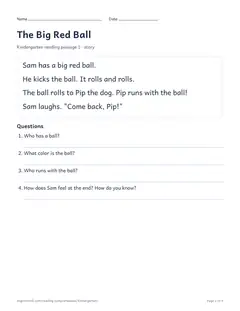 Kindergarten reading passages (PDF)All three passages from this page, with questions and an answer key.
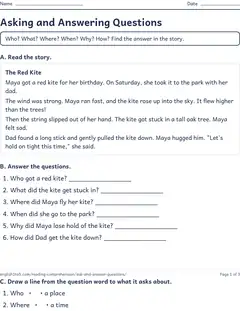 Asking and Answering QuestionsRead a short story, answer who, what, where, when, why and how questions, and write your own question.
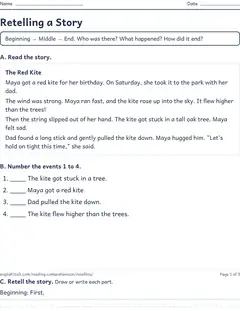 Retelling a StoryRead a short story, draw and write the beginning, middle and end, and number events in order.
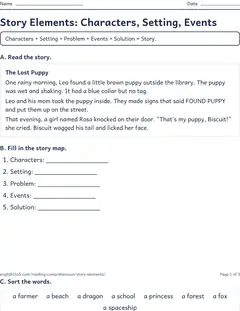 Story Elements: Characters, Setting, EventsRead a short story, fill in a story map, and sort words into characters and settings.
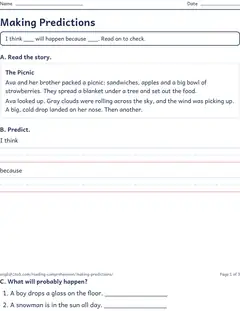 Making PredictionsRead a story that stops at an exciting part, predict what happens, find the clue, then check the ending.
Practicing at home
Read aloud every day
Picture books, rhyming books, nonfiction about animals: variety builds vocabulary and background knowledge.
Ask one or two questions
"Who was in the story? What happened at the end?" Not a quiz, just a chat.
Retell with toys
Act out the story with stuffed animals. It's retelling, and it's fun.
Look at the pictures
Ask what the picture shows and how it matches the words.
More kindergarten practice
See every reading and writing skill for the year on the kindergarten page. Next: 1st grade reading passages. All lessons: reading comprehension.
Practice with a game
Free, no sign-up, and they work on phones, tablets and computers.
 Letter Sound PopPop the balloon with the letter a picture word starts with.Kindergarten
 Rhyme RocketTap the picture that rhymes to fuel the rocket.Kindergarten–1st grade
 Syllable DrumDrum once for each syllable in a word.Kindergarten–1st grade
 Sight Word SplashTap the sight word you hear as it pops up.Kindergarten–2nd grade
Last reviewed: November 11, 2026
Questions parents ask
What is reading comprehension in kindergarten?
Understanding stories that are read aloud: answering questions, retelling, and naming characters, setting and events (RL.K.1–RL.K.3).
Should my kindergartner read these passages alone?
Not necessarily. Read them aloud; some kids will read along or read a few words.
How many questions should I ask?
Two or three after each story. Keep it relaxed.
What if my child can't retell the story?
Reread it, use the pictures and give order words: first, next, last.