Fragments and Run-Ons
- 4th grade
- CCSS L.4.1f
A fragment is a piece of a sentence that can't stand alone: Because it was raining. A run-on is two sentences jammed together without the right punctuation: It rained we stayed in. Both are easy to fix once you can spot them.
What are fragments and run-ons?
A complete sentence has a subject (who or what), a verb (what they do or are) and a complete thought. A fragment is missing one of those. "Ran to the store." has no subject. "The big dog." has no verb. "When we got home." leaves you waiting.
A run-on goes the other way: it holds two complete sentences but treats them as one. A fused sentence has nothing between them ("I ran I fell"). A comma splice uses only a comma ("I ran, I fell").
Fragment: missing a subject, a verb or a complete thought.
Run-on: two sentences with no proper break.
The 4th grade Common Core standard (L.4.1f) asks kids to write complete sentences and fix fragments and run-ons. It builds on compound and complex sentences, which are the usual fixes.
How to fix fragments and run-ons
Each problem has a quick fix.
| Problem | Example | Fix |
|---|---|---|
| Fragment: no subject | Ran to the bus. | Add who: Leo ran to the bus. |
| Fragment: no verb | The tall girl with red shoes. | Add what she did: The tall girl with red shoes won. |
| Fragment: not a complete thought | Because it was cold. | Attach it: We stayed in because it was cold. |
| Fused run-on | It was late we went home. | Add a period: It was late. We went home. |
| Comma splice | It was late, we went home. | Add a joining word: It was late, so we went home. |
A third fix for run-ons: turn one half into a complex sentence. "Because it was late, we went home."
Fragment, run-on or complete?
Read each one aloud. Ask your child: is anything missing, or is too much crammed in?
- After the game ended. (fragment)
- The game ended. (complete)
- The game ended we went home. (run-on)
- The game ended, so we went home. (complete)
- My best friend from camp. (fragment)
- My best friend from camp called me. (complete)
- I love pizza, it is my favorite food. (run-on: comma splice)
- I love pizza. It is my favorite food. (complete)
- Jumped over the fence. (fragment)
- The deer jumped over the fence. (complete)
Notice how short the fixes are. Usually you only need one word or one punctuation mark.
The read-aloud test
Kids can usually hear both problems:
- Fragments sound unfinished. Read it alone and ask "...and then what?" or "Who did that?"
- Run-ons make you run out of breath or want to stop in the middle. Where you'd naturally stop, a period probably belongs.
- Check each sentence by itself, not as part of the paragraph. A fragment often hides after a sentence it belongs to.
How to teach fragments and run-ons
Five short steps, about 10 minutes each.
- Find who and do. For every sentence, your child points to the subject and the verb.
- Ask "...and then what?" Read fragments like "When I got home." Your child finishes the thought.
- Breathe and stop. Read a run-on aloud in one breath. Your child shows where they'd stop.
- Three fixes for run-ons. Practice all three: a period, a comma plus a joining word, or because/when.
- Edit a real page. Read your child's own writing aloud together and fix one fragment or run-on.
Common mistakes and how to fix them
| Mistake | Why it happens | How to fix it |
|---|---|---|
| Because I was hungry. | Answering a why-question in writing. | Attach the reason: I ate because I was hungry. |
| I was tired, I went to bed. | Using a comma as a period. | Add so, or use a period: I was tired, so I went to bed. |
| We went to the zoo we saw lions we saw bears. | Writing the way they talk. | Break it into sentences: We went to the zoo. We saw lions and bears. |
| Calling a long sentence a run-on. | Thinking run-on means long. | Length doesn't matter. A run-on is two sentences with no proper break. |
Practice: fragments and run-ons quiz
10 questions. Your child can tap the speaker to hear a question read aloud. The first try on each question counts toward the score.
-
1.Which is a fragment?
Show answer
Because it was cold. It's not a complete thought.
-
2.Which is a run-on?
Show answer
I was late I missed the bus.
-
3.What is missing? Ran across the yard.
Show answer
a subject. Who ran?
-
4.What is missing? The fluffy white cat.
Show answer
a verb. What did the cat do?
-
5.Which fixes the comma splice? It snowed, school closed.
Show answer
It snowed, so school closed.
-
6.Which is a complete sentence?
Show answer
After lunch, we played tag.
-
7.What is a comma splice?
Show answer
two sentences joined with only a comma.
-
8.Which is a fragment?
Show answer
When we got to the beach.
-
9.Which fixes the run-on? I like soccer my sister likes swimming.
Show answer
I like soccer. My sister likes swimming.
-
10.Is a long sentence always a run-on?
Show answer
No. A run-on is about missing breaks, not length.
Fragments and Run-Ons worksheet (free PDF)
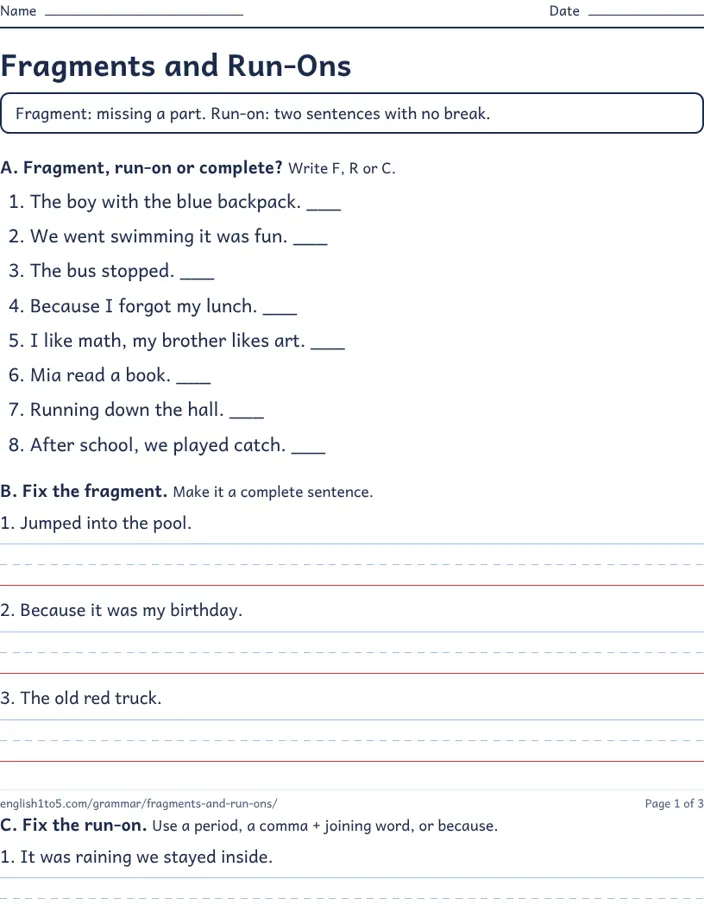
Fragments and Run-Ons Worksheet, 4th grade
Label fragments, run-ons and complete sentences, fix fragments, fix run-ons three ways and edit a short paragraph. Prints on US Letter paper, with an answer key.
Download the PDFTry it at home
- Read aloud: your child reads their writing to you and listens for missing parts.
- Finish my sentence: say a fragment ("When I woke up..."); your child finishes it.
- Breath test: read a run-on in one breath; laugh, then fix it.
- Texts: find a fragment in a text message. It's fine in texts, but not in schoolwork.
- One fix a week: focus on run-ons one week, fragments the next.
What comes next
Next, kids learn their, there, they're and other confused words. For the comma fix, see commas before and, but and so. See all 4th grade skills on the 4th grade page, or browse all grammar lessons.
Last reviewed: November 11, 2026
Questions parents ask
What is a sentence fragment for kids?
It's part of a sentence that can't stand alone because it's missing a subject, a verb or a complete thought, like "Because it was raining."
What is a run-on sentence?
Two complete sentences joined without the right punctuation, like "It rained we stayed in." A comma alone between them is also a run-on, called a comma splice.
What grade learns fragments and run-ons?
4th grade. The Common Core standard L.4.1f asks kids to write complete sentences and fix fragments and run-ons.
How do you fix a run-on sentence?
Three ways: split it with a period, add a comma and a joining word like and, but or so, or join it with because, when or if.
Is a long sentence a run-on?
Not necessarily. A sentence can be long and correct. A run-on is about missing breaks between complete sentences, not length.