Compound Sentences
- 2nd grade
- CCSS L.2.1f
A compound sentence is two complete sentences joined into one. You join them with a comma and a joining word: "It was raining, so we stayed inside."
What is a compound sentence?
A simple sentence has one subject and one verb and makes sense on its own: "Mia likes soccer." A compound sentence glues two of those together: "Mia likes soccer, but Leo likes baseball."
The glue is a comma plus one of the conjunctions kids learned in 1st grade: and, but, or or so. Each half could still stand alone as its own sentence. That's the test.
sentence + , + and/but/or/so + sentence
I was hungry, so I ate lunch.
The 2nd grade Common Core standard (L.2.1f) asks kids to produce, expand and rearrange simple and compound sentences. In 3rd grade they add complex sentences, which use words like because and when.
Build a compound sentence
Read across. The left and right columns are both complete sentences.
| Sentence 1 | Comma + joining word | Sentence 2 |
|---|---|---|
| The bell rang | , and | the kids ran outside. |
| I wanted pizza | , but | we had tacos. |
| We can go to the park | , or | we can stay home. |
| The dog was muddy | , so | Dad gave him a bath. |
| Ava drew a picture | , and | Sam wrote a poem. |
| It was sunny | , but | the wind was cold. |
The comma goes before the joining word, never after it.
Simple or compound?
The joining words are highlighted. Ask your child: can each half stand alone?
- I fed the cat, and Mom fed the dog. (compound)
- I fed the cat and the dog. (simple: one subject, one verb)
- We were late, so we ran to the bus. (compound)
- You can have juice, or you can have milk. (compound)
- The movie was long, but it was funny. (compound)
- Leo and Mia built a fort. (simple)
- The sun came out, and the snow melted. (compound)
- I studied hard, so I passed the test. (compound)
- The cake smelled good but tasted strange. (simple: one subject)
- My brother is tall, but I am taller. (compound)
Sentences 2, 6 and 9 use and or but too, but they're still simple. "The dog" in sentence 2 isn't a sentence on its own. That's why there's no comma.
Expand and rearrange sentences
The standard also asks kids to grow and reshape sentences. Using its own example:
- Simple: The boy watched the movie.
- Expanded: The little boy watched the funny movie.
- Rearranged: The funny movie was watched by the little boy.
- Compound: The little boy watched the movie, and his sister ate popcorn.
How to teach compound sentences
Five short steps, about 10 minutes each.
- Use sentence strips. Write simple sentences on strips of paper. Your child picks two that go together and joins them with a FANBOYS card (and, but, or, so).
- Do the cover test. Cover one half of a sentence with your hand. Can the other half stand alone? Then cover the other half.
- Place the comma. Practice saying "comma and" out loud when joining two sentences.
- Grow a sentence. Start with "The dog ran." Add describing words, then add a second sentence with but.
- Fix a choppy paragraph. Write four short sentences. Your child combines two pairs into compound sentences.
Common mistakes and how to fix them
| Mistake | Why it happens | How to fix it |
|---|---|---|
| I like cats, I like dogs. | Joining two sentences with only a comma. | Add a joining word: I like cats, and I like dogs. |
| I like cats and, dogs. | Putting a comma where there's only one sentence. | Dogs isn't a sentence, so no comma: I like cats and dogs. |
| It rained but, we played. | Comma after the joining word. | The comma goes before it: It rained, but we played. |
| I went home and I ate and I slept and I woke up. | Joining too many with and. | Split it up. Two halves per compound sentence is enough. |
Practice: compound sentences quiz
10 questions. Your child can tap the speaker to hear a question read aloud. The first try on each question counts toward the score.
-
1.Which is a compound sentence?
Show answer
I like tea, but Mom likes coffee.
-
2.Tap the joining word.
, .
Show answer
so.
-
3.It started to rain, ___ we went inside.
Show answer
so.
-
4.Where does the comma go?
Show answer
I was tired, but I kept reading.
-
5.Which is not a compound sentence?
Show answer
Sam and Ana went to the zoo. It's simple.
-
6.We can bake cookies, ___ we can make a pie.
Show answer
or.
-
7.Tap the joining word.
, .
Show answer
but.
-
8.Which fixes this? I like art, I like music.
Show answer
I like art, and I like music.
-
9.Which joining word shows a surprise?
Show answer
but.
-
10.Which sentence is expanded with describing words?
Show answer
The tiny kitten chased a red ball.
Compound Sentences worksheet (free PDF)
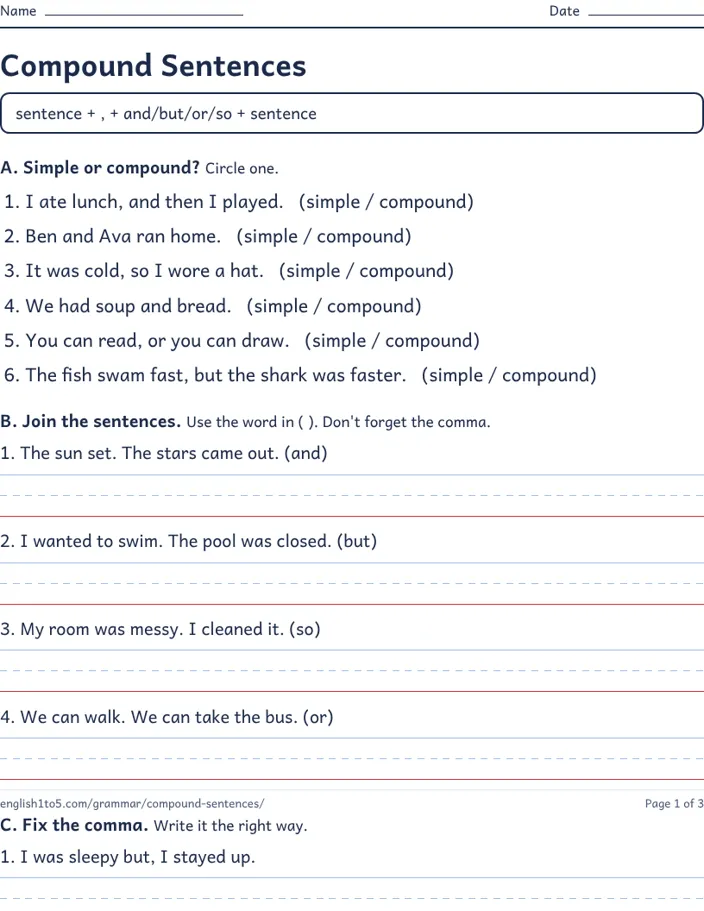
Compound Sentences Worksheet, 2nd grade
Sort simple and compound sentences, join pairs with a comma and a joining word, fix comma mistakes and expand a sentence. Prints on US Letter paper, with an answer key.
Download the PDFTry it at home
- At dinner: each person says one thing they did and one thing someone else did, joined with and.
- In the car: start a sentence and let your child finish it: "I wanted ice cream, but..."
- When your child writes: find two short sentences and join them.
- Reading together: hunt for a comma followed by and, but, or or so.
- At bedtime: tell a two-part story: "The bear was hungry, so..."
What comes next
Next, kids learn complex sentences, which join ideas with words like because, when and if. See all 2nd grade skills on the 2nd grade page, or browse all grammar lessons.
Last reviewed: November 11, 2026
Questions parents ask
What is a compound sentence for kids?
It's two complete sentences joined by a comma and a joining word like and, but, or or so: It was raining, so we stayed inside.
What grade learns compound sentences?
2nd grade. The Common Core standard L.2.1f asks kids to produce, expand and rearrange simple and compound sentences.
Where does the comma go in a compound sentence?
Before the joining word: I was tired, but I kept reading.
What is FANBOYS?
A memory trick for the seven joining words: for, and, nor, but, or, yet, so. 2nd graders mostly use and, but, or and so.
Is "Sam and Ana went to the zoo" a compound sentence?
No. It has one verb and "Ana went to the zoo" isn't split off as its own sentence, so it's a simple sentence with two subjects.