Complex Sentences
- 3rd grade
- CCSS L.3.1i
- CCSS L.3.1h
A complex sentence joins a complete sentence to a part that can't stand alone. The joining word is something like because, when, if or after: "We stayed inside because it was raining."
What is a complex sentence?
In a compound sentence, both halves are complete sentences. In a complex sentence, only one half is. The other half starts with a word like because or when, and it doesn't make sense on its own: "because it was raining" leaves you waiting.
That waiting half is called a dependent clause because it depends on the rest. The joining words are called subordinating conjunctions. 3rd graders don't need the terms, but they do need to finish the thought.
complete sentence + because/when/if/after + part that can't stand alone
The 3rd grade Common Core standards ask kids to write all three kinds of sentences (L.3.1i) and to use both kinds of conjunctions (L.3.1h). Complex sentences are what make writing sound grown-up: they show cause, time and condition.
Joining words for complex sentences
Each word shows a different link between the ideas.
| Word | What it shows | Example |
|---|---|---|
| because | why | I wore boots because it was muddy. |
| when | time | When the bell rings, we line up. |
| if | a condition | If it snows, we'll build a snowman. |
| after / before | order | We ate dinner after we got home. |
| while | two things at once | Mom read while I drew. |
| although | a surprise | Although it was cold, we swam. |
| until | how long | Keep stirring until it bubbles. |
Notice the comma rule. When the joining word comes first, put a comma after that part: "When the bell rings, we line up." When it comes in the middle, usually no comma: "We line up when the bell rings."
Simple, compound or complex?
Read each one aloud. The highlighted word starts the part that can't stand alone.
- The dog barked. (simple)
- The dog barked, and the cat ran. (compound)
- The dog barked because a truck drove by. (complex)
- When it gets dark, the owls come out. (complex)
- I'll call you if I need help. (complex)
- We brushed our teeth before we went to bed. (complex)
- Mia studied, so she did well. (compound)
- Although the test was hard, Leo finished it. (complex)
- Wait here until I come back. (complex)
- Dad cooked while we set the table. (complex)
Sentence 3 and sentence 7 both explain a cause. One uses because (complex) and the other uses so (compound).
Don't stop halfway
The most common mistake with complex sentences is writing only the waiting half.
- Fragment: Because I was hungry.
- Ask: What happened because you were hungry?
- Fixed: I made a sandwich because I was hungry.
- Or flip it: Because I was hungry, I made a sandwich.
How to teach complex sentences
Five short steps, about 10 minutes each.
- Say half a sentence. Say "When I got home..." and stop. Ask how it feels. Your child finishes it.
- Flip it around. Take a complex sentence and move the joining part to the front. Add the comma.
- Use joining-word cards. Draw a card (because, when, if, after) and build a sentence about your day with it.
- Sort three kinds. Write a simple, a compound and a complex sentence on cards. Your child sorts them.
- Upgrade writing. Find two short sentences in your child's writing and join them with because or when.
Common mistakes and how to fix them
| Mistake | Why it happens | How to fix it |
|---|---|---|
| Because it was raining. | Answering a why-question in writing. | Add the main idea: We stayed in because it was raining. |
| When the bell rang we ran outside. | Missing the comma after a front clause. | Add it: When the bell rang, we ran outside. |
| I was hungry, because I ate. | Mixing up cause and result. | Because goes before the reason: I ate because I was hungry. |
| Uses only because. | It's the first one kids learn. | Practice when, if, after, while and although from the table. |
Practice: complex sentences quiz
10 questions. Your child can tap the speaker to hear a question read aloud. The first try on each question counts toward the score.
-
1.Which is a complex sentence?
Show answer
We stayed in because it rained.
-
2.Tap the joining word.
.
Show answer
if.
-
3.Which part can't stand alone?
Show answer
when the movie ended.
-
4.Which is a fragment?
Show answer
Because I was tired. It needs a main idea.
-
5.Where does the comma go?
Show answer
When school ended, we went to the park.
-
6.I'll bring an umbrella ___ it rains.
Show answer
if.
-
7.Tap the joining word.
.
Show answer
while.
-
8.___ it was cold, we went swimming.
Show answer
Although. It shows a surprise.
-
9.Which joining word shows time?
Show answer
when.
-
10.Which sentence is compound, not complex?
Show answer
I was hungry, so I ate.
Complex Sentences worksheet (free PDF)
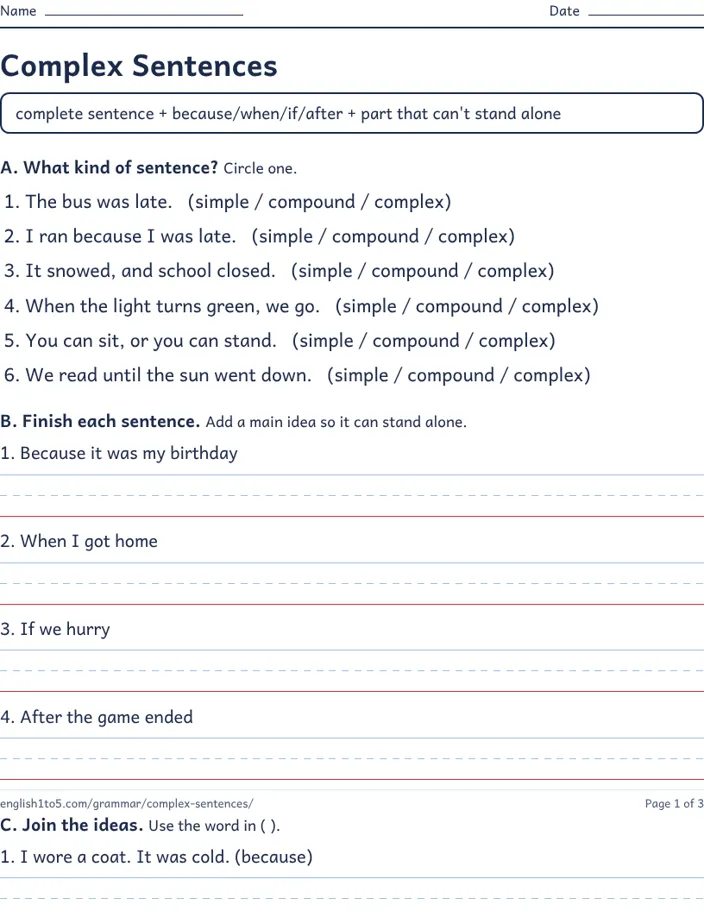
Complex Sentences Worksheet, 3rd grade
Sort simple, compound and complex sentences, finish fragments, join ideas with because, when or if and write your own. Prints on US Letter paper, with an answer key.
Download the PDFTry it at home
- At dinner: ask why-questions and expect a full because-answer.
- Planning the weekend: use if: "If it's sunny, we'll go to the lake."
- Daily routine: describe it with when and after: "After I brush my teeth, I read."
- Reading together: find a sentence that starts with when or if and point out the comma.
- When your child writes: underline every because and check the sentence is finished.
What comes next
Next, kids learn nouns for ideas and feelings in abstract nouns, and review simple verb tenses. See all 3rd grade skills on the 3rd grade page, or browse all grammar lessons.
Last reviewed: November 11, 2026
Questions parents ask
What is a complex sentence for kids?
It's a sentence with one complete idea and one part that can't stand alone, joined by a word like because, when, if or after: We stayed inside because it was raining.
What grade learns complex sentences?
3rd grade. The Common Core standard L.3.1i asks kids to write simple, compound and complex sentences.
What's the difference between compound and complex sentences?
In a compound sentence both halves can stand alone (It rained, so we stayed in). In a complex sentence one half can't (because it rained).
When does a complex sentence need a comma?
When the joining part comes first: When the bell rings, we line up. If it comes second, you usually don't need one.
What are subordinating conjunctions?
They're the joining words that start the part that can't stand alone, like because, when, if, after, before, while, although and until.