Types of Sentences
- 1st grade
- CCSS L.1.1j
- CCSS L.1.2b
There are four types of sentences. A statement tells (.), a question asks (?), a command tells someone to do something (.) and an exclamation shows strong feeling (!).
What are the four types of sentences?
Every sentence has a job. Some tell us something, some ask, some give orders and some shout with feeling. The end mark shows which job it's doing, so readers know how to read it aloud.
Teachers often use kid-friendly names: telling sentences, asking sentences, bossy sentences and excited sentences. The grown-up names are statement, question, command and exclamation.
Telling . Asking ?
Command . Exclamation !
The 1st grade Common Core standards ask kids to write all four kinds (L.1.1j) and to end each one with the right punctuation (L.1.2b).
The four types of sentences
Read each example aloud. Your voice changes with the end mark.
| Type | What it does | Ends with | Example |
|---|---|---|---|
| Statement (telling) | tells something | . period | The sun is hot. |
| Question (asking) | asks something | ? question mark | Is the sun hot? |
| Command (bossy) | tells someone to do something | . period | Put on your hat. |
| Exclamation (excited) | shows strong feeling | ! exclamation point | Wow, it's so hot! |
A command can end with an exclamation point if it's urgent: "Stop!" Most everyday commands end with a period.
Examples of each type
Read each one aloud and ask your child which type it is.
- My cat is gray. (statement)
- Where is my backpack? (question)
- Please pass the salt. (command)
- We won the game! (exclamation)
- Can you tie your shoes? (question)
- Wash your hands. (command)
- Dad made pancakes. (statement)
- That spider is huge! (exclamation)
- Who wants to play? (question)
- Close the door, please. (command)
Commands often start with an action word and don't name who should do it: "Wash your hands." The "you" is understood.
How to spot a question
Questions usually start with one of these words:
- Question words: who, what, where, when, why, how. Where are you going?
- Helping verbs: is, are, can, do, did, will. Can you help me?
- Turn it around: a statement becomes a question when you swap the first two words. You can swim. → Can you swim?
How to teach the four types of sentences
Five short steps, about 10 minutes each.
- Use your voice. Say the same words three ways: "It's raining." "It's raining?" "It's raining!" Your child names each type.
- Hold up end marks. Write . ? ! on cards. Say a sentence; your child holds up the right card.
- Play bossy boss. Take turns giving commands: "Hop three times." Point out that commands start with a verb.
- Turn it around. Say a statement. Your child turns it into a question: "Sam is home." → "Is Sam home?"
- Write one of each. Your child writes four sentences about a pet or toy, one of each type.
Common mistakes and how to fix them
| Mistake | Why it happens | How to fix it |
|---|---|---|
| Where is my hat. | Forgetting the question mark. | It starts with a question word: Where is my hat? |
| I like pizza!!! | Using exclamation points everywhere. | Save ! for real excitement. One is enough. |
| Calls "Sit down." a statement. | It ends with a period like a statement. | It tells someone to do something, so it's a command. |
| i went to the park and it was fun and we played | Writing one long sentence with no end marks. | Split it and end each sentence: I went to the park. It was fun! |
Practice: types of sentences quiz
10 questions. Your child can tap the speaker to hear a question read aloud. The first try on each question counts toward the score.
-
1.What type of sentence is this? Where is my hat?
Show answer
question.
-
2.Which end mark goes here? Are you ready__
Show answer
question mark.
-
3.What type of sentence is this? Please sit down.
Show answer
command.
-
4.What type of sentence is this? Wow, that is a huge cake!
Show answer
exclamation.
-
5.What type of sentence is this? My dog is brown.
Show answer
statement.
-
6.Which sentence is a question?
Show answer
Can you swim?
-
7.Which end mark goes here? I have two sisters__
Show answer
period. It's a statement.
-
8.Which sentence is a command?
Show answer
Wash your hands.
-
9.Which word often starts a question?
Show answer
Why.
-
10.Which sentence shows strong feeling?
Show answer
We won the game!
Types of Sentences worksheet (free PDF)
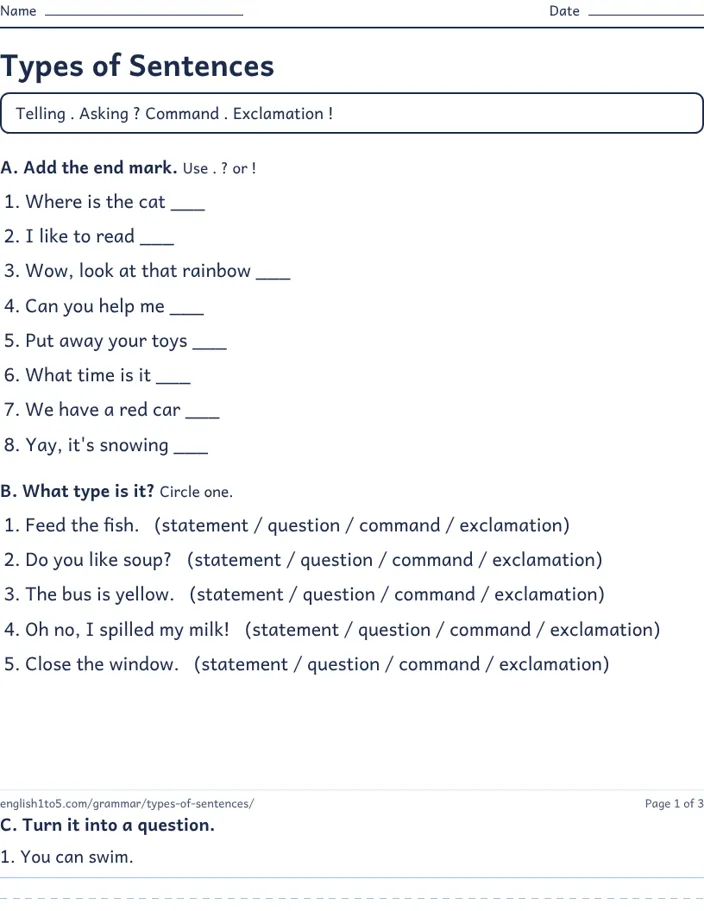
Types of Sentences Worksheet, 1st grade
Add end marks, label statements, questions, commands and exclamations, and turn statements into questions. Prints on US Letter paper, with an answer key.
Download the PDFTry it at home
- At dinner: everyone asks one question, then makes one exclamation.
- Bossy boss: let your child give you three commands to follow.
- When reading aloud: stop at an end mark and ask how to read the sentence.
- With texts: show a family text message and name the type of each sentence.
- When your child writes: check that every sentence ends with a mark.
What comes next
Next, kids join two sentences with a conjunction to make compound sentences, and learn all the punctuation rules. See all 1st grade skills on the 1st grade page, or browse all grammar lessons.
Practice with a game
Free, no sign-up, and they work on phones, tablets and computers.
 Kinds of Sentences
 Sentence Scramble
 Syntax Skies
Last reviewed: November 11, 2026
Questions parents ask
What are the 4 types of sentences?
Statements (telling), questions (asking), commands (telling someone to do something) and exclamations (showing strong feeling).
What grade learns types of sentences?
1st grade. The Common Core standard L.1.1j asks kids to write all four types, and L.1.2b asks them to use the right end punctuation.
What punctuation goes with each type?
Statements and commands end with a period, questions end with a question mark and exclamations end with an exclamation point.
What's the difference between a statement and a command?
A statement tells something (The door is open). A command tells someone to do something (Close the door). Both usually end with a period.
What are declarative and interrogative sentences?
Those are the formal names. Declarative means statement, interrogative means question, imperative means command and exclamatory means exclamation.