- Recommended Reading Age: 7 to 11 years
- Reading Level: Upper elementary
- Estimated Reading Time: 10–12 minutes
- Ideal For: Exploring cleverness, problem-solving skills, and classic French folklore
- Author / Source: A classic tale by Charles Perrault (1697)
- Story Type: Folktale / Fairy tale
- Origin: France
- Main Characters: Puss in Boots, Tom (the miller’s son), the king, the princess, and the ogre
- Key Themes / Moral: Cleverness, wit, loyalty, social mobility, and perseverance
The Miller’s Inheritance
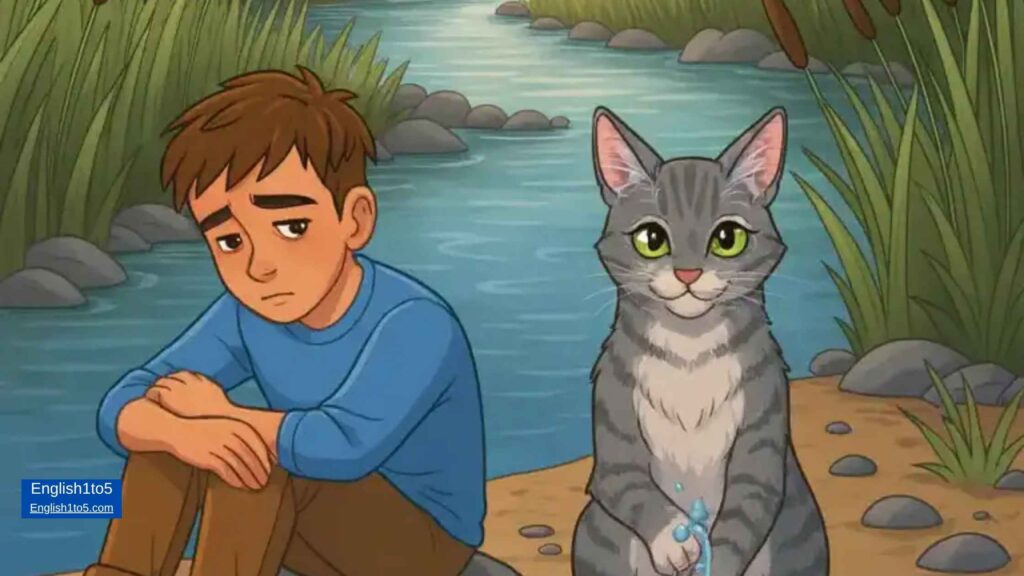
Once upon a time, there was a poor miller who, upon his death, left his meager belongings to his three sons. The inheritance was divided quickly and without the need for a lawyer: the eldest son received the mill, the middle son took the donkey, and the youngest son was left with nothing but the cat.
The youngest brother sat in despair. “My brothers can earn a living by working together,” he sighed, “but once I have eaten my cat and made a muff from his skin, I shall surely die of hunger.”
The cat, who was listening quietly, suddenly spoke up with a confident air. “Do not worry, master. Give me a sturdy sack and have a pair of boots made for me so I can walk through the brambles, and you shall see that your portion is not as poor as you think.”
The First Trick
Though the young man did not have much hope, he had seen the cat perform clever tricks to catch mice, so he spent his last few coins to get the cat his boots and sack.
Looking dashing in his new leather boots, the cat put bran and lettuce into his sack, lay dead still in a warren, and waited. Soon, a foolish, hungry young rabbit hopped right into the sack. Pulling the strings tight, the cat caught his prize.
Instead of taking it to his master, Puss marched directly to the King’s palace. He bowed low before His Majesty and presented the rabbit. “Sire,” said the cat, “I bring you a rabbit from the warren of my master, the Marquis of Carabas”—for that was the noble title the cat had just invented for his poor master.
The King was delighted. “Tell your master I thank him and am greatly pleased.”
For the next few months, Puss continued to catch partridges and other game, presenting them all to the King as lavish gifts from the generous “Marquis of Carabas.”
The Royal Carriage
One day, Puss learned that the King was planning to take a drive along the riverside with his daughter, the most beautiful princess in the world.
The cat rushed to his master and said, “If you follow my advice, your fortune is made! You need only go and bathe in the river at the exact spot I show you, and leave the rest to me.”
The young man, confused but trusting, did as he was told. While he was bathing, the royal carriage passed by. Puss began to shout with all his might: “Help! Help! The Marquis of Carabas is drowning!”
The King recognized the cat who had brought him so many fine gifts and ordered his guards to help the Marquis. While they pulled the young man from the river, Puss explained to the King that thieves had stolen his master’s clothes while he swam (though Puss had actually hidden them under a rock).
The King immediately ordered his servants to fetch one of his finest suits for the Marquis. Dressed in royal velvet and gold, the young miller looked entirely like a handsome nobleman. The Princess cast her eyes upon him, and it was not long before she fell completely in love.
The Lands of the Marquis
The King invited the young man to join them in the carriage. Puss, overjoyed that his plan was working, ran far ahead of the royal procession.
He came across peasants mowing a vast meadow. “Good people,” the cat threatened, glaring fiercely, “if you do not tell the King that this meadow belongs to the Marquis of Carabas, you shall be chopped up as small as mincemeat!”
When the King’s carriage rolled by and the King asked whose meadow it was, the terrified peasants cried out, “It belongs to the Marquis of Carabas!”
Puss continued running ahead, making the same terrible threat to the reapers in the cornfields, and the woodcutters in the forests. Every time the King asked who owned the magnificent lands, the answer was always the same: The Marquis of Carabas. The King was astonished by the immense wealth of the young nobleman.
The Ogre’s Castle
Finally, Puss reached a grand, towering castle. It belonged to a fearsome and immensely wealthy Ogre, who was the true owner of all the lands the King had just admired.
Puss bravely marched up to the castle and demanded an audience. “I have heard,” the cat said to the Ogre, “that you possess the magical ability to transform yourself into any sort of creature. A lion, for example, or an elephant.”
“That is true!” boomed the Ogre, eager to show off. In a flash, he turned into a massive, roaring lion. Puss was so terrified he scrambled up the curtains, nearly ruining his boots.
Once the Ogre turned back into a giant, Puss climbed down, trembling. “That was incredible,” the cat said. “But I have also heard a rumor—though I find it impossible to believe—that you can transform into the smallest of animals, like a rat or a mouse. Surely, that is too difficult even for you?”
“Impossible?” roared the insulted Ogre. “Watch this!”
In the blink of an eye, the giant Ogre vanished, replaced by a tiny brown mouse scurrying across the floor. Without missing a beat, Puss pounced on the mouse and ate him in one bite.
A Happy Ending
Just then, the King’s carriage arrived at the gates of the magnificent castle. Puss ran out to greet them. “Welcome, Your Majesty, to the castle of the Marquis of Carabas!”
“What!” cried the King. “This spectacular castle belongs to you as well, Marquis? I have never seen anything so splendid!”
The King, thoroughly convinced of the young man’s nobility, wealth, and good nature—and seeing how deeply his daughter had fallen in love with him—turned to the miller’s son. “It will be your own fault, Marquis, if you do not become my son-in-law.”
The young man, bowing low, gratefully accepted the King’s offer. He and the Princess were married that very same day.
As for Puss in Boots, he became a great lord of the court. He never had to hunt for survival again, and from that day forward, he only chased after mice for the pure fun of it.
Moral of the Story
Cleverness and resourcefulness are more valuable than wealth. With a sharp mind and a little confidence, you can create your own fortune out of nothing.
Vocabulary Spotlight
- Inherited: To receive something, usually money or property, from someone after they have passed away.
- Ridiculous: Extremely silly or unreasonable; something that does not make sense.
- Marquis: A noble title given to a man of high rank, just below a duke.
- Briskly: In a quick, active, and energetic way.
- Reapers: People who harvest crops by cutting and gathering them from fields.
- Impressed: Feeling admiration or respect for someone or something.
- Trophies: Objects kept to show success, achievement, or victory.
- Boasted: Spoke with too much pride about one’s abilities or possessions.
- Vast: Very large in size, amount, or extent.
- Blessing: Approval, permission, or support for something to happen.