Commas After Introductory Words
- 5th grade
- CCSS L.5.2b
When a sentence starts with an introductory word, phrase or clause, put a comma after it: However, it rained. After lunch, we played outside. When we got home, the dog was waiting.
What is an introductory element?
It's the warm-up before the main part of the sentence. It sets the time, place, reason or attitude, and then the comma signals "here comes the main idea." If you cover the introductory part, a complete sentence remains.
Introductory elements come in three sizes: a single word (However, Finally, Yes), a phrase (After lunch, In the morning) or a clause with its own subject and verb (When the bell rang, Because it was late).
Introductory part + comma + main sentence
After dinner, we watched a movie.
The 5th grade Common Core standard (L.5.2b) covers this comma. Kids already used it after a when- or because-part in complex sentences.
Three kinds of introductory elements
Each one is followed by a comma.
| Kind | Examples | Sentence |
|---|---|---|
| word | However, Finally, Suddenly, Luckily, First | Luckily, I found my keys. |
| phrase | After lunch, In the morning, With a smile | In the morning, we left for camp. |
| clause | When..., If..., Because..., Although..., After we... | When the bell rang, we lined up. |
Some teachers allow skipping the comma after a very short phrase ("In 2020 we moved"). Keeping it is never wrong, so it's the safest habit for 5th graders.
Commas after introductory elements
The introductory parts are highlighted. Cover each one: is a full sentence left?
- However, the store was closed.
- After school, I walk the dog.
- When it started to rain, we ran inside.
- Finally, the movie began.
- In the summer, we visit our cousins.
- If you need help, ask me.
- Suddenly, the lights went out.
- Because it was late, we took a taxi.
- First, preheat the oven.
- Although she was tired, Mia finished her project.
Notice the comma is always right before the main subject: the store, I, we, the movie.
When the same part comes at the end
- Front: When the bell rang, we lined up. (comma)
- End: We lined up when the bell rang. (usually no comma)
- Front: After lunch, we played. (comma)
- End: We played after lunch. (no comma)
How to teach commas after introductory words
Five short steps, about 10 minutes each.
- Cover test. Cover the opening part. Is a full sentence left? Then add the comma.
- Transition word list. Make a list: first, next, then, finally, however, luckily. Each gets a comma at the start.
- Flip it. Move an ending phrase to the front and add the comma: "We played after lunch" → "After lunch, we played."
- Write steps. Your child writes a how-to using First, Next, Then and Finally, each with a comma.
- Edit a story. Find every sentence that starts with a time or reason and check the comma.
Common mistakes and how to fix them
| Mistake | Why it happens | How to fix it |
|---|---|---|
| However the store was closed. | Missing the comma. | However, the store was closed. |
| After, lunch we played. | Comma inside the phrase. | Put it after the whole phrase: After lunch, we played. |
| We played, after lunch. | Adding a comma when the phrase is at the end. | We played after lunch. |
| When the bell rang. | Writing the introductory part as a sentence. | Add the main idea: When the bell rang, we lined up. |
Practice: commas after introductory words quiz
10 questions. Your child can tap the speaker to hear a question read aloud. The first try on each question counts toward the score.
-
1.Which is correct?
Show answer
However, it rained.
-
2.Where does the comma go? After school we went to the park.
Show answer
After school, we went to the park.
-
3.Which is correct?
Show answer
When the bell rang, we lined up.
-
4.Which sentence needs a comma?
Show answer
Luckily, I found my keys.
-
5.Which is correct?
Show answer
We played after lunch.
-
6.Which is an introductory clause?
Show answer
Because it was late, It has a subject and a verb.
-
7.Which is correct?
Show answer
First, mix the flour and sugar.
-
8.How can you check if you need the comma?
Show answer
Cover the opening part. If a full sentence remains, add the comma.
-
9.Which is correct?
Show answer
If you need help, ask me.
-
10.Which is correct?
Show answer
Suddenly, the lights went out.
Commas After Introductory Words worksheet (free PDF)
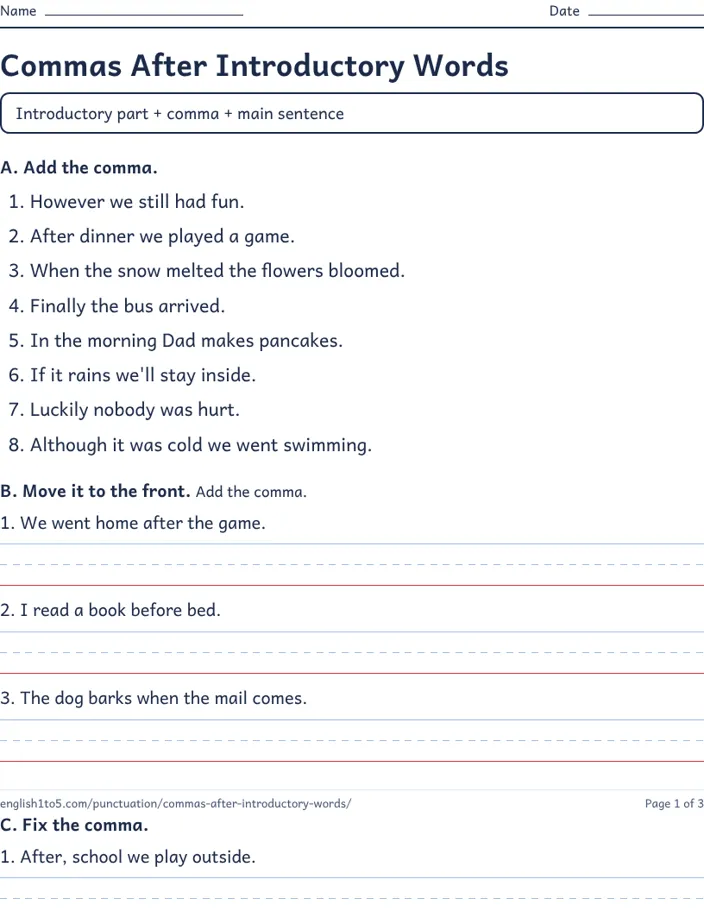
Commas After Introductory Words Worksheet, 5th grade
Add commas after introductory words, phrases and clauses, flip sentences, fix comma mistakes and write a how-to. Prints on US Letter paper, with an answer key.
Download the PDFTry it at home
- Recipes: read recipe steps that start with First, Then and Finally.
- Flip it: say a sentence and move the time phrase to the front.
- Cover test: check sentences in your child's writing.
- Stories: start each paragraph with a time phrase and a comma.
- Reading: find sentences that start with However or Suddenly.
What comes next
Next, kids learn commas with yes, no and names. See all 5th grade skills on the 5th grade page, or browse all punctuation lessons.
Last reviewed: November 11, 2026
Questions parents ask
When do you put a comma after an introductory word?
When a sentence begins with an introductory word, phrase or clause before the main part: However, it rained. After lunch, we played.
What grade learns commas after introductory words?
5th grade. The Common Core standard L.5.2b covers a comma after an introductory element.
Do you need a comma after a short phrase like "In 2020"?
Some style guides allow skipping it, but the comma is never wrong. It's the safest habit for students.
Is there a comma if the phrase comes at the end?
Usually not: We played after lunch.
What are introductory words?
Words like however, finally, first, luckily, suddenly and yes that start a sentence before the main idea.