Relative Pronouns
- 4th grade
- CCSS L.4.1a
A relative pronoun links extra information to a noun. "The girl who won the race is my sister." "The book that I borrowed is funny." The words are who, whose, whom, which and that.
What is a relative pronoun?
Relative pronouns let kids combine two short sentences into one. "I have a friend. She speaks three languages." becomes "I have a friend who speaks three languages." The relative pronoun points back to the noun right before it.
Three related words do the same job for places, times and reasons. They're called relative adverbs: where (the park where we play), when (the day when it snowed) and why (the reason why I'm late).
who = people which = things
that = people or things whose = owning
The 4th grade Common Core standard (L.4.1a) covers both relative pronouns and relative adverbs. They build on the everyday pronouns kids learned in 1st grade and the complex sentences from 3rd.
Which relative word to use
Match the word to what it describes.
| Word | Use it for | Example |
|---|---|---|
| who | people (doing the action) | the boy who sings |
| whom | people (receiving the action) | the girl whom I met |
| whose | owning | the man whose dog barked |
| which | things and animals | my bike, which is red |
| that | people or things | the cake that Mom baked |
| where | places | the town where I was born |
| when | times | the day when we met |
| why | reasons | the reason why I laughed |
Whom sounds formal and is rarely used when talking. 4th graders should recognize it, but who or that is fine in most everyday writing.
Relative pronouns in sentences
The relative words are highlighted. Ask your child which noun each one points back to.
- The teacher who helped me is Ms. Park.
- I found the key that you lost.
- My dog, which is a beagle, loves walks.
- That's the boy whose bike was stolen.
- This is the park where we had the picnic.
- I remember the day when we got our puppy.
- Do you know the reason why she left?
- The cookies that Grandma made are gone.
- The girl whom we invited is new.
- Kids who read every day learn new words.
In sentence 3, commas surround which is a beagle because it's extra information. The sentence still makes sense without it: My dog loves walks.
Who, which or that?
- who is for people: the player who scored.
- which is for things and animals: the game, which was long.
- that works for both, and it's the most common choice in everyday writing: the player that scored, the game that we won.
- Don't use which for people. "The girl which won" should be "the girl who won."
How to teach relative pronouns
Five short steps, about 10 minutes each.
- Combine two sentences. "I have a cat. It sleeps all day." becomes "I have a cat that sleeps all day."
- Draw an arrow. Your child draws an arrow from the relative pronoun back to the noun it describes.
- Sort people and things. Give nouns: teacher, bike, dog, uncle. Your child decides who or which.
- Play "Guess who." Describe a family member: "I'm thinking of someone who loves gardening."
- Use places and times. Finish sentences: "This is the room where ___." "I remember the day when ___."
Common mistakes and how to fix them
| Mistake | Why it happens | How to fix it |
|---|---|---|
| the girl which won | Using which for people. | People take who: the girl who won. |
| the man who's car is red | Mixing up whose and who's. | Owning is whose: whose car. Who's means who is. |
| The book that I read it was funny. | Repeating the noun with it. | Drop it: The book that I read was funny. |
| the park which we play | Using which instead of where for a place. | the park where we play |
Practice: relative pronouns quiz
10 questions. Your child can tap the speaker to hear a question read aloud. The first try on each question counts toward the score.
-
1.The boy ___ won the race is my brother.
Show answer
who.
-
2.I lost the pen ___ you gave me.
Show answer
that.
-
3.That's the girl ___ dog is so friendly.
Show answer
whose. It shows owning.
-
4.This is the town ___ my mom grew up.
Show answer
where.
-
5.Tap the relative pronoun.
.
Show answer
that.
-
6.I remember the summer ___ we went camping.
Show answer
when.
-
7.Which sentence is correct?
Show answer
The teacher who helped me is nice.
-
8.Tap the relative pronoun.
, , .
Show answer
which.
-
9.Combine: I have a friend. She plays the drums.
Show answer
I have a friend who plays the drums.
-
10.Do you know the reason ___ he left?
Show answer
why.
Relative Pronouns worksheet (free PDF)
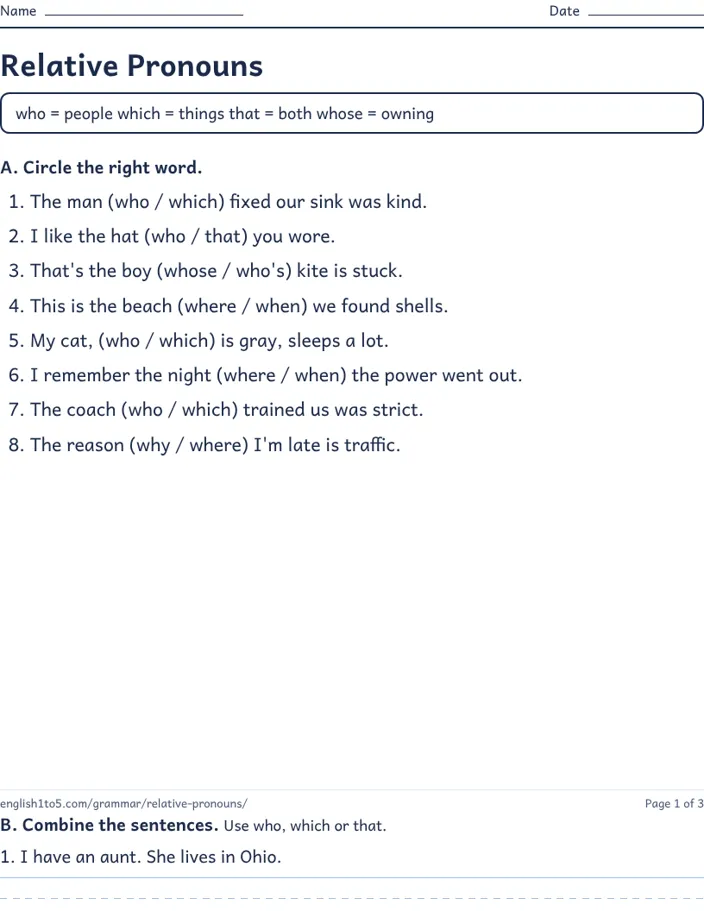
Relative Pronouns Worksheet, 4th grade
Choose the right relative word, combine sentences with who, which and that, fix mistakes and describe people and places. Prints on US Letter paper, with an answer key.
Download the PDFTry it at home
- Guess who: describe a relative with "someone who..." and let your child guess.
- Combine at dinner: two short sentences become one with who or that.
- Memory lane: "Remember the day when...?" Take turns finishing it.
- Writing: find two short sentences in your child's work and combine them.
- Reading: spot who, which and that in a chapter book.
What comes next
Next, kids learn the progressive verb tense (was walking, am walking, will be walking). See all 4th grade skills on the 4th grade page, or browse all grammar lessons.
Last reviewed: November 11, 2026
Questions parents ask
What are relative pronouns for kids?
They're words like who, whose, whom, which and that that add extra details about a noun: the girl who won, the book that I read.
What grade learns relative pronouns?
4th grade. The Common Core standard L.4.1a covers relative pronouns and relative adverbs (where, when, why).
When do you use who or which?
Who is for people and which is for things and animals. That can be used for both.
What's the difference between whose and who's?
Whose shows owning (the boy whose bike was stolen). Who's means who is (who's coming?).
What are relative adverbs?
Where, when and why, used to add details about a place, a time or a reason: the park where we play.