- Recommended Reading Age: 7 to 10 years
- Reading Level: Lower to middle elementary (Grades 2–5)
- Estimated Reading Time: 12–15 minutes
- Ideal For: Exploring themes of jealousy and kindness, along with discussions on stranger safety
- Author / Source: A traditional tale collected by Brothers Grimm, adapted for children
- Story Type: Fairy tale
- Origin: Germany / European folk tradition
- Main Characters: Snow White, the queen, the huntsman, the seven dwarfs, and the prince
- Key Themes / Moral: Jealousy, kindness, courage, caution, truth, and the value of inner beauty
A Winter Wish
One quiet winter morning, a queen sat beside her window, stitching a piece of cloth. Outside, soft snowflakes drifted down from the sky, covering the world in a blanket of white. The scene was peaceful, like feathers falling gently to the ground.
As she worked, the queen’s hand slipped, and the needle pricked her finger. Three bright drops of blood fell onto the snow outside the window. The contrast caught her eye—red on pure white.
Looking at it, she softly whispered, “I wish for a child with skin as white as snow, lips as red as blood, and hair as black as night.”
Not long after, her wish came true. She gave birth to a beautiful baby girl with fair skin, rosy cheeks, and dark hair. The child was named Snow White.
But happiness did not last long. Soon after Snow White’s birth, the kind queen fell ill and passed away. A deep sadness filled the palace, colder than the winter wind outside.
After some time, the king married again. The new queen was very beautiful, but she was also proud and selfish. She cared deeply about her appearance and wanted to be admired above all else.
She owned a magic mirror, which she kept in a private chamber. Every morning, she would stand before it and ask, “Mirror, mirror on the wall, who is the fairest of them all?”
And each day, the mirror would reply, “You, my queen.”
Meanwhile, Snow White grew into a kind and gentle girl. She treated everyone with respect—the servants, the guards, and all those around her. She was cheerful, helpful, and full of warmth.
As the years passed, Snow White became more beautiful each day.
One morning, the queen stood before her mirror and asked her usual question. But this time, the answer changed.
“Snow White is the fairest of them all.”
The queen’s face turned cold. Jealousy burned inside her heart like fire. She could not bear the thought that someone else—especially Snow White—was more beautiful than her.
Determined to get rid of her, the queen summoned a huntsman.
“Take Snow White deep into the forest,” she ordered. “Make sure she never returns.”
The huntsman obeyed, though his heart felt heavy. He led Snow White into the thick forest, where the trees grew tall and the light grew dim.
Snow White noticed his sadness and fear. “Please,” she begged, “do not harm me. I will run away and never come back.”
The huntsman could not bring himself to hurt her. He lowered his weapon and said, “Run. Go far away and never return.”
Snow White ran as fast as she could, deeper and deeper into the forest. Branches scratched her arms, and roots tripped her feet, but she did not stop until she was completely alone.
As evening fell, she found a small cottage hidden among the trees. Tired and frightened, she knocked on the door, but no one answered.
She slowly stepped inside.
The cottage was small but neat. Inside, she saw seven tiny chairs, a table with seven plates, and seven little beds upstairs.
Hungry and weak, she took a small bite from each plate and a sip from each cup. Then, feeling safe for the first time, she lay down across the beds and soon fell asleep.
That evening, the owners of the cottage returned. They were seven dwarfs who worked in the mountains, digging for precious stones.
When they entered, they noticed something strange. The house was cleaner than before, and someone had used their things.
They quietly went upstairs and found Snow White asleep.
When she woke up, she was frightened at first, but the dwarfs were kind. She told them her story, and they felt sorry for her.
“You may stay with us,” they said. “If you cook, clean, and take care of the house, we will protect you.”
Snow White gladly agreed.
But they warned her, “Never open the door to strangers.”
Back at the palace, the queen once again asked her mirror, “Who is the fairest of them all?”
The mirror answered, “Snow White, who lives with the seven dwarfs.”
Furious, the queen decided to take matters into her own hands.
First, she disguised herself as an old woman and went to the cottage. She tricked Snow White into letting her in and tightened a bodice around her so tightly that Snow White fainted.
When the dwarfs returned, they quickly saved her.
They warned her again to never trust strangers.
But the queen returned a second time, this time with a poisoned comb. Snow White made the mistake of letting her in again, and the comb made her collapse. Once again, the dwarfs saved her.
They begged her, “Please, do not open the door again.”
Snow White promised.
But the queen tried one last time.
She made a beautiful red apple, poisoned on one side. Disguised as a kind old woman, she offered it to Snow White. To gain her trust, she bit the safe side of the apple.
Snow White, convinced it was harmless, took a bite from the poisoned side.
At once, she fell to the ground, still and silent.
When the dwarfs returned, they tried everything to wake her, but nothing worked. She looked as if she were only sleeping.
Heartbroken, they placed her in a glass coffin and set it on a hill in the forest, where they could watch over her.
Time passed. Seasons changed. But Snow White remained still.
One day, a prince passed through the forest and saw the glass coffin. He was struck by Snow White’s beauty and listened carefully as the dwarfs told her story.
Moved by her kindness and fate, he asked to take her with him.
As his men carried the coffin away, they stumbled slightly, and the movement caused the piece of poisoned apple to dislodge from Snow White’s throat.
Suddenly, she coughed and opened her eyes.
The prince and the dwarfs were filled with joy.
Snow White sat up, confused but safe. The prince spoke kindly to her, and she thanked him and the dwarfs for their care.
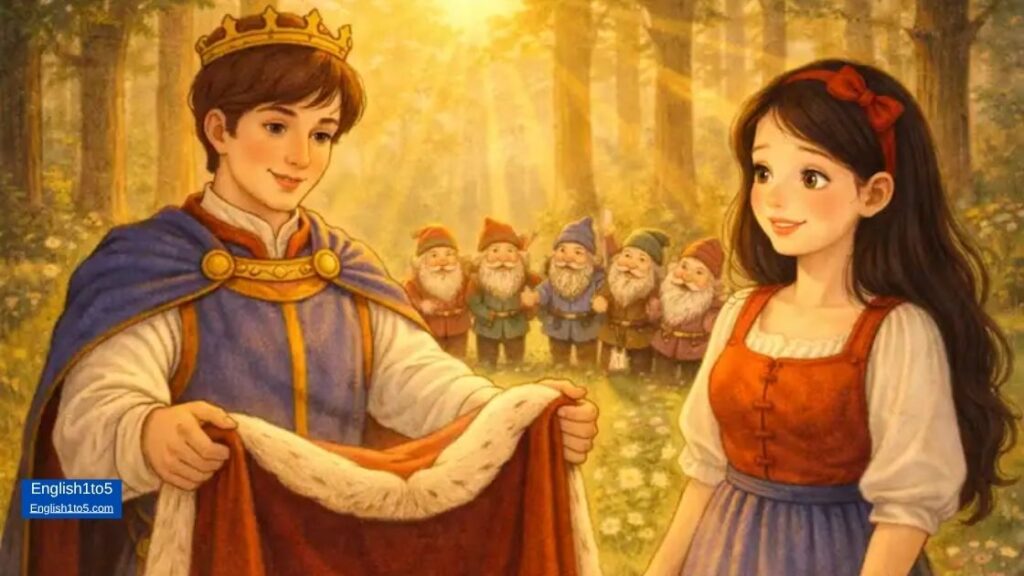
In time, Snow White and the prince fell in love and decided to marry.
When the queen heard of the wedding, she once again asked her mirror the same question.
And once again, the mirror answered, “Snow White is the fairest.”
Filled with anger, the queen went to the wedding, disguised. But when she saw Snow White alive and happy, her power and pride faded.
Snow White forgave her past and chose a life of kindness and peace.
She and the prince lived happily together, and the dwarfs remained their dear friends.
And in the end, everyone remembered one simple truth:
True beauty comes from kindness, courage, and a good heart.
Moral of the Story:
True beauty lies not in appearance, but in kindness, goodness, and a pure heart.
Jealousy and pride can lead to destruction, while honesty, courage, and compassion always bring happiness in the end.