Word Endings: -s, -ed, -ing
- 1st grade
- CCSS RF.1.3f
- CCSS L.1.4c
An ending is a small part added to the end of a word. It changes how the word is used: jump, jumps, jumped, jumping. Teachers call these inflectional endings. Kids who can spot the base word and the ending can read much longer words.
What do -s, -ed and -ing mean?
-s or -es means more than one (cats, boxes) or tells what one person does (she runs). -ed means it already happened (I jumped). -ing means it's happening now or keeps going (I am jumping).
The trick for reading is to cover the ending, read the base word, then add the ending back. Played is play + ed. Looking is look + ing. That turns one hard word into two easy parts.
base word + ending:
jump + s, jump + ed, jump + ing.
1st graders read words with endings (RF.1.3f) and find the base word in forms like looks, looked and looking (L.1.4c). In 2nd grade, kids learn more spelling changes and use endings in their own writing, as in past tense verbs.
One base word, four forms
Read across each row. The base word stays the same; only the ending changes.
| Base word | -s | -ed | -ing |
|---|---|---|---|
| jump | jumps | jumped | jumping |
| look | looks | looked | looking |
| play | plays | played | playing |
| help | helps | helped | helping |
| kick | kicks | kicked | kicking |
| fix | fixes | fixed | fixing |
| wish | wishes | wished | wishing |
Words ending in s, x, sh or ch add -es, not just -s: fixes, wishes, boxes, lunches. You can hear the extra part: fix-es.
Endings in sentences
The ending is highlighted. Cover it to find the base word.
- The dog jumps up.
- We played tag.
- She is reading a book.
- I have two cats.
- Dad fixed my bike.
- The birds are singing.
- He wishes for snow.
- I looked for my hat.
- Mom packed two boxes.
- They are helping me.
Example 6 has two endings in one sentence. Kids can hunt for every ending.
The three sounds of -ed
- /t/: jumped, looked, kicked, fixed. Say "jump-t."
- /d/: played, called, rained. Say "play-d."
- /ed/ (an extra beat): after t or d, as in wanted, needed, landed. Say "want-ed."
How to teach endings
Five short steps, about 10 minutes each.
- Cover the ending. Put a finger over the ending, read the base word, then lift and add the ending.
- Act it out. Jump, jumps, jumped, jumping: act out each form.
- Ending cards. Write base words on cards and endings on sticky notes. Build new words.
- Listen to -ed. Sort -ed words by sound: /t/, /d/ or an extra beat.
- Write with endings. Ask your child to write what they did yesterday (-ed) and what they're doing now (-ing).
Common mistakes and how to fix them
| Mistake | Why it happens | How to fix it |
|---|---|---|
| Reads jump for jumped | Skipping the ending. | Ask your child to point at the end of the word before reading it. |
| Reads jumped as "jump-ed" | Adding an extra beat to every -ed. | Only words ending in t or d get the extra beat (want-ed). |
| Writes jumpt | Spelling the sound, not the ending. | The past ending is always spelled -ed, even when it sounds like /t/. |
| Writes foxs | Forgetting -es. | After s, x, sh and ch, add -es. You can hear it: fox-es. |
Practice: word endings quiz
10 questions. Your child can tap the speaker to hear a question read aloud. The first try on each question counts toward the score.
-
1.Tap the word with -ed.
.
Show answer
played.
-
2.What is the base word in jumping?
Show answer
jump.
-
3.Which means more than one?
Show answer
cats.
-
4.Add -es to box.
Show answer
boxes.
-
5.Tap the word with -ing.
.
Show answer
sleeping.
-
6.Which word tells about yesterday?
Show answer
helped.
-
7.How does the -ed in jumped sound?
Show answer
/t/.
-
8.Which word has an extra beat at the end?
Show answer
wanted: want-ed.
-
9.Finish it: She ___ the ball every day.
Show answer
kicks.
-
10.Add -s to wish.
Show answer
wishes.
Word Endings: -s, -ed, -ing worksheet (free PDF)
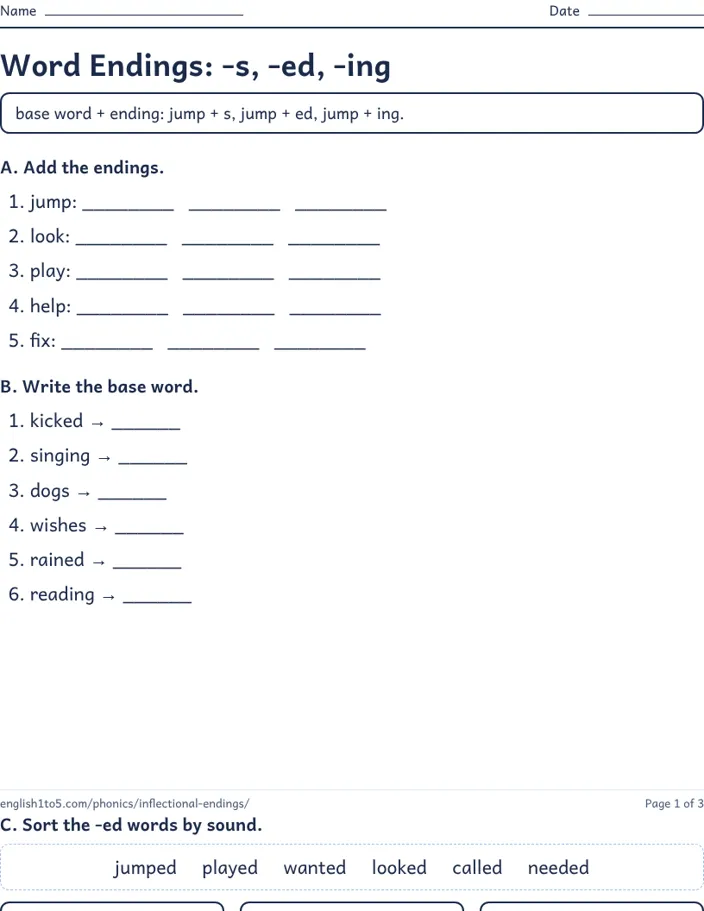
Word Endings: -s, -ed, -ing Worksheet, 1st grade
Add -s, -ed and -ing to base words, find the base word, sort -ed words by sound and write sentences about yesterday and today. Prints on US Letter paper, with an answer key.
Download the PDFTry it at home
- Act it out: "I am hopping. I hopped."
- Cover game: cover endings in a book with your thumb and read the base word.
- Yesterday talk: at dinner, everyone says one thing they did with -ed.
- Plural hunt: count things in the kitchen: two cups, three boxes.
- Listen for -ed: does it sound like /t/, /d/ or an extra beat?
What comes next
Next, kids learn vowel teams and r-controlled vowels. For grammar, see plural nouns. See all skills on the 1st grade page, or browse all phonics lessons.
Last reviewed: November 11, 2026
Questions parents ask
What are inflectional endings?
Small endings like -s, -es, -ed and -ing that change how a word is used without making a brand-new word.
What grade learns -ed and -ing?
1st grade. The Common Core standard RF.1.3f asks kids to read words with endings.
Why does -ed sound different in different words?
It sounds like /t/ after sounds like p and k (jumped), like /d/ after most other sounds (played) and adds a beat after t or d (wanted).
When do you add -es instead of -s?
After s, x, sh, ch and z: buses, boxes, wishes, lunches.
What is a base word?
The word before any ending is added. Jump is the base word in jumps, jumped and jumping.