Interjections
- 5th grade
- CCSS L.5.1a
An interjection is a word or short phrase that shows sudden feeling: Wow! Oops! Hooray! It isn't connected to the grammar of the rest of the sentence; it just bursts in.
What is an interjection?
Interjections are the eighth part of speech. Unlike nouns or verbs, they don't do a grammar job in the sentence. Take one out and the sentence still works: "Wow, that's a big dog" becomes "That's a big dog." What you lose is the feeling.
Strong feelings get an exclamation point and often stand alone: "Ouch! I hit my toe." Milder feelings get a comma and start the sentence: "Oh, I forgot my lunch."
Strong feeling: Wow! That was close.
Mild feeling: Oh, I see.
The 5th grade Common Core standard (L.5.1a) asks kids to explain what conjunctions, prepositions and interjections do. Kids use interjections in speech from toddlerhood; 5th grade is when they name and punctuate them.
Interjections by feeling
Grouped by the feeling they show.
| Feeling | Interjections |
|---|---|
| surprise | wow, whoa, oh, gosh |
| joy | hooray, yay, yippee, woohoo |
| pain | ouch, ow, yikes |
| mistake | oops, uh-oh, whoops |
| disgust | yuck, ew, ugh |
| agreement or greeting | yes, okay, hello, hey |
| thinking or doubt | hmm, um, well |
Some words are interjections only sometimes. "Well, I'm not sure" uses well as an interjection; "She sings well" uses it as an adverb.
Interjections in sentences
The interjections are highlighted. Ask your child what feeling each one shows.
- Wow! Look at that rainbow.
- Oops, I spilled my juice.
- Hooray! We won the game!
- Ouch! That hurt.
- Hmm, I'm not sure about that.
- Yuck! This milk is sour.
- Oh, I didn't see you there.
- Yikes! The bus is leaving!
- Well, let's try again.
- Uh-oh, I forgot my homework.
The strong ones (1, 3, 4, 6, 8) take an exclamation point. The milder ones take a comma and lead into the sentence.
Conjunctions, prepositions and interjections
The standard asks kids to explain what these three do:
- Conjunctions join words or ideas: and, but, or, so, because.
- Prepositions connect a noun to the rest of the sentence, showing where, when or how: under, after, with.
- Interjections express feeling and stand apart from the sentence: wow, oops, hooray.
- In "Wow, the dog jumped over the fence and ran," you can find all three.
How to teach interjections
Five short steps, about 10 minutes each.
- Act out feelings. Your child says an interjection with a face to match: surprise, pain, disgust, joy.
- Read comics. Comics are full of interjections. Find five and name the feeling.
- Strong or mild? Sort interjections into exclamation-point words and comma words.
- Spot all three. In a sentence, find the interjection, the conjunction and the preposition.
- Write dialogue. Your child writes four lines of dialogue, each starting with an interjection.
Common mistakes and how to fix them
| Mistake | Why it happens | How to fix it |
|---|---|---|
| Wow! Wow! Wow!!! | Using too many. | One interjection per moment is enough. Save them for real feeling. |
| Oops I dropped it. | Missing punctuation after the interjection. | Add a comma or exclamation point: Oops, I dropped it. |
| Calls wow an adjective. | It seems to describe something. | It doesn't describe a noun. It shows the speaker's feeling, so it's an interjection. |
| Uses interjections in a formal report. | Not knowing when they fit. | Interjections belong in dialogue, stories and casual writing, not in reports. |
Practice: interjections quiz
10 questions. Your child can tap the speaker to hear a question read aloud. The first try on each question counts toward the score.
-
1.Tap the interjection.
, !
Show answer
Wow.
-
2.Which word is an interjection?
Show answer
oops.
-
3.Tap the interjection.
! .
Show answer
Ouch.
-
4.Which is punctuated correctly?
Show answer
Oh, I forgot my coat.
-
5.Which feeling does yuck show?
Show answer
disgust.
-
6.What does an interjection do?
Show answer
shows sudden feeling.
-
7.What does a conjunction do?
Show answer
joins words or ideas.
-
8.Tap the interjection.
, !
Show answer
Hooray.
-
9.Where do interjections fit best?
Show answer
in dialogue and stories.
-
10.In Well, I think so, what is well?
Show answer
an interjection.
Interjections worksheet (free PDF)
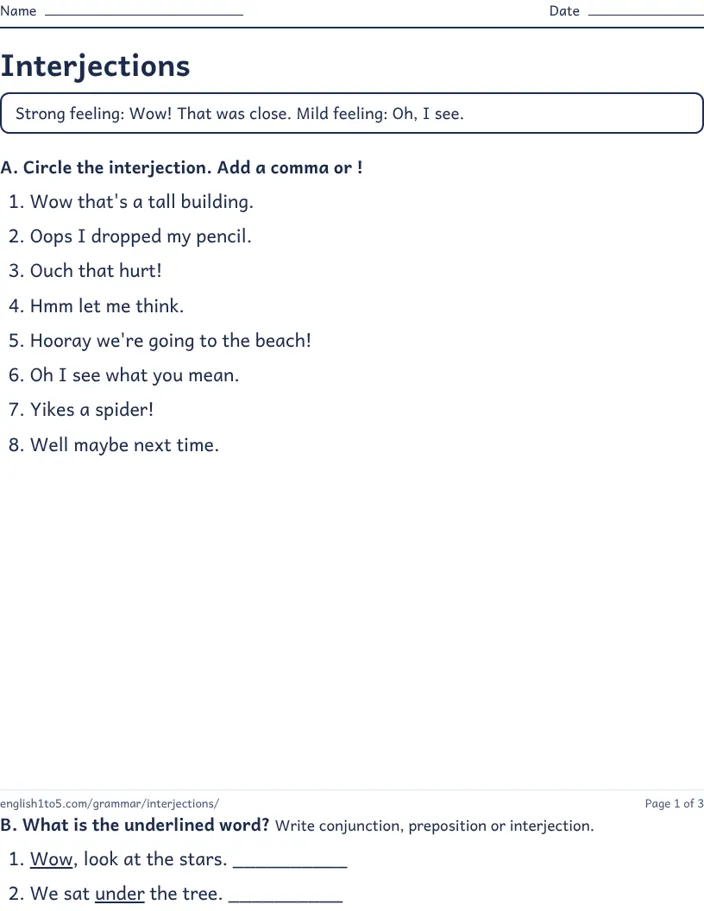
Interjections Worksheet, 5th grade
Find interjections, add the right punctuation, name conjunctions, prepositions and interjections, and write comic dialogue. Prints on US Letter paper, with an answer key.
Download the PDFTry it at home
- Comics: read a comic together and list the interjections.
- Sports: listen for interjections while watching a game.
- Feelings: match an interjection to a face.
- Stories: add one interjection to the dialogue in your child's story.
- Three jobs: find a conjunction, preposition and interjection in one sentence.
What comes next
Next, kids learn the perfect verb tenses (had walked, have walked, will have walked). See all 5th grade skills on the 5th grade page, or browse all grammar lessons.
Last reviewed: November 11, 2026
Questions parents ask
What is an interjection for kids?
A word or short phrase that shows sudden feeling, like wow, oops, ouch or hooray. It isn't grammatically connected to the rest of the sentence.
What grade learns interjections?
5th grade. The Common Core standard L.5.1a asks kids to explain what conjunctions, prepositions and interjections do.
How do you punctuate an interjection?
Use an exclamation point for strong feeling (Wow! Look at that.) and a comma for mild feeling (Oh, I see).
Is "yes" an interjection?
It can be. In "Yes, I'll come," yes works like an interjection and is followed by a comma.
Should kids use interjections in essays?
No. They fit dialogue, stories and casual writing, but not reports or formal essays.