Adjectives and Adverbs
- 2nd grade
- CCSS L.2.1e
Adjectives describe nouns: a quick fox. Adverbs describe verbs: the fox ran quickly. Many adverbs end in -ly.
What is an adverb?
Kids already know adjectives, which describe people, places and things. An adverb describes an action instead. It tells how (slowly, loudly), when (today, soon) or where (outside, here).
Many adverbs are made by adding -ly to an adjective: quiet → quietly, sad → sadly. That pattern is a handy clue, but it isn't a rule. Fast, soon and here are adverbs too.
Adjectives describe nouns.
Adverbs describe verbs: how, when or where.
The 2nd grade Common Core standard (L.2.1e) asks kids to use both and to choose between them depending on what's being described. That choice is the skill this page practices.
Adjective to adverb
Read across each row. The left side describes a person or thing. The right side describes how someone does something.
| Adjective (describes a noun) | Adverb (describes a verb) |
|---|---|
| a quick runner | runs quickly |
| a quiet voice | speaks quietly |
| a slow turtle | moves slowly |
| a loud drum | bangs loudly |
| a careful driver | drives carefully |
| a happy song | sings happily |
| a good singer | sings well |
Two spelling notes: a final y changes to i (happy → happily, easy → easily), and good doesn't take -ly at all. Its adverb is well.
Adjectives and adverbs in sentences
Adjectives and adverbs are highlighted. Ask your child: is it describing a thing or an action?
- The sleepy cat yawned. (adjective)
- The cat yawned sleepily. (adverb)
- Mia is a neat writer. (adjective)
- Mia writes neatly. (adverb)
- The loud thunder scared us. (adjective)
- The thunder boomed loudly. (adverb)
- We will go tomorrow. (adverb: when)
- The kids played outside. (adverb: where)
- Leo is a fast swimmer. (adjective)
- Leo swims fast. (adverb)
Sentences 9 and 10 use the same word. Fast describes Leo the swimmer in one and how he swims in the other. That's why the test below asks what is being described, not how the word is spelled.
Adjective or adverb? The one-question test
Ask: What is this word describing?
- A person, place or thing? Use an adjective. "She is a careful painter." (careful describes painter)
- An action? Use an adverb. "She paints carefully." (carefully describes paints)
- Good or well? Good describes nouns (a good game). Well describes verbs (you played well). Say "You did well," not "You did good."
How to teach adjectives and adverbs
Five short steps, about 10 minutes each.
- Act out adverbs. Your child walks across the room slowly, quickly, sadly, proudly. You guess the adverb.
- Add -ly. Write five adjectives. Your child adds -ly and uses each in a sentence: quiet → quietly.
- Point to the word it describes. In "The dog barked loudly," draw an arrow from loudly to barked.
- Practice good and well. Ask about their day: "Did you play well?" "Was it a good game?"
- Rewrite with both. Your child writes "The ___ bird sang ___." and fills in an adjective and an adverb.
Common mistakes and how to fix them
| Mistake | Why it happens | How to fix it |
|---|---|---|
| He ran quick. | Quick sounds fine in everyday speech. | Ran is a verb, so use the adverb: He ran quickly. |
| You did good. | Very common when talking. | Did is a verb: You did well. |
| a quickly dog | Using the -ly form for a noun. | Dog is a noun: a quick dog. |
| happyly | Adding -ly without changing the y. | Change y to i: happily. |
Practice: adjectives and adverbs quiz
10 questions. Your child can tap the speaker to hear a question read aloud. The first try on each question counts toward the score.
-
1.The turtle moves ___.
Show answer
slowly.
-
2.She has a ___ voice.
Show answer
quiet.
-
3.Tap the adverb.
.
Show answer
peacefully. It describes slept.
-
4.Which word is an adverb?
Show answer
loudly.
-
5.You did ___ on your test.
Show answer
well.
-
6.Tap the adjective.
.
Show answer
tired. It describes dog, a noun.
-
7.What does the adverb tell? We will go to the park tomorrow.
Show answer
when.
-
8.Which sentence is correct?
Show answer
He ran quickly.
-
9.Add -ly to happy.
Show answer
happily.
-
10.Tap the adverb.
.
Show answer
softly.
Adjectives and Adverbs worksheet (free PDF)
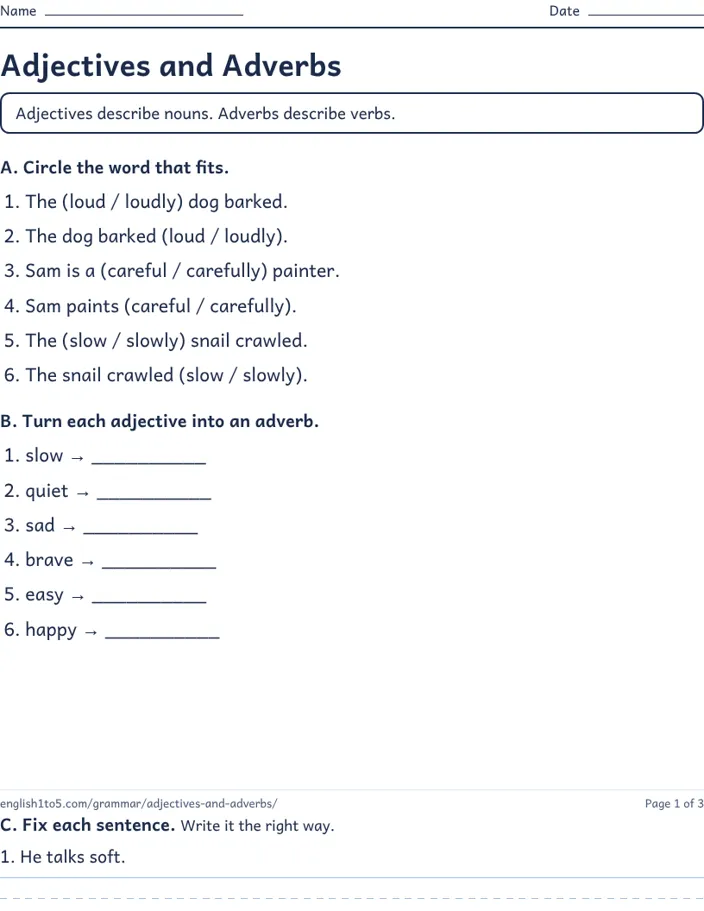
Adjectives and Adverbs Worksheet, 2nd grade
Choose between adjectives and adverbs, add -ly, fix good and well and write about how you do things. Prints on US Letter paper, with an answer key.
Download the PDFTry it at home
- In the hallway: call out adverbs for your child to walk: slowly, sneakily, proudly.
- After a game: "You played well!" Point out well, not good.
- At dinner: describe how people eat: quickly, neatly, noisily.
- In the car: "Is that a fast car, or is it driving fast?"
- When your child writes: add one adverb to a sentence about an action.
What comes next
Next, kids learn the small words a, an and the, then where-and-when words in prepositions. See all 2nd grade skills on the 2nd grade page, or browse all grammar lessons.
Last reviewed: November 11, 2026
Questions parents ask
What is the difference between an adjective and an adverb?
An adjective describes a noun (a quick fox). An adverb describes a verb (the fox ran quickly) and tells how, when or where.
What grade learns adverbs?
2nd grade. The Common Core standard L.2.1e asks kids to use adjectives and adverbs and choose between them.
Do all adverbs end in -ly?
No. Many do, but fast, soon, here, today and well are adverbs too.
Is it "you did good" or "you did well"?
You did well. Did is a verb, and well is the adverb that describes it. Good describes nouns: a good job.
How do you spell adverbs from words ending in y?
Change the y to i, then add -ly: happy becomes happily, easy becomes easily.