Writing a Complete Sentence
- Kindergarten
- 1st grade
- CCSS L.K.1f
- CCSS L.K.2a
- CCSS L.1.1j
A complete sentence tells a whole idea. It has a who (someone or something) and a did what (what they do or are). It starts with a capital letter and ends with a period, question mark or exclamation point: The dog ran.
The parts of a sentence
Every sentence needs two parts. The who part (the subject) names a person, animal or thing: The dog, My mom, I. The did-what part (the predicate) tells what they do or are: ran, likes pizza, is happy. Put them together and you have a sentence: My mom likes pizza.
A group of words missing one part is not a sentence. The big dog has a who but no did-what. Ran to the park has a did-what but no who. Young writers can check with two questions: Who? Did what? Then check the capital letter and the end mark.
Capital letter + who + did what + end mark.
The dog ran.
Kindergartners build sentences out loud and in shared writing, and capitalize the first word and I (L.K.1f, L.K.2a). 1st graders write and expand sentences of all four types (L.1.1j). Next: end marks and types of sentences.
Who + did what = sentence
Mix and match to build sentences.
| Who (subject) | Did what (predicate) | Sentence |
|---|---|---|
| The cat | sleeps. | The cat sleeps. |
| My brother | kicked the ball. | My brother kicked the ball. |
| I | like apples. | I like apples. |
| The bird | sang a song. | The bird sang a song. |
| We | went to the park. | We went to the park. |
| The sun | is hot. | The sun is hot. |
Once kids can write simple sentences, show them how to expand: add when, where or how. The cat sleeps becomes The cat sleeps on my bed every night.
Sentence or not?
Each one is labeled. The fixes are shown.
- Sentence: The dog ran.
- Sentence: I can jump.
- Not a sentence: The big red ball. (no did-what) → The big red ball bounced.
- Not a sentence: Swims in the pond. (no who) → The duck swims in the pond.
- Missing capital: my cat is soft. → My cat is soft.
- Missing end mark: We ate lunch → We ate lunch.
- Lowercase i: i like dogs. → I like dogs.
- Question: Can you play?
- Exclamation: I won!
- Expanded: The dog ran fast to the gate.
Read a sentence aloud. If it sounds like a whole idea and answers who and did what, it's a sentence.
How to teach complete sentences
Five short steps, about 10 minutes each.
- Say it first. Have your child say the sentence out loud before writing.
- Count the words. Tap or draw a line for each word, then write.
- Check who and did what. Point to each part.
- Capital and end mark. Circle the capital, check the period.
- Make it longer. Add where, when or how.
Common mistakes and how to fix them
| Mistake | Why it happens | How to fix it |
|---|---|---|
| Writes only a few words like the cat | Missing the did-what. | Ask: what did the cat do? |
| Forgets capital letters | Not a habit yet. | Check the first letter every time. |
| Leaves off the period | Thinks the idea is finished. | Read it aloud; stop at the dot. |
| Writes lowercase i | Forgetting the rule. | I is always a capital. |
Practice: complete sentences quiz
10 questions. Your child can tap the speaker to hear a question read aloud. The first try on each question counts toward the score.
-
1.Which is a complete sentence?
Show answer
The dog ran.
-
2.A sentence starts with a...
Show answer
capital letter.
-
3.What does a telling sentence end with?
Show answer
A period.
-
4.What is missing? Swims in the pond.
Show answer
The who.
-
5.What is missing? The little bird
Show answer
The did-what.
-
6.Tap the who part.
.
Show answer
Grandma.
-
7.Which sentence is written correctly?
Show answer
I like dogs.
-
8.Tap the did what word.
.
Show answer
jumped.
-
9.Which is a longer, better sentence?
Show answer
The cat sleeps on my bed.
-
10.What does a question end with?
Show answer
A question mark.
Writing a Complete Sentence worksheet (free PDF)
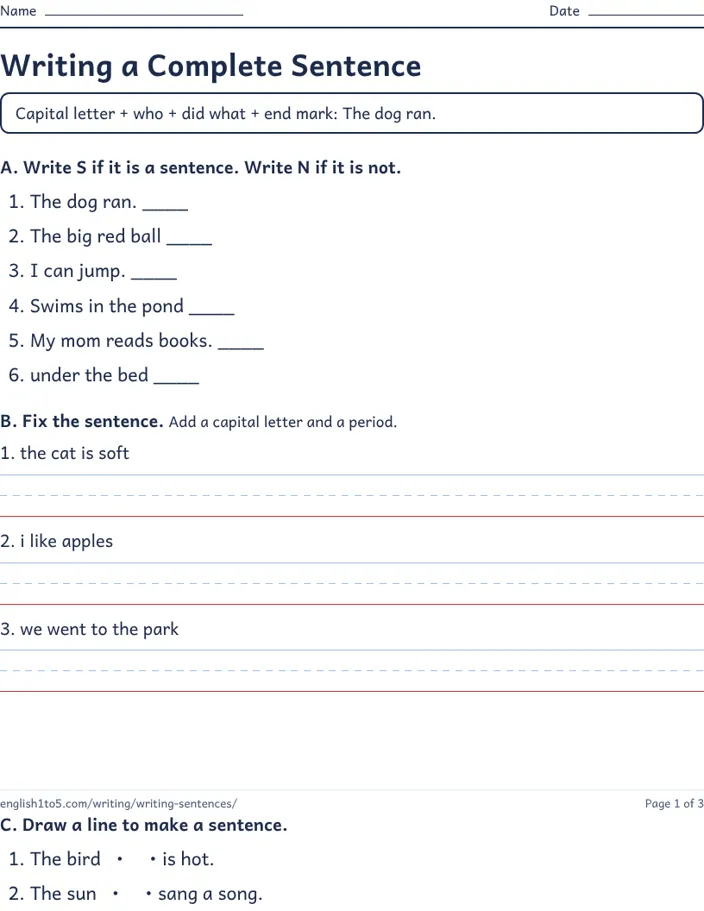
Writing a Complete Sentence Worksheet, Kindergarten–1st grade
Circle complete sentences, fix capitals and periods, match who and did-what parts, and write your own sentences. Prints on US Letter paper, with an answer key.
Download the PDFTry it at home
- Say it first: say the sentence before writing.
- Who and did what: point to each part.
- Caption photos: write one sentence under a picture.
- Grocery sentences: "We need milk."
- Make it longer: add where or when.
What comes next
Next: how-to writing. Related: capital letters, end marks and types of sentences.
Practice with a game
Free, no sign-up, and they work on phones, tablets and computers.
 Sentence or Fragment?
 Keyboard Explorer
Last reviewed: November 11, 2026
Questions parents ask
What is a complete sentence for kids?
A group of words that tells a whole idea: it has a who (subject) and a did-what (predicate), starts with a capital letter and ends with an end mark.
What are the parts of a sentence?
The subject (who or what the sentence is about) and the predicate (what they do or are).
What grade learns complete sentences?
Kindergarten builds sentences with help (L.K.1f); 1st grade writes and expands them (L.1.1j).
What's a sentence fragment?
A group of words missing a part, like 'The big dog' or 'Ran fast.'
How do I help my child write sentences?
Have them say the sentence aloud first, count the words, then check for a capital and a period.