A Family That Underestimated One Boy
A man and his wife lived beside a great forest with their three sons. The two older boys were strong, quick, and proud of it. They worked fast, spoke loudly, and always believed they were right. The youngest son, however, was different. He liked to observe quietly, think before speaking, and smile gently at others. Because of this, everyone in the house called him Simpleton.
But the name was not kind. His brothers used it as an insult. If anything went missing, they blamed him. If work was not finished on time, they blamed him again. Whenever guests visited, the older boys showed off their skills and pushed Simpleton aside, as if he did not belong.
Their father cared for all his sons, yet he valued strength more than kindness. Their mother worked tirelessly from morning till night. She did not intend to be unfair, but she often gave better food and attention to the older boys because they complained the most.
One cold morning, the father looked at the empty woodpile and said, “Winter is near. One of you must go into the forest and cut firewood.”
“I will go,” said the eldest son immediately.
His mother packed him a sweet cake and a bottle of fine wine. “Take care of yourself,” she said warmly.
As he walked into the forest, tall trees surrounded him and the path grew quiet. Soon, a small old man appeared from behind a bush.
“Good day,” the old man said politely. “I am hungry and thirsty. Will you share your food with me?”
The eldest son frowned and pulled his bundle closer. “No. This is mine,” he said. “Go away.”
The old man said nothing more, but as the boy walked on, the forest seemed strangely silent. When he began chopping a tree, his axe slipped and struck his arm. Crying out in pain, he rushed back home.
The next day, the second son went into the forest. His mother gave him the same fine food, even adding extra for him. Soon enough, he met the same old man, who asked again for food and drink.
“No,” said the second son firmly. “I need it for myself.”
Once again, the forest grew still. When he began chopping wood, his axe slipped and injured his leg. He had to be carried home.
The father shook his head in worry. “Something is wrong in that forest,” he said.
Then Simpleton stepped forward. “Father, let me try,” he said quietly.
His brothers laughed loudly, and even his father doubted him. But Simpleton kept asking patiently until his father finally agreed.
His mother, expecting little from him, gave him only a rough ash cake and a bottle of sour beer. It was the poorest food in the house. Still, Simpleton smiled and thanked her before heading into the forest.
Not long after, he met the same little old man.
“I am hungry and thirsty,” the old man said. “Will you share what you have?”
Simpleton opened his bag. “It is not much,” he said kindly, “but we can share.”
They sat together and ate. As they did, something magical happened. The simple ash cake became warm and delicious, and the sour beer turned into fine wine.
The old man smiled. “Kindness turns little into plenty,” he said.
After they finished, the old man pointed toward a crooked tree. “Cut that tree down,” he said, “and look among its roots.”
Then he disappeared.
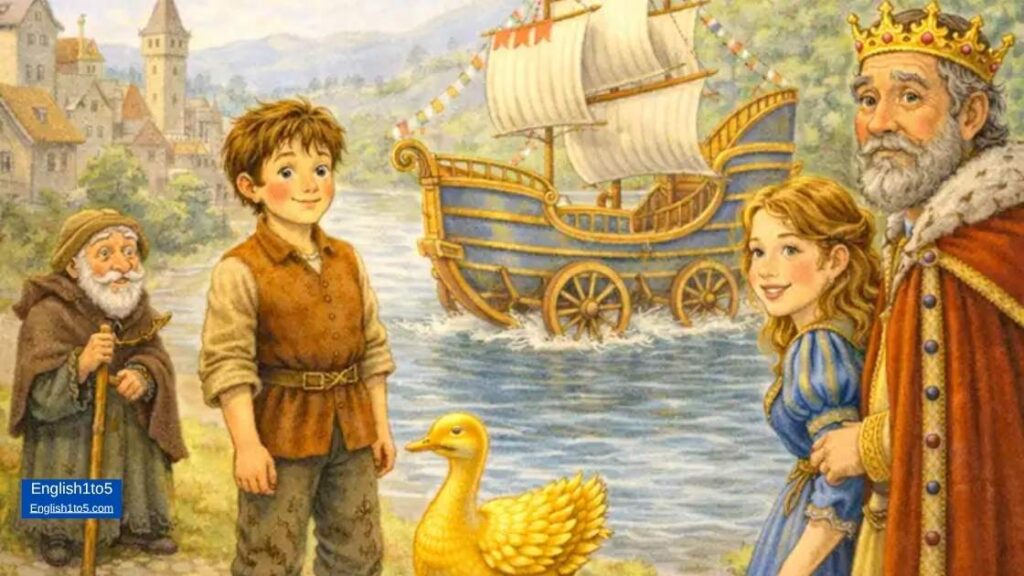
Simpleton did as he was told. When the tree fell, he discovered something astonishing among its roots—a goose with feathers made of pure gold. The feathers shimmered like sunlight.
Carefully, Simpleton picked up the goose and carried it with him. Instead of going home, he stopped at a nearby inn for the night.
The innkeeper welcomed him, but his three daughters were fascinated by the golden goose.
“If I had just one feather,” said the eldest.
“Just one,” agreed the others.
That night, when Simpleton was away, the eldest daughter crept into his room and tried to pull out a feather. But as soon as she touched the goose, her hand stuck fast!
Her sisters rushed to help her, but each of them got stuck too. Soon, all three were helplessly attached to the goose.
The next morning, Simpleton picked up the goose and began walking away. The three sisters had no choice but to follow him, still stuck together.
As they passed through the fields, a priest saw them and scolded them. He grabbed one of the girls—and got stuck too. A farmer tried to help, then two workers, and each of them became stuck in the growing chain.
Soon, a long, ridiculous line of people followed Simpleton wherever he went.
Eventually, they reached a great city. There lived a princess who had never laughed. The king had declared that whoever could make her laugh would win her hand in marriage.
When the princess saw Simpleton walking calmly with a golden goose and a long line of people stumbling behind him, she tried to remain serious.
But she could not.
She burst into laughter—loud, joyful, and uncontrollable. As she laughed, the spell broke, and everyone fell free.
The king came out, surprised and amazed. Simpleton bowed and said, “Your Majesty, I have made your daughter laugh. I ask for her hand in marriage.”
The king hesitated. Simpleton looked poor and simple. So he set three difficult tasks.
First, Simpleton had to bring a man who could drink an entire cellar of wine.
Simpleton returned to the forest and found a man who was endlessly thirsty. He brought him to the palace, where the man drank every drop of wine.
Next, the king demanded a man who could eat a mountain of bread.
Again, Simpleton found such a man in the forest—one who was always hungry. He ate all the bread the king provided.
Finally, the king demanded a ship that could travel on both land and water.
Simpleton returned to the forest once more. The old man appeared again and rewarded his kindness with a magical ship. It had wheels for land and a hull for water.
Simpleton brought the ship to the king. It rolled across the ground and then sailed smoothly on the river.
Now the king could not refuse. He kept his promise.
The princess happily married Simpleton, for she saw his true nature—kind, honest, and gentle.
Simpleton became king in time. He ruled wisely and never forgot his past. He listened to the quiet voices, helped those in need, and treated everyone fairly.
People no longer called him Simpleton.
They called him The Good King.
And though many remembered the golden goose, they remembered his kindness even more.