- Recommended Reading Age: 7 to 10 years
- Reading Level: Lower to middle elementary (Grades 2–4)
- Estimated Reading Time: 8–10 minutes
- Ideal For: Building resilience, self-esteem, and classroom discussions on bullying and kindness
- Author / Source: A literary fairy tale by Hans Christian Andersen (adapted for children)
- Story Type: Literary fairy tale
- Origin: Denmark
- Main Characters: The Ugly Duckling, Mother Duck, the swans, and the farmer
- Key Themes / Moral: Identity, patience, self-acceptance, and looking beyond outward appearances
The Ugly Duckling: A Hans Christian Andersen Fairy Tale
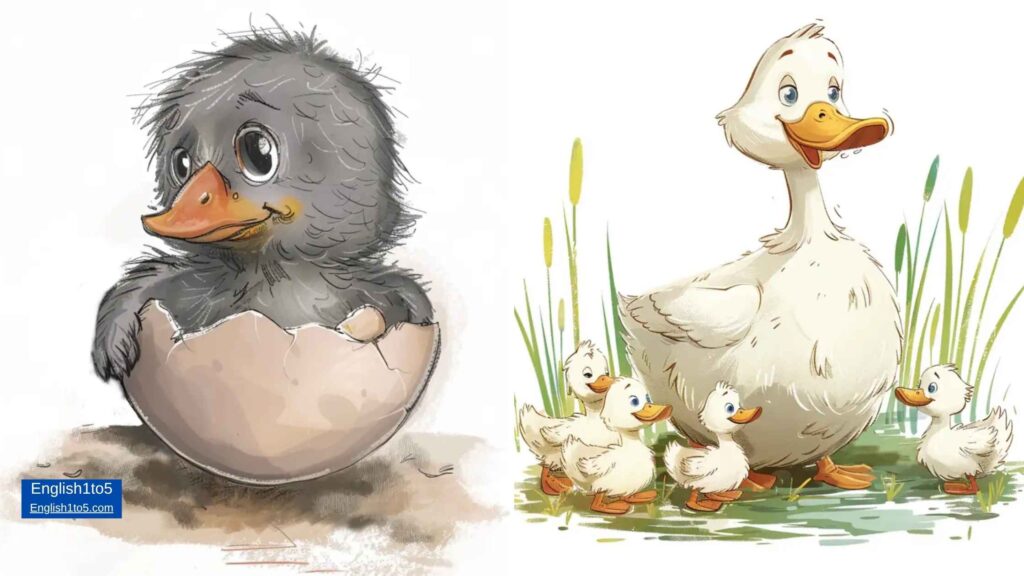
On a beautiful summer day out in the country, a mother duck sat patiently on her nest, waiting for her eggs to hatch. One by one, the shells cracked open with little cheeps, and fluffy yellow ducklings tumbled out into the world.
But one egg, the largest of them all, remained completely intact. An older, wiser duck waddled by and warned the mother that it looked like a turkey egg, but the mother duck decided to sit on it a little longer. Finally, the great shell cracked. Out tumbled a bird, but he was not small, yellow, and fluffy. He was large, gray, and very clumsy.
“Well,” the mother duck sighed, “he is terribly big and ugly, but he swims wonderfully. Perhaps he will grow to be handsome.”
The Cruel Farmyard
The next day, the mother duck took her brood to the farmyard to introduce them to the other animals. The yard was a noisy, unforgiving place. As soon as the other birds saw the large, gray duckling, they began to whisper and point.
“Look at that strange creature!” they quacked. “He is much too big and far too ugly to be one of us!”
The poor duckling was pecked by the chickens, bitten by the other ducks, and chased by the farm girl who fed them. At first, his mother defended him, but as the days turned into weeks, the bullying grew worse. Even his own siblings wished the cat would catch him. Exhausted and embarrassed, his mother finally sighed, “I wish you would just go away.”
Heartbroken, the ugly duckling flapped his clumsy wings and ran away over the farmyard fence.
A Journey of Hardships
The duckling fled to the great marsh where the wild ducks lived. They told him he was incredibly ugly but agreed he could stay, provided he didn’t try to marry into their families. But soon, hunters arrived with loud guns and hunting dogs, and the terrified duckling had to flee once again.
He wandered through a fierce storm until he found a small, run-down cottage. Inside lived an old woman with her tomcat, who could purr and spark when stroked backwards, and her hen, who laid excellent eggs.
“Can you lay eggs?” the hen asked.
“No,” the duckling replied.
“Can you purr or curve your back?” asked the cat.
“No.”
“Then keep your opinions to yourself when sensible people are talking,” they scolded.
Feeling entirely useless and out of place, the duckling left the warm cottage to live in the water, where he could float and dive. But autumn arrived, bringing cold winds and brown leaves.
The Harsh Winter
One evening, just as the sun was setting, a flock of magnificent, dazzlingly white birds with long, graceful necks rose from the bushes. They were swans, flying south for the winter. The duckling had never seen anything so beautiful. He stretched his neck after them, letting out a cry so loud and strange that it frightened even him. He did not know what they were called or where they were flying, but he felt a deep, unexplainable love for them.
Winter set in, and it grew bitterly cold. The duckling had to paddle continuously to keep the water from freezing around him, but eventually, he became exhausted and froze fast in the ice. A kind farmer found him, broke the ice, and took him home to thaw out. However, the duckling was terrified of the noisy farm children and ended up making a terrible mess of the kitchen before escaping back into the freezing winter.
The Spring Awakening
The duckling survived the cruel winter by hiding among the reeds. One morning, the warm sun began to shine, and the larks began to sing. Spring had finally arrived.
The duckling flapped his wings and was surprised to find them strong and powerful. They carried him high into the air, and before he knew it, he landed in a beautiful garden with a sprawling, clear pond.
Out of the thicket glided three beautiful white swans, their feathers rustling softly. The duckling remembered the magnificent birds and felt a sudden wave of sadness.
“I will fly over to those royal birds,” he thought. “They will likely peck me to death because I am so ugly, but I do not care. It is better to be killed by them than to be bitten by ducks, pecked by hens, and starved in the winter.”
The Reflection
He swam out into the water and bowed his head low, waiting for the swans to strike him. But as he looked down at the clear, glassy water, he saw his own reflection.
He was no longer a dark, clumsy, gray bird. He was a swan.
The three great swans swam around him, stroking him gently with their beaks to welcome him. A group of children ran into the garden, throwing bread and grain into the water.
“Look!” cried the youngest child. “There is a new one! And he is the most beautiful of all!”
The new swan felt perfectly shy and tucked his head under his wing. He was overwhelmingly happy, but not at all proud, for a good heart is never proud. He remembered how he had been mocked and persecuted, and now he heard everyone say he was the most beautiful of all beautiful birds.
The Moral of the Story
- True beauty comes from within, and everyone blossoms at their own pace. The story teaches us not to judge someone based on their outward appearance or awkward beginnings. Just because someone doesn’t fit in immediately doesn’t mean they aren’t destined for something beautiful.
- Being different is a strength, not a weakness. The duckling suffered because he was trying to fit into a world of ducks and chickens when he was actually a swan. The environment you are in does not define your worth. As Andersen wrote in the story: “It does not matter if you are born in a duck yard, so long as you are hatched from a swan’s egg.”
Vocabulary Spotlight
- Burdock: A wild plant with large, wide leaves, often found growing in fields or along roadsides.
- Scruffy: Looking messy, untidy, or not well cared for.
- Moor: A wide, open area of land with grass or low plants, often damp or marshy.
- Elegant: Graceful, stylish, and beautiful in movement or appearance.
- Resilience: The ability to stay strong and keep going during difficult times.
- Molasses: A thick, dark, sweet syrup that flows very slowly.